



The Agentic Bank Run
If Apollo is right, a bank run is coming. But it won’t be the panicked, lines-around-the-block variety...



A bank doesn’t hang around for nearly two centuries without being adaptable….

At the peak of the British Empire during the 19th century, a bank rose to prominence.
Founded in 1853 with a royal charter from Queen Victoria, it helped finance trade across Asia, Africa, and the Middle East. In some real sense, this bank played a major role in shaping the vast British Empire of the 19th century.
That bank was Standard Chartered, and 172 years later, it’s still going strong.
Standard Chartered’s success was built via emerging markets. And nearly two centuries later, that mindset also is still going strong.
This time, Standard Chartered isn’t taking a stake in an emerging geographic market, it’s paying close attention to an emerging asset class and technology—decentralized finance (DeFi).
Specifically, their recently released research on Aave and Uniswap caught my eye. These are two of the largest DeFi protocols on Ethereum and in the digital asset industry.
And what they said might surprise you…
Aave is a lending and borrowing protocol. Users can pledge an array of collateral, borrow various assets, and even lend assets for yield. It’s a bank that anybody can lend to or access capital from.
Back in October of 2025, it would have been among the top 30 banks in the United States based upon the amount of capital sitting on its protocol.
Last week, Standard Chartered made a bold prediction. The bank believes the protocol’s native asset, AAVE, will touch $3,500 per token in the next 3.5 years.
That’s 42x higher than today’s price.
The other project they broke down was Uniswap, a protocol that makes it possible to swap assets onchain. It eliminates the need to move assets to a centralized exchange to trade into stablecoins or another asset. Uniswap removes any middlemen by using smart contracts – small scripts of code that automate the entire transaction.
Standard Chartered published their report two weeks ago with a price target of $100 in 3.5 years. That’s nearly 36 times higher than today’s prices.
While the price targets are certainly worth noting, what we should really focus on is Standard Chartered recognizing the utility of Aave and Uniswap. Both remove middlemen from the equation. Middlemen such as Standard Chartered itself, which of course is in the loan writing business.
This is in stark contrast to banks like JPMorgan Chase or exchanges such as CME Group, Nasdaq, or the NYSE.
Rather than embrace innovation, these groups have lobbied politicians with one goal: delay progress and protect their moats.
The reason is simple… These entities don’t want to showcase just how much these protocols are poised to disrupt.
That’s why it’s worth noting what Standard Chartered said. It’s a storied institution woven into the fabric of our existing financial system. But the bank appears willing to embrace the change that’s coming.
After all, a bank as old as Standard Chartered doesn’t hang around for nearly two centuries without being adaptable. And the bank’s recent coverage of Aave and Uniswap suggests it’s willing to adapt again.
And Standard Chartered is not the only institution embracing this wave of innovation.
We also have BlackRock and Apollo Global Management gaining exposure to Uniswap and a platform similar to Aave, Morpho. And the recent moves from these players are more than handshakes and good PR. They’re substantial.
Even $1.7 trillion asset manager Franklin Templeton just acquired digital asset specialist 250 Digital. This came with the announcement of Franklin Crypto, a new division built to offer large investors active digital asset strategies.
These are major acquisitions. Asset managers like this don’t enter new markets thoughtlessly. They have plenty of money and talent to fully understand what they’re getting into. And the recent actions suggest there is an anticipation of future opportunities.
But you wouldn’t know it by looking at the price action…
Here’s the price of Bitcoin over the last nine months.
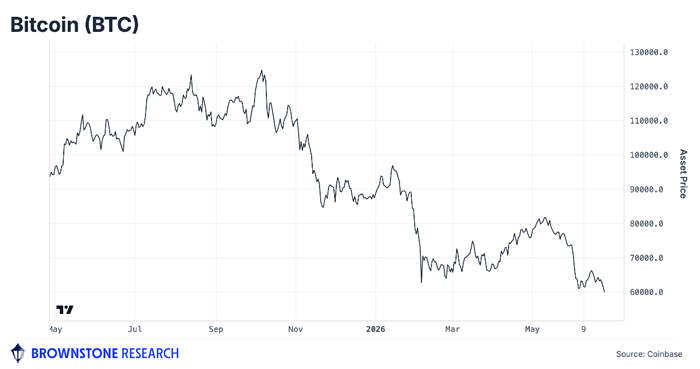
It’s down 52% from its high. Ether is doing worse, down 65% since October. And many altcoins are down more.
The Crypto Fear and Greed Index has been hovering around 10 (extreme fear) for much of February, March, and June of this year. We haven’t seen readings like that since the depths of the 2022 bear market.
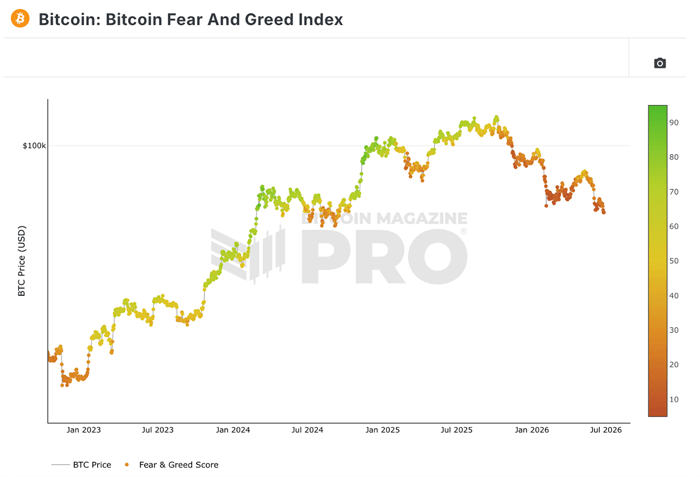
As Bitcoin fell below $60,000 last week, a class action lawsuit investigation went live.

The investigation centers around Strategy (MSTR) and the other Strategy securities. Strategy is, of course, a Bitcoin treasury company. As Bitcoin goes, so goes MSTR, which is down 46% over the past month.
I’ve had my fair share of things to say about Strategy’s CEO Michael Saylor in the past. But I can’t imagine he’s crossing any legal boundaries. This feels more like a group of lawyers making the most of people’s emotion to try and get their name out there more than anything substantial.
It’s the type of thing we see when traders and investors want to find somebody to blame when things seem most difficult.
Bottom line: It’s ugly out there.
And yet, massive institutions are taking meaningful positions in DeFi. And they’re not doing it with handshakes and headline commentary. But with real dollars and acquisitions.
In fact, we’re starting to even hear rumors that the cryptocurrency exchange Kraken is trying to gain a significant share of AAVE.
Those building inroads at the cross section of traditional finance and digital assets understand the tsunami of capital getting ready to move onchain.
This is inevitable.
And now might just be our last opportunity before the industry hits mass adoption.
I’m not here to say this is the bottom of the market.
Price can go lower.
But we continue to find various signals and indicators that tell us that we’re near a bottom.
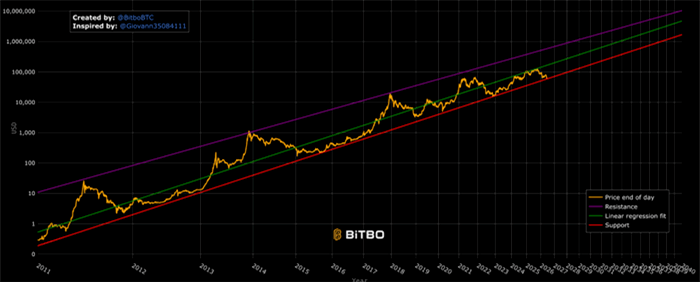
Bitcoin Power Law is one such indicator. The last three times Bitcoin hit this model’s support level, as it did earlier this month, the average return was nearly 110% in less than three months’ time.
Power Law is not a crypto-centric model. It’s used to model the pace of growing cities, understand how river networks spread, and it even helps pin down the timing and size of earthquakes. Power Laws describe a range of natural phenomena…
When it comes to Bitcoin, Power Law suggests that, as the network matures over time, the price of each coin grows at a certain rate.
And when we plot the function on a log-scale, we get a straight line. Which is what you see below…
Source: Bitbo.io
The red line is the support line, which is currently at $59,109, slightly lower than where Bitcoin closed late last week. What it also says is fair value is at $166,000+.
To sum it up, now is the time to be acting like the banks.
It’s time to be the smart money and stay focused on the opportunity, not distracted by the emotions that can come with market volatility.
Stay patient. Stay diligent. Be ready.
Your Pulse on Crypto,
Ben Lilly
Editor, Chain of Thought
Add Brownstone Research as your preferred source on Google to see our latest stories in your feed.
 Add as a preferred source
Read the latest insights from the world of high technology.
If Apollo is right, a bank run is coming. But it won’t be the panicked, lines-around-the-block variety...

The old guard is competing to build the new gatekeeper that the market uses … and the result will...

Blockchains are infrastructure built for machines. And now the machines are here.