



Bessent Finds His Buyer
Fortunately for Bessent, there’s one group of buyers with a voracious appetite for short-term U.S. debt.



We’re seeing the leading edge of the reshoring wave… and it’s only beginning.

By Jeff Brown, Founder & CEO, Brownstone Research
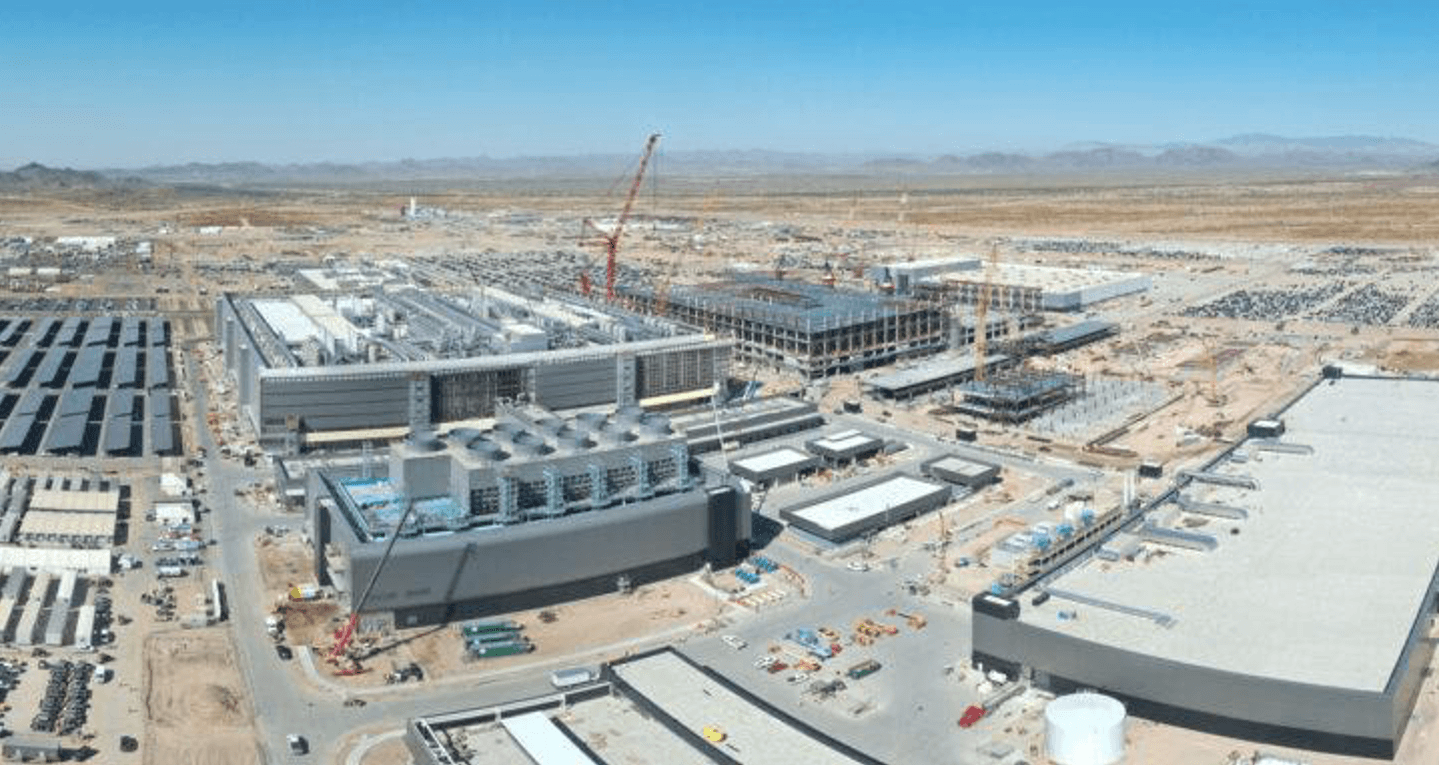
Drive an hour northwest of Phoenix, and you’ll see this:
Source: Technology.org
This is Taiwan Semiconductor Manufacturing Company’s (TSMC) Arizona complex. The first fabrication plant, Fab 21 Phase 1, is now operational. It is producing the advanced semiconductors inside Nvidia’s Blackwell AI processors.
This is the first time the most sophisticated semiconductor manufacturing on Earth has happened on American soil at scale. And it is only the beginning.
TSMC has committed $165 billion to this single site. That sum will fund three fabs, two advanced packaging facilities, and a research center. All of them are scheduled to rise out of the desert in phases that stretch into the next decade.
It is staggering to behold. And here’s the thing – TSMC Arizona is just one project among hundreds.
As of June 2026, the running tally of announced private-sector manufacturing investment in the United States has reached $1.76 trillion. That’s for verified, dollar-committed projects across 36 states.
What’s more, an entire belt of electric vehicle (EV) battery gigafactories is rising across the Midwest. Panasonic is building a battery plant in Kansas. Samsung SDI is building in Indiana. BlueOval is working on a Gigafactory in Kentucky.
In addition, Eli Lilly, AstraZeneca, Merck, and Johnson & Johnson are pouring hundreds of billions into pharmaceutical plants. Private construction spending for pharmaceutical manufacturing has tripled in four years, from roughly $76 billion a year in early 2021 to over $230 billion a year today.
All of this is evidence of a trend I have been following for years—America’s reshoring and reindustrialization. I refer to it as The Great Recalibration.
The construction boom is the headline, but it’s not the story. The story is what happens after the construction is finished.
A modern factory is much different from the version we used to know. They aren’t just buildings with some mechanical equipment and a bunch of people running them.
Instead, each modern factory requires an army of intelligent machines. They are manned with robotic arms moving at speeds no human hand could match, conveyor lines running 24 hours a day, and production tolerances measured in microns.
Automation and machine vision—these will be the technologies that will power America’s reindustrialization. And it’s why we’ve spent so much time researching these areas and helping our subscribers gain exposure to the best companies in the space.
We’re seeing the leading edge of the reshoring wave… and it’s only beginning.
By Nick Rokke, Senior Analyst, Brownstone Research
For the last three years, investors have viewed artificial intelligence through a narrow lens.
We’ve focused on NVIDIA GPUs… hyperscale data centers… cloud computing… and large language models.
That was the right place to start.
The first phase of the AI boom was digital, and these arenas were the infrastructure to support it.
But now, a new phase is poised to transform the physical world. This is what Jeff Brown has long called “manifested AI.”
Manifested AI can take many forms—a robotaxi, a factory arm, a drone, an autonomous warehouse robot, or even a primitive Roomba.
All these technologies have one thing in common. They’re examples of artificial intelligence leaving the computer screen and interacting with the real world.
When investors think about this trend, they often think of humanoids. These are general-purpose machines in human form, designed to work in environments built for people.
We’ve followed this trend for years and believe humanoids will reach commercial production this year.
And Wall Street is finally catching on.
Goldman Sachs recently said it sees the narrative shifting away from chips alone and toward real-world deployment. And they see humanoid robotics as one of the clearest monetization frontiers for AI’s next stage.
When Goldman starts talking this way, we should listen. Their institutional clients tend to put a lot of capital behind their recommendations.
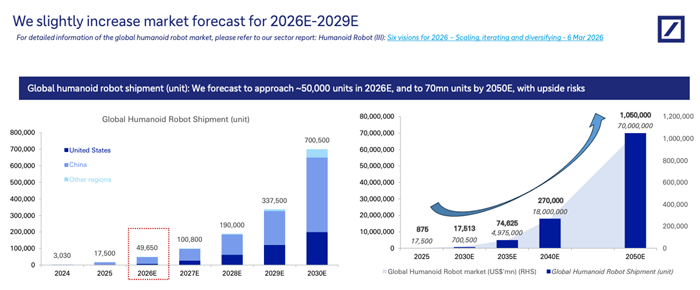
Deutsche Bank is putting hard numbers behind the same idea. The firm’s APAC automation team recently raised its forecast for global humanoid shipments to nearly 50,000 units in 2026. By 2030, Deutsche expects about 700,000 units. By 2050, it sees annual production reaching 70 million.
Source: Deutsche Bank
That may sound aggressive.
But humanoids could become the next major electronics platform, following the adoption curve of PCs and smartphones. Early models will look expensive and awkward. Then software will improve.
Components get standardized. Factories scale. Costs fall. And adoption accelerates.
We are already seeing the first steps. Chinese manufacturers are ramping faster than expected. Chinese firm Unitree Robotics is emerging as an early leader. Tesla continues pushing Optimus toward mass production.
Humanoids are moving from proof-of-concept to pilot deployments, then to early commercialization. The first high-value use cases probably won’t be in the home. They will be in industrial handling, logistics, inspection, testing, and commercial environments where the ROI is obvious.
This is how every major technology wave begins. The early applications are narrow. Then capability improves. Then the market broadens.
And for investors, the best opportunities usually appear before the final product reaches the mainstream.
Right now, that opportunity is not necessarily in the robot makers themselves. Other than Tesla, many leading humanoid companies remain private or difficult for U.S. investors to access.
The cleaner opportunity is the supply chain. Actuators. Harmonic reduction gears. Planetary roller screws. Motors. Sensors. Vision systems. Dexterous hands. Edge AI chips. Batteries.
These are the critical components that make embodied intelligence possible. They are the picks and shovels of the manifested AI boom.
The robotics buildout will be one of the defining investment stories at the end of this decade. And just like the early AI boom, most investors will recognize it only after the biggest gains have already been made.
At Brownstone Research, we don’t wait for consensus.
We follow the technology. And as AI leaves the screen, the age of manifested AI will begin.
By Joe Withrow, Senior Analyst, Brownstone Research
Gold recently fell to $4,195…its lowest level since last year.
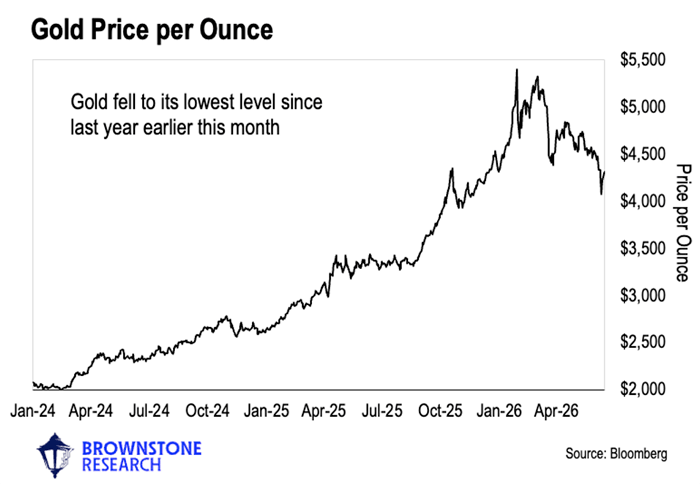
You can thank the “hot” jobs report released on June 5 for that.
A stronger jobs report means the Federal Reserve has cover to focus on the other side of its dual mandate—price stability. And with inflation on the warmer side, investors began to wonder if the Fed might hike its key rate.
That pushed the 10-year Treasury yield up to 4.53%… and a stronger dollar followed. All else equal, higher yields and a stronger dollar are a headwind for gold. And considering the gold market had priced in rate cuts over the summer, gold ETFs saw outflows and the metal pulled back.
Then, something interesting happened.
That same week, Goldman Sachs maintained its $5,400 year-end price target for gold. And JPMorgan reiterated its forecast of gold averaging $6,000 per ounce in the fourth quarter of this year. That is not a typo.
Goldman Sachs sees 29% upside from the June 12 correction low. JPMorgan sees 43% upside… by year-end.
These are two of the largest investment banks in the world, each running $2–4 trillion in client assets… and each has become unusually bullish on gold.
What do they know that the market is currently ignoring?
We can look at the data and make an educated case.
The data tells us that Western central banks are beginning to add gold reserves for the first time in over a decade. And industry reports are forecasting that these large central banks may consume 2,000 to 3,000 tonnes of new demand per year for the next several years.
Given that the physical gold market is already tight, this demand would create immense upward pressure on the price of physical gold.
And here’s the twist…
The United States holds 8,133 tonnes of gold. Assuming it’s all still there, that’s the largest gold reserve in the world.
Yet, the US Treasury has valued that gold at $42.22 per ounce ever since 1973. Someone fixed the price 53 years ago and nobody has bothered to change it.
At the fixed price, that equates to just over $11 billion worth of assets on the government’s balance sheet, sitting opposite the growing mound of debt.
But at current market prices, the actual market value of those reserves is well over $1.2 trillion. That’s a $1.2 trillion gap between what’s on the books and what’s in the vault.
And the question that serious policy thinkers are now asking publicly is: What if you closed that gap? What if the US Treasury simply revalued its gold at market prices?
If they did, nearly $1.2 trillion would appear on the balance sheet overnight… without borrowing a dollar or raising a tax.
At a time when the US government is staring at fiscal challenges that seem almost intractable with higher interest rates… that’s not a small number.
The takeaway is this…
If the US Treasury were to mark its gold reserves to market as a means of recapitalizing the federal balance sheet, that would signal to the market that the US government valued gold as a reserve asset and wanted a higher gold price.
How do we think the market would respond to that?
Perhaps that’s why institutions like Goldman Sachs and JPMorgan are suddenly bullish on gold after having ignored the yellow metal for decades.
None of this means that gold’s correction is over. But it does mean that there’s likely a strong floor undergirding the gold price at around the current levels.
And we should note that the institutions that manage the most capital in the world are not at all spooked by gold’s correction.
On the contrary, they are stating publicly, with specific price targets, that this is a buying opportunity within a structural bull market.
Add Brownstone Research as your preferred source on Google to see our latest stories in your feed.
 Add as a preferred source
Read the latest insights from the world of high technology.
Fortunately for Bessent, there’s one group of buyers with a voracious appetite for short-term U.S. debt.

Stocks were climbing out of bear territory, but then the bond market spoke up.

These factories will cost billions before even a single working chip is produced…