



Bessent Finds His Buyer
Fortunately for Bessent, there’s one group of buyers with a voracious appetite for short-term U.S. debt.



Sometimes, prices have less to do with business fundamentals and more to do with who needs cash before the closing bell.

Editor’s Note: According to Jeff Brown, a rare window of opportunity just opened in a completely overlooked sector. At the center of the story is Elon Musk, SpaceX, and the essential “ingredient” to make Musk’s ambitions a reality. This has nothing to do with the typical AI stocks. It’s something else entirely. Get all the details right here.

Consider this…
Why would Google report outstanding earnings, announce another $200 billion investment in AI, and still trade lower?
Great question.
My answer: Leverage is coming out of the system.
According to FINRA, margin debt recently climbed to a record $1.5 trillion.
Borrowing money feels like rocket fuel on the way up. On the way down, it can fuel the blowup.
Banks begin asking for more collateral. Funds don’t necessarily sell what they want to sell. They sell what they can sell. The biggest winners become sources of cash because they’re the easiest positions to liquidate.
Selling creates more selling.
Then more margin calls arrive.
Eventually, the market reaches the point where prices have less to do with business fundamentals and more to do with who needs cash before the closing bell.
We’ve seen this movie before.
Long-Term Capital Management.
Amaranth.
Archegos.
Different names.
Same ending.
Recently, we watched another version unfold.
Leopold Aschenbrenner, a former AI researcher, launched a hedge fund that reached peak exposure of $45 billion. He was heavily long AI infrastructure stocks and short software names. Then both legs of that trade went wrong simultaneously.
AI names fell while software recovered. Margin calls came. The fund liquidated its entire public equity portfolio to meet them.
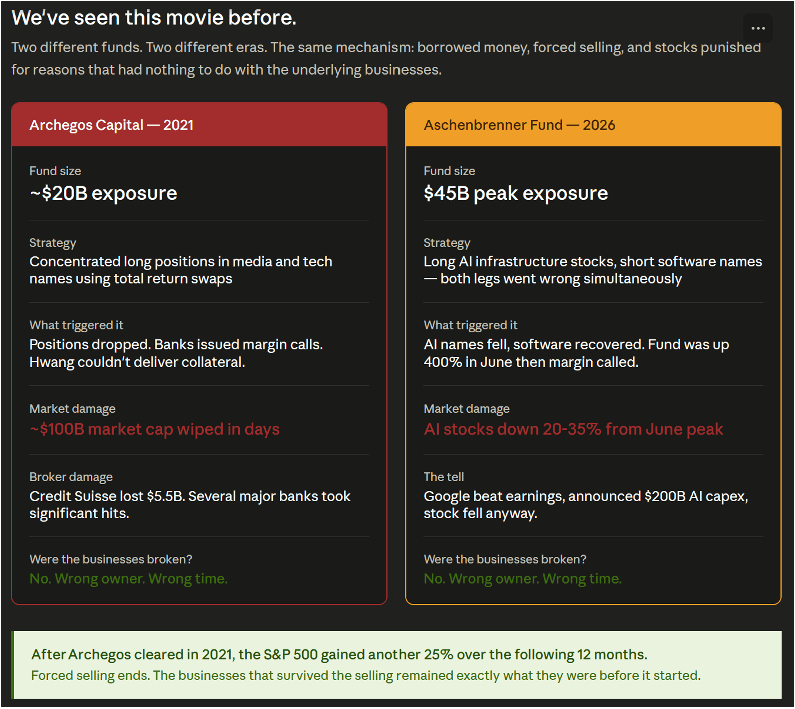
When you’re managing $45 billion, you’re not selling $5,000 positions. You’re liquidating hundreds of millions of dollars per stock. Every sale triggers more selling. High-frequency algorithms notice softening bids, widen spreads, and buyers step back. The cascade doesn’t stop to check whether the underlying businesses are growing. It just needs cash before the closing bell.
Google reported earnings on July 22 that blew past expectations and announced $200 billion in AI capital spending.
The stock fell anyway.
That is not the market making a judgment about these businesses. That is someone who needed liquidity selling whatever they could sell.
Then selling stopped. Microsoft blew out its numbers. Amazon followed. South Korea’s KOSPI index rallied 17.91% overnight—an entire country’s stock market, not a single stock.
That’s what happens when forced sellers exhaust themselves and short sellers scramble to cover.
Whether that’s the whole story or just part of it almost doesn’t matter.
It’s exactly what forced deleveraging looks like.
Meanwhile, the companies themselves continue doing exactly what investors hoped they would do.
According to FactSet, 86% of S&P 500 companies reporting second-quarter earnings have beaten expectations. Eighty percent have exceeded revenue estimates. Earnings growth is tracking near its strongest pace since 2021.
This wasn’t an earnings problem. It was a liquidity problem. Someone needed cash. That’s an important distinction.
Because liquidity problems eventually end.
Earnings problems usually don’t.
The storm may not be completely over, but the part driven by forced deleveraging of at least one massive player appears to be behind us. What’s left are the normal waves every market has to navigate.
For long-term investors, that’s a far healthier backdrop than the panic we’ve been living through over the past several weeks.

Bitcoin’s biggest bull has been raising cash.
On Monday, Strategy (formerly MicroStrategy), the world’s largest public Bitcoin holder, announced that it sold over $100 million worth of BTC last week.
For anyone familiar with the company or its controversial founder, Michael Saylor, this may come as a bit of a shock.
Saylor has gone viral in the past for not only amassing one of the largest Bitcoin stockpiles on earth, but for saying things like this:

Source: X.com
This is not Strategy’s first sale either.
Since June, the company has parted with more than 5,200 Bitcoin. That draws its net holdings down to 842,138 BTC at present, worth about $53 billion. That’s down from its peak of 847,363 earlier this year.
The company that vowed to buy and hold forever has become an active seller.
But what that headline misses is the fact that since the start of 2026 Strategy has added more than 169,000 BTC in total to its balance sheet, worth over $10.65 billion at current prices.
These recent sales are simply part of Strategy’s new active capital management playbook. It’s a shift that began last summer when it launched STRC, its preferred stock offering product.
We provided Chain of Thought readers with a deep dive on this back in April in Michael Saylor’s Financial Alchemy. As a quick refresher, STRC has become the company’s primary vehicle for raising capital to fund its BTC purchases.
It’s a high-yield product that offers holders 12% in annual dividends, which are paid out semi-monthly. In total, STRC and the company’s other monthly debt obligations cost Strategy just under $150 million each month.
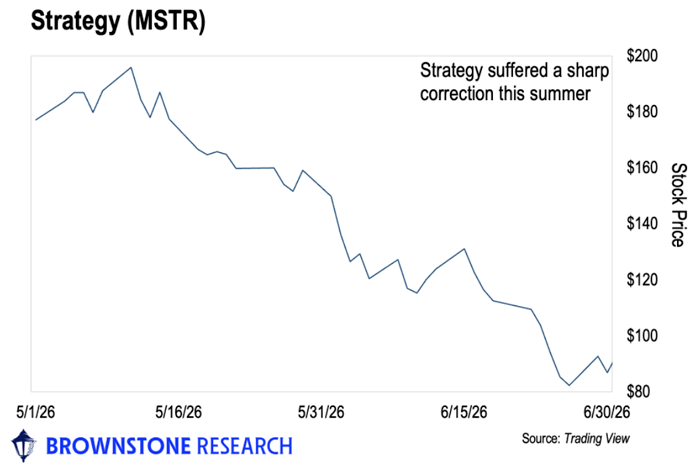
Because of this high monthly cost, the company’s common stock, MSTR, as well as its STRC preferred shares came under deep stress as BTC fell from $80,000 in May to the sub-$60,000 level in July.
Strategy shares dropped by over 50% in just over a month.
STRC, which is supposed to trade with low volatility in the $95-$100 range, fell all the way to $71.
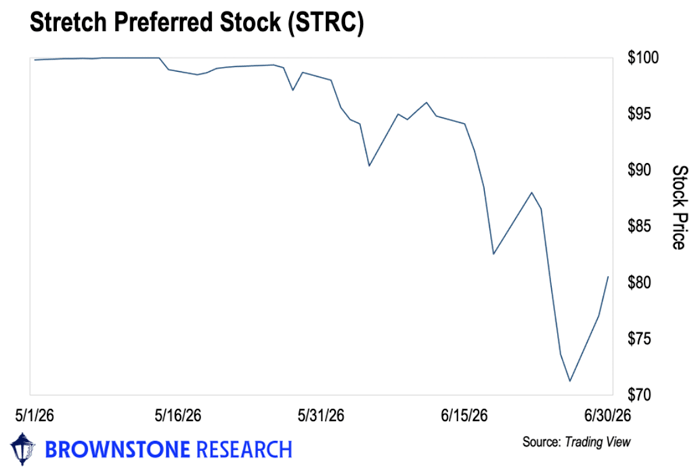
The market was concerned that Strategy would be unable to sell any of its Bitcoin collateral without crashing the price further and accelerating its own death loop.
This was its new capital structure being stress tested in real time.
And so far, the company has passed with flying colors…
At the time of writing, STRC has now recovered back around $92 for the first time since June.
Strategy’s large recent sales of BTC proved to the market that Bitcoin is larger than any one participant. Even its largest holder can sell in size without causing a crash.
In fact, Bitcoin is trading higher now than it was when Strategy began its heavy selling in June.
These sales also helped Strategy strengthen its balance sheet as the company now holds $4 billion in cash. That alone covers more than two years of payouts, and it sits beside its $53 billion hoard of Bitcoin, which would service its debts for an additional 30-plus years at current prices.
This robust balance sheet makes STRC a more attractive product for potential investors. Its high yield looks safer by the day. And more continued flows for STRC mean more fresh capital for Strategy.
This means it likely won’t be long before the company is a net buyer of BTC once again, and the 5,200 BTC it recently sold will seem like just a drop in the bucket.

GlaxoSmithKline (GSK) recently announced plans to save approximately $2.5 billion a year by improving the efficiency of its business over the next several years.
At first glance, the announcement may sound like a typical corporate cost-cutting program.
However, a closer look suggests that GSK is not simply trying to reduce expenses. It is preparing the company for the next generation of pharmaceutical innovation.
Rather than treating the savings as an end goal, GSK plans to reinvest much of that money into research and development, helping accelerate the discovery of new medicines and strengthen its future pipeline.
The company’s strategy focuses on improving areas such as procurement, supply chain management, and operations supporting its older, mature products. These parts of the business are essential but often become more expensive and complex over time.
By simplifying internal processes and making the company more efficient, GSK expects to free up significant financial resources without reducing its commitment to scientific research.
At the same time, the company continues to invest in its research capabilities, including a new research center in Cambridge, one of the world’s leading biotechnology and life science hubs.
This announcement also reflects a much broader trend taking place across the pharmaceutical industry.
Drug development has become increasingly expensive, while scientific advances are moving faster than ever. Artificial intelligence, automation, advanced data analysis, and robotics are beginning to reshape how medicines are discovered and developed.
Companies are realizing that remaining competitive requires not only great science but also highly efficient organizations that can quickly turn scientific discoveries into successful medicines.
While some pharmaceutical companies, such as Bristol Myers Squibb, are investing heavily in AI supercomputers to speed up research, GSK is taking a complementary approach by first creating the financial flexibility needed to support future innovation.
Many of the areas where GSK plans to improve efficiency are also well suited for artificial intelligence and automation.
Modern AI systems can help optimize purchasing decisions, improve inventory management, forecast product demand, streamline manufacturing schedules, and simplify regulatory documentation.
Although this announcement is not specifically about AI, these technologies are likely to play an increasingly important role in helping the company achieve its long-term efficiency goals.
In many ways, operational excellence is becoming just as important as scientific excellence.
The announcement also sends an important message to investors.
Instead of waiting for future competitive pressures, such as patent expirations on older medicines, GSK is acting proactively to strengthen its business today. By reducing unnecessary complexity and redirecting resources toward innovation, the company is positioning itself to compete more effectively over the coming decade.
This reflects disciplined long-term planning rather than a short-term effort to improve financial results.
Looking beyond GSK, this announcement highlights an important transformation taking place across the healthcare industry.
Pharmaceutical companies are no longer competing only through larger sales forces or bigger manufacturing facilities.
Increasingly, they are competing through smarter operations, advanced technologies, artificial intelligence, and stronger research capabilities.
Whether companies invest directly in AI infrastructure, like Bristol Myers Squibb, or improve efficiency to create more resources for innovation, like GSK, the destination is the same: developing better medicines faster, more efficiently, and at lower cost.
As this transformation continues, the companies that successfully combine scientific excellence with operational efficiency are likely to be the ones that lead the next generation of pharmaceutical innovation.
Add Brownstone Research as your preferred source on Google to see our latest stories in your feed.
 Add as a preferred source
Read the latest insights from the world of high technology.
Fortunately for Bessent, there’s one group of buyers with a voracious appetite for short-term U.S. debt.

Stocks were climbing out of bear territory, but then the bond market spoke up.

These factories will cost billions before even a single working chip is produced…