







Another Step Toward the Future of Precision Medicine
An acquisition that spotlights a major shift taking place across personalized medicine… CLARITY news… and market headwinds in today’s First Signal.

In this issue
01
Tempus’ Bet on AI-Powered Cancer Care
Feruz Kurbanov
02
CLARITY Is Not Priced In
Ben Lilly
03
Market Skepticism Is in Full Swing
Larry Benedict
Tempus’ Bet on AI-Powered Cancer Care

Feruz Kurbanov
Senior Analyst
Tempus (TEM) recently announced that it will acquire Personalis (PSNL) in a deal valued at approximately $1.5 billion.
The acquisition builds on a partnership between the two companies that began in 2023 and gives Tempus full ownership of one of the industry’s most advanced cancer monitoring technologies. The transaction is expected to close after shareholder and regulatory approvals.
Tempus has quickly become a leading company in precision medicine by combining artificial intelligence (AI), genomic testing, and one of the world’s largest collections of clinical data.
Beyond simply running genetic tests, Tempus uses AI to help doctors understand a patient’s cancer, choose the best treatments, and support pharmaceutical companies in developing new medicines.
Its strength comes from integrating DNA sequencing, medical records, imaging, and pathology into one technology platform, making it a leader in personalized cancer care.
The primary reason Tempus wanted Personalis is its industry-leading minimal residual disease (MRD) blood test called NeXT Personal.
MRD tests search for trace amounts of cancer DNA that may remain in the body after treatment, often detecting a recurrence months before it appears on medical scans.
While Tempus already excelled at identifying a patient’s cancer mutations and helping physicians choose treatments, it lacked a best-in-class tumor-informed MRD platform. Personalis fills that important gap.
Strategically, the acquisition allows Tempus to follow patients throughout nearly their entire cancer journey. A patient can receive genomic testing to guide initial treatment, benefit from AI-powered support, and then continue using Personalis’ MRD test to monitor for recurrence after surgery or chemotherapy.
Each stage generates valuable clinical and genomic data that feeds back into Tempus’ AI platform, making its algorithms even more powerful.
Tempus is not simply buying another diagnostic test. It is strengthening the data ecosystem that drives its entire business.
The acquisition also highlights a major shift taking place across personalized medicine.
Cancer diagnostics are evolving from one-time tests performed at diagnosis to continuous monitoring throughout a patient’s treatment. As targeted therapies become more common, physicians increasingly need ongoing molecular information to guide care.
This trend is creating one of the fastest-growing areas in cancer diagnostics, with the MRD market expected to become a multi-billion-dollar opportunity over the coming years.
The deal also has important implications for competitors, particularly Natera (NTRA) and Roche (RHHBY).
Natera remains the current leader in MRD testing through its widely adopted Signatera platform, but Tempus has now become a much stronger competitor by combining high-quality MRD technology with its AI platform, genomic testing business, extensive hospital relationships, and pharmaceutical partnerships.
The acquisition also reinforces the growing importance of AI and integrated data in cancer diagnostics.
Roche – through its Foundation Medicine subsidiary – remains a global leader in genomic testing, but the industry is increasingly rewarding companies that combine diagnostics, AI, real-world clinical data, and long-term patient monitoring into a single platform.
Overall, the Personalis acquisition is far more than a traditional merger.
It represents another step toward the future of precision medicine, where cancer care becomes increasingly personalized, data-driven, and continuous.
For Tempus, the deal fills one of the few remaining gaps in its oncology platform and strengthens its position as an AI-powered leader in cancer diagnostics.
For the broader industry, it signals that the next generation of winners will likely be companies that combine advanced diagnostics, artificial intelligence, and long-term patient monitoring into one connected ecosystem.
CLARITY Is Not Priced In

Ben Lilly
Senior Crypto Analyst
The crypto market just tipped its hand.
Last week it showed us that the CLARITY Act is not priced in…
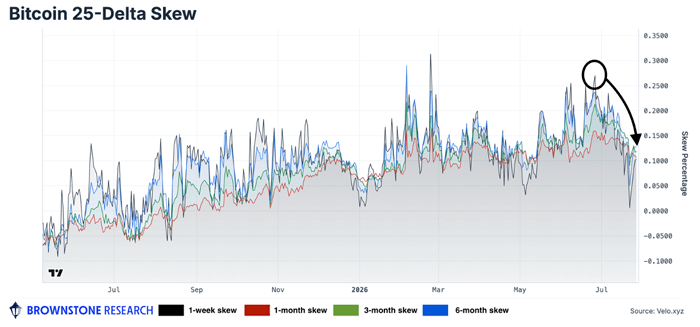
The 25-delta skew we track is once again showing us how the market is perceiving the bill.
Back in June, Bitcoin broke below $60,000 for the first time this year. Fear was high. We used this chart’s historical data to show that fear was a major buying opportunity.
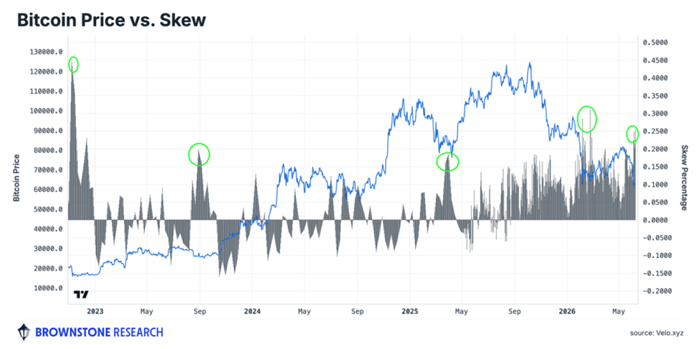
Then earlier this month we followed up on it after Bitcoin retested the $60,000 level. This time around, the chart showed us a hidden bullish divergence, a sign that sellers were exhausted.
Price action went on to recover by more than 10% through the month of July. And now this same chart is giving us a third signal, one that’s more exciting than the previous two …
That’s because last week, news of the CLARITY Act deal broke. The bill’s text was released, which included updated ethics language around President Trump’s crypto holdings. As a result, odds of passage ramped up. Skew then went on to turn negative for the first time since 2025. More than 12 months of positive, bearish skew. For the first time in more than a year, traders were favoring calls over puts.
The market’s tell here is that the same skew has since bounced back to indecision. This happened just as news surfaced that the CLARITY Act might not be able to get a vote in before Congress goes on a four- to five-week August recess.
The market now waits for more news on CLARITY. But what this showed us is two things…
The market is not properly positioned for the upside if CLARITY passes. Which is to say capital will come rushing into position once we know with greater certainty what’s about to happen.
This is often how new trends start. If we look at the shape of the curve across options expiration dates today, every expiry from next week through the end of the year is now in a downward trend. This looks more and more like the top in skew came last month, right when we first flagged it here.
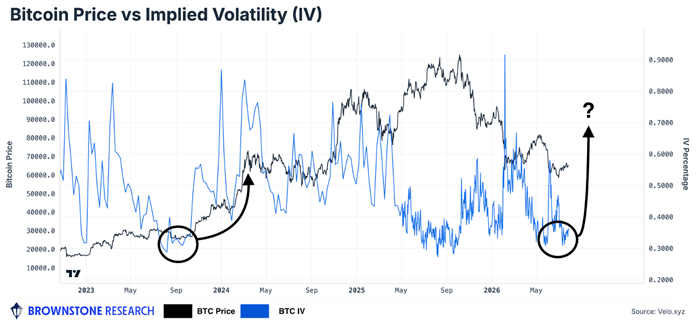
We also see it in implied volatility, which is the magnitude of the expected move options are pricing in. Today it remains near historic lows.
This is a set-up that rhymes with the fourth quarter of 2023, just before BlackRock’s iShares Bitcoin Trust ETF, IBIT, won SEC approval.
Back then, price was in a boring consolidation in the $20,000-30,000 range. The big institutional catalyst was looming, yet the options market was indifferent and priced as if things would remain boring forever.
But what came next was anything but boring…
After the ETF got approved, price nearly tripled from its September 2023 lows, hitting new all-time highs above $70,000 by March 2024. Options traders then fueled the move further, chasing the institutional capital flow with upside bets into and after the ETF launch.
A vote and eventual passage of CLARITY this summer could create upside similar to what took place when Bitcoin got its ETFs.
We released a full breakdown of where the bill sits in Chain of Thought last Friday. The catalyst we have waited for all year is inching closer, and the options market is telling us that right now is the time to pay close attention. Now we just wait to see if the bill gets time on the Senate floor this or next week.
As history shows, price may move fast without us if we aren’t prepared.
Market Skepticism Is in Full Swing

Larry Benedict
Founder, The Opportunistic Trader
Last week’s market reaction to key earnings announcements shows that investors are no longer willing to buy into every growth story or reward every earnings beat…
Tesla (TSLA) was brutally sold down 14% despite a revenue beat and reporting record deliveries. Negative cash flow, worries over margin pressure, and a subdued outlook for its robotaxi rollout set off its biggest fall in over a year.
Fellow Magnificent Seven member Alphabet (GOOGL) also fell sharply – down around 7% – over concerns about its massive AI spending plan. That came despite a clear revenue and earnings beat.
To me, these reactions reveal that we’ve entered the next phase of the AI story – one where a skeptical market is no longer rewarding companies simply for spending billions on AI. They now want proof that these investments will translate into meaningful returns.
And it’s not just valuation concerns putting pressure on the market. Other headwinds are building too – not least of which is oil. Both Brent and WTI crude oil pushed up into the $90s last week, increasing fears over resurging inflation.
The probability of a 0.25% rate rise at the Federal Reserve’s meeting this week has climbed to around 31.5%. While it’s still unlikely at this stage, sentiment around rates has clearly shifted. The probability increases to 55% in September. (There’s no Fed meeting in August.)
Investors will be hanging on every word at Fed chair Kevin Warsh’s press conference after the Fed’s decision on Wednesday. But clearly, higher oil prices will ripple through the economy.
That leads to bond market concerns, which might finally be filtering into the markets’ consideration. Last Thursday, U.S. 10-year Treasury yields topped out at just over 4.71%, their highest level since January last year.
Higher yields don’t just increase borrowing costs across the economy; they also provide investors with an increasingly attractive alternative to stocks. When government bonds start yielding 5% and above, the hurdle for owning highly priced growth stocks becomes difficult to clear, making them vulnerable to any disappointment.
As discussed, we saw that play out last week with TSLA and GOOGL. This week will also be key with four other Mag 7 stocks – Microsoft (MSFT), Apple (AAPL), Amazon (AMZN), and Meta Platforms (META) – also scheduled to announce earnings.
That’s why this week’s FOMC meeting could prove critical for the markets and where they’re headed next. If Warsh hints that the next rate move is higher and Treasury yields continue to climb, stock valuations could face pressure.
While the market has largely ignored these headwinds, last week’s action indicates that investors are starting to pay attention. That could mark the beginning of a much less forgiving environment for stocks.
Ultimately, I think we’re setting up for a highly volatile and profitable second half of the year.
More stories like this
Read the latest insights from the world of high technology.
-
-

This ‘Hidden’ Market Is Quietly Essential
The process begins with a simple question: What should the chip do?
-

The Inflation Warnings Keep Piling Up
The move in commodities will keep pushing inflation higher, which will put pressure on the Fed to act on...