




The Fast Money Is Gone (For Now)
Once the major indexes broke key technical levels, there were forced sellers across the board.


Did Nvidia just lose its CEO, or did it lose the extraordinary business he built?


Jensen Huang is out…
After 33 years at Nvidia’s helm, the man who built one of the world’s most important companies has resigned amid a personal scandal and an investigation involving possible Chinese intelligence activity.
It’s a stunning development.
And if you own Nvidia (NVDA), I understand why you’re nervous. But this story goes well beyond shareholders.
Nvidia sits at the center of the AI revolution. Its processors power enormous data centers, support the world’s most advanced AI models, and are strategically important to the United States.
So, losing its legendary founder is no small matter.
But here’s the question getting lost in the headlines: Did Nvidia just lose its CEO, or did it lose the extraordinary business he built?
Because those are two very different things.
Before the headlines took over, Nvidia was delivering blockbuster results.
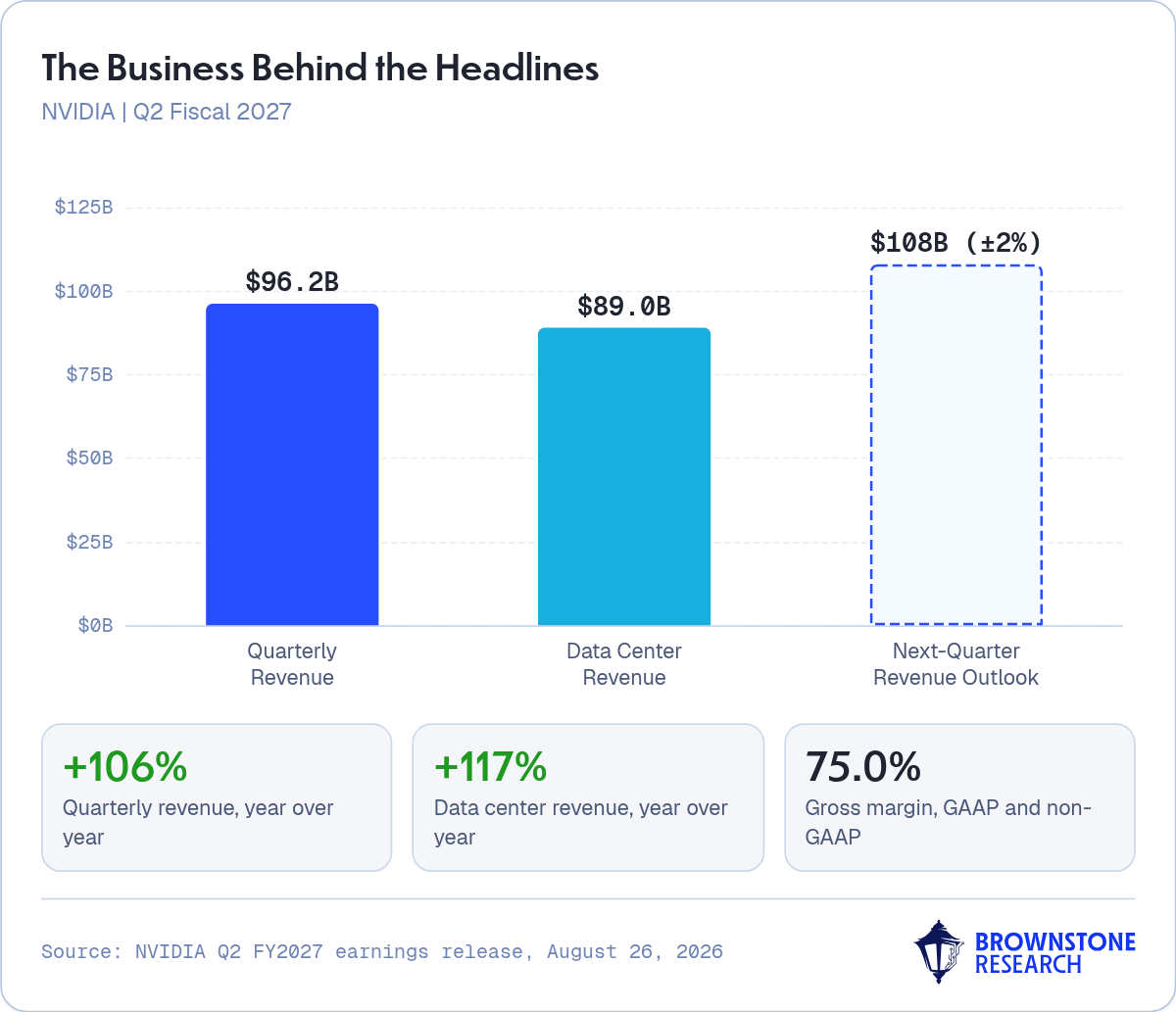
Quarterly revenue reached $96.2 billion, up 106% from a year earlier. Data center revenue grew 117% to $89 billion. Gross margin reached 75%.
Management projected about $108 billion in revenue for the next quarter.
Nvidia is enormously profitable and more than doubling its revenue.
Microsoft, Amazon, Google, Meta, and other technology giants are investing heavily in AI infrastructure. They need processors to train models and run increasingly sophisticated applications.
That demand doesn’t disappear because Huang resigned.
And Nvidia has something more valuable than a popular chip: an ecosystem.
Its CUDA software, networking technology, integrated systems, and developer relationships create a competitive advantage that took decades to build.
Customers build entire computing environments around Nvidia’s technology. That’s not easily replaced.
Nvidia certainly isn’t invulnerable.
AMD is developing competitive AI accelerators. Intel wants a bigger role. Broadcom is helping technology giants design custom chips. And Nvidia’s largest customers are investing billions in alternatives.
A leadership crisis could give competitors an opening.
But Nvidia is still the 800-pound gorilla in AI computing.
Its rivals aren’t simply trying to match a processor. They’re competing against an entire computing platform supported by decades of software development and customer investment.
And Nvidia isn’t standing still. Its Blackwell and Rubin platforms continue advancing, with a roadmap extending beyond today’s AI infrastructure.
Competition will intensify. Market share and margins could come under pressure. But neither outcome follows automatically from Huang’s departure.
I examined five technology giants that faced founder controversies or major leadership changes: Amazon, Microsoft, Alphabet, Tesla, and Apple.
Bezos faced a personal scandal. Gates and Brin faced revelations involving their personal lives. Musk battled the SEC. And Apple had to continue without Steve Jobs.
The stock-market results were remarkable.
All five stocks were higher two years after each event. All five were also higher five years later.
The median five-year gain was about 120%.
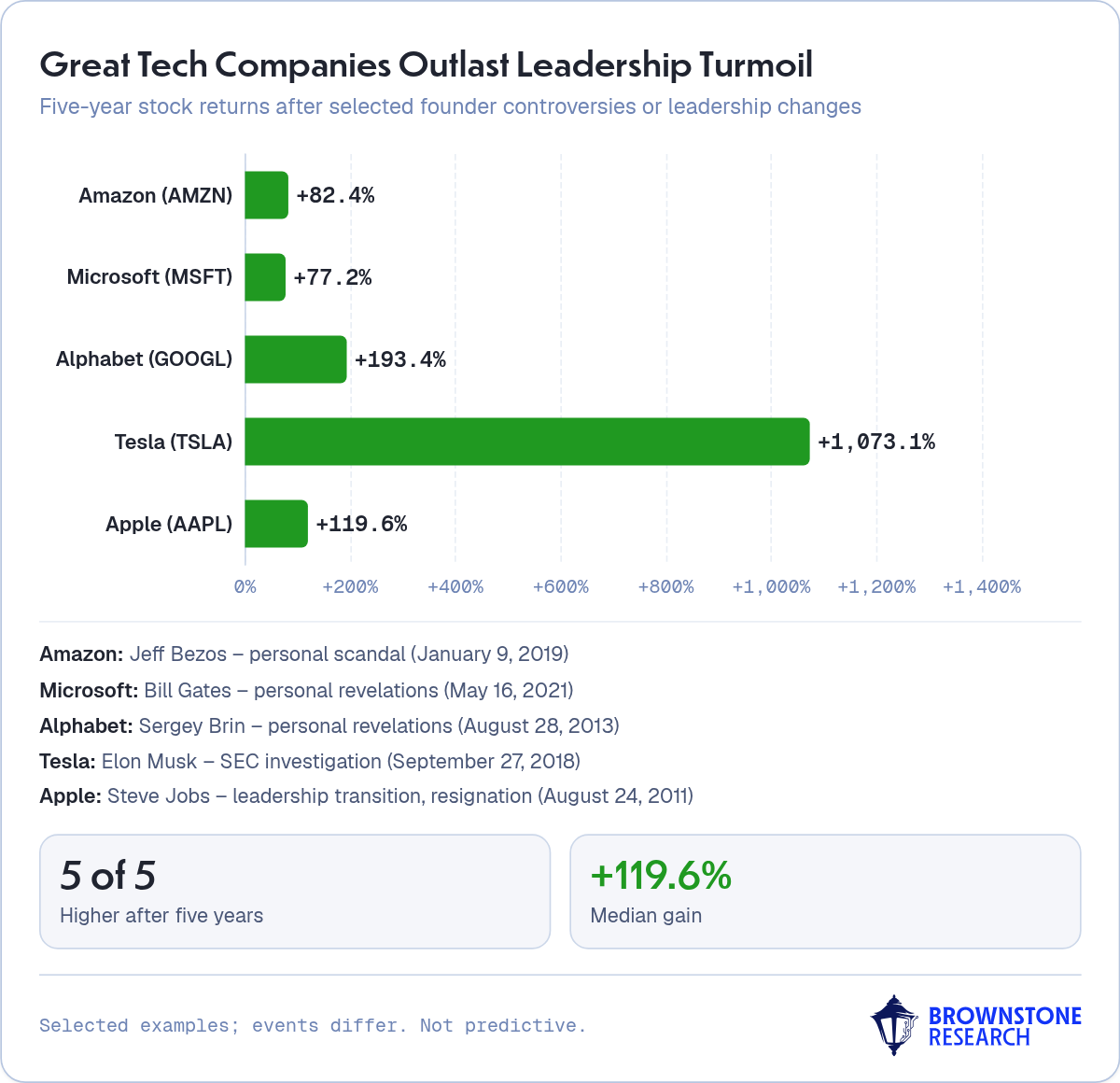
Those gains weren’t caused by the controversies, and these are selected examples, not a guarantee.
But they illustrate something important.
Over time, products, innovation, customers, and earnings mattered more than the turmoil surrounding their founders.
Nvidia deserves to be judged by the same standard.
The greatest achievement of a visionary founder isn’t creating a business that can’t survive without him. It’s creating one that can.
And Jensen Huang has done exactly that.

On January 3, a move by Wall Street, Silicon Valley and Washington could send a new group of stocks soaring as high as 852%, 1,267%, 1,532%, and even 1,921% or more… To get all the details about this rare market event, including the name of the #1 stock for 2027, click here now.
There’s a new “$20 super computer.” Beginning November 18, it could light up the most lucrative trading signal of 2026, with the potential to make you a year’s worth of gains. Click here to learn more.

Last week’s election rattled AI investors. Data center backlash became a campaign issue, and infrastructure stocks sold off hard.
But politics is about what people say. Business is about where they put their money. And this week CoreWeave’s (CRWV) earnings showed the money is still moving in one direction.
CoreWeave is the largest “neocloud,” and its business model is relatively straightforward. It buys huge quantities of GPUs, houses them in data centers, and rents that compute out. For that reason, the company’s financial performance is a fair barometer of AI compute demand and, by extension, the strength of the AI trend.
And Tuesday’s earnings didn’t disappoint.
Third-quarter revenue rose more than $1 billion from the previous quarter, and the company raised its full-year forecast to at least $13 billion. That implies over 150% annual revenue growth. And Wall Street expects revenue to climb another 110% in 2027.
It also lifted the bottom of its capital spending range. CoreWeave now expects to spend $37 billion to $39 billion on infrastructure this year, up from $35 billion at the low end. It was able to raise the floor because it’s delivering capacity to customers sooner than planned.
This fast execution is creating goodwill and orders from clients. CoreWeave expects roughly $9 billion in customer prepayments and deposits over the next three months. That’s cash customers hand over before CoreWeave has delivered all the computing power they bought.
CoreWeave’s facilities take enormous spending before they earn a dime. The chips, networking gear, and power systems all have to be in place first.
Customer prepayments help bridge that gap. They give CoreWeave another source of funding alongside borrowing and operating cash flow. And for customers, paying ahead is a way to lock in capacity they can’t count on finding later.
The $9 billion hasn’t all arrived yet. And customer deposits don’t erase CoreWeave’s debt (all $47 billion of it) or the risk of construction delays. But they do show customers helping to fund the expansion they need. That should help ease investor concerns about the rising yields of CoreWeave’s bonds.
We can see the same thing farther up the supply chain. Before CoreWeave can rent out a single processor, someone has to manufacture it. That someone is usually Taiwan Semiconductor Manufacturing Co. (TSM).
TSM makes chips designed by other companies. In October, its revenue rose 59.7% from a year earlier and 14.7% from September.
Those figures cover all of TSM’s business, but the primary growth driver is leading-edge chips used in AI data centers.
Look at the two companies together. Customers are committing cash to future computing capacity, and chip production continues to post strong growth.
The market rallied the day after CoreWeave’s earnings report. Not because it’s the new Nvidia. But because it shows demand for compute remains strong and the AI infrastructure buildout will continue.
The evidence is clear. The election changed the mood, but it did not change the orders.

Robots performing medical procedures still sound like science fiction to many, but they’re getting closer to reality. And the U.S. Food and Drug Administration (FDA) is preparing for exactly that possibility.
On November 6, the FDA released a new discussion paper asking doctors, patients, medical-device companies, and researchers how the agency should evaluate medical robots that can perform some tasks autonomously or be controlled remotely from another location.
This is not yet a new regulation. The FDA says it is not proposing formal requirements at this stage. Instead, the agency is trying to understand the risks and benefits before the technology becomes widely used.
Medical robots are already common in healthcare. Surgical systems can help physicians make extremely precise movements, while other robots assist with imaging, radiation treatment, rehabilitation, or positioning medical instruments. But today’s systems generally remain under direct human control.
The next generation could go further.
A medical robot might someday position instruments autonomously, perform certain parts of a procedure on its own, or allow a specialist hundreds of miles away to operate on a patient.
The FDA believes these capabilities could improve the consistency of medical procedures and bring specialist care to hospitals or communities that lack it.
Imagine a patient in a small rural hospital who needs an emergency procedure normally performed only by a specialist at a major medical center. Instead of transporting the patient, a specialist might someday control a robotic system from another city.
A patient in rural Nebraska could receive treatment from a specialist at Johns Hopkins… without either party having to travel.
It’s an intriguing possibility, but it raises difficult safety questions.
What happens if the internet connection slows down or disappears during a remote procedure?
How should a robot respond if a patient’s anatomy differs from what it expected?
How much decision-making should the machine be allowed without asking a doctor?
And if software is updated and the robot gains new capabilities, should regulators have to review those changes again?
Cybersecurity is another major concern. A remotely controlled medical robot depends on computers, software, and communications networks. A technical failure or a cyberattack could directly threaten patient safety.
All these risks are worth investigating, which is what the FDA is doing.
The agency is looking beyond whether the robot itself works properly. Regulators are considering the entire system around it, and the FDA has scheduled a public workshop for December 2–3 to discuss these issues with the medical-robotics community.
The discussion is important because medical robotics may eventually follow a path similar to artificial intelligence (AI) in medicine.
At first, AI mainly helped doctors analyze information. Increasingly, some systems influence diagnosis and treatment decisions. Medical robots could follow a similar progression from tools that assist doctors to machines that perform selected medical tasks with increasing independence.
That does not mean surgeons are about to disappear. Complex procedures will likely still require substantial human judgment for a long time.
But the FDA’s decision to begin discussing autonomous and remotely operated robots now suggests regulators believe the technology is moving quickly enough that rules need attention before these systems become widely used.
The central question may eventually become simple: How much medical responsibility can safely be given to a machine, and how much should always remain with a human?
The FDA does not yet have the answer… but it’s asking the right questions.
Add Brownstone Research as your preferred source on Google to see our latest stories in your feed.
 Add as a preferred source
Read the latest insights from the world of high technology.
Once the major indexes broke key technical levels, there were forced sellers across the board.

None of the AI infrastructure companies I heard from last week said anything other than business as usual.

Yesterday was bruising, but the selling started long before Election Day...