





The Midterm Hangover
Yesterday was bruising, but the selling started long before Election Day...

From The Editor
Editor’s note: A new type of trade is getting attention, and on Wednesday, November 11th at 8 p.m. Eastern, Jeff Brown and Larry Benedict will explain it on camera. They call them “Penny Tech Trades,” where every trade costs less than $1 per contract. One on Nvidia went from 2 cents to $1 in two days, while the stock was down. You’ll watch them place real trades with their own money, see how the trades work, and learn how to get set up in about three minutes. Add your name to the guest list with one click right here.
In this issue
01
The Midterm Hangover
Jason Bodner
02
This Is What Fiscal Dominance Looks Like
Joe Withrow
03
The FDA Prepares for the Era of Personalized Medicine
Feruz Kurbanov
The Midterm Hangover

Jason Bodner
Founder, Outlier Intel
If you own AI stocks, I don’t need to tell you how unpleasant the last several weeks have been. Yesterday was particularly bad, with the Nasdaq down about 5.5%.
But the selling started long before Election Day.
Hedge funds had already been aggressively reducing technology exposure, pushing the market into deeply oversold territory.
Concerns about the enormous sums being invested in AI infrastructure were already weighing on technology stocks.
The election gave investors another reason to worry. It didn’t create the underlying pressure. But history suggests political uncertainty may be less important than investors think.
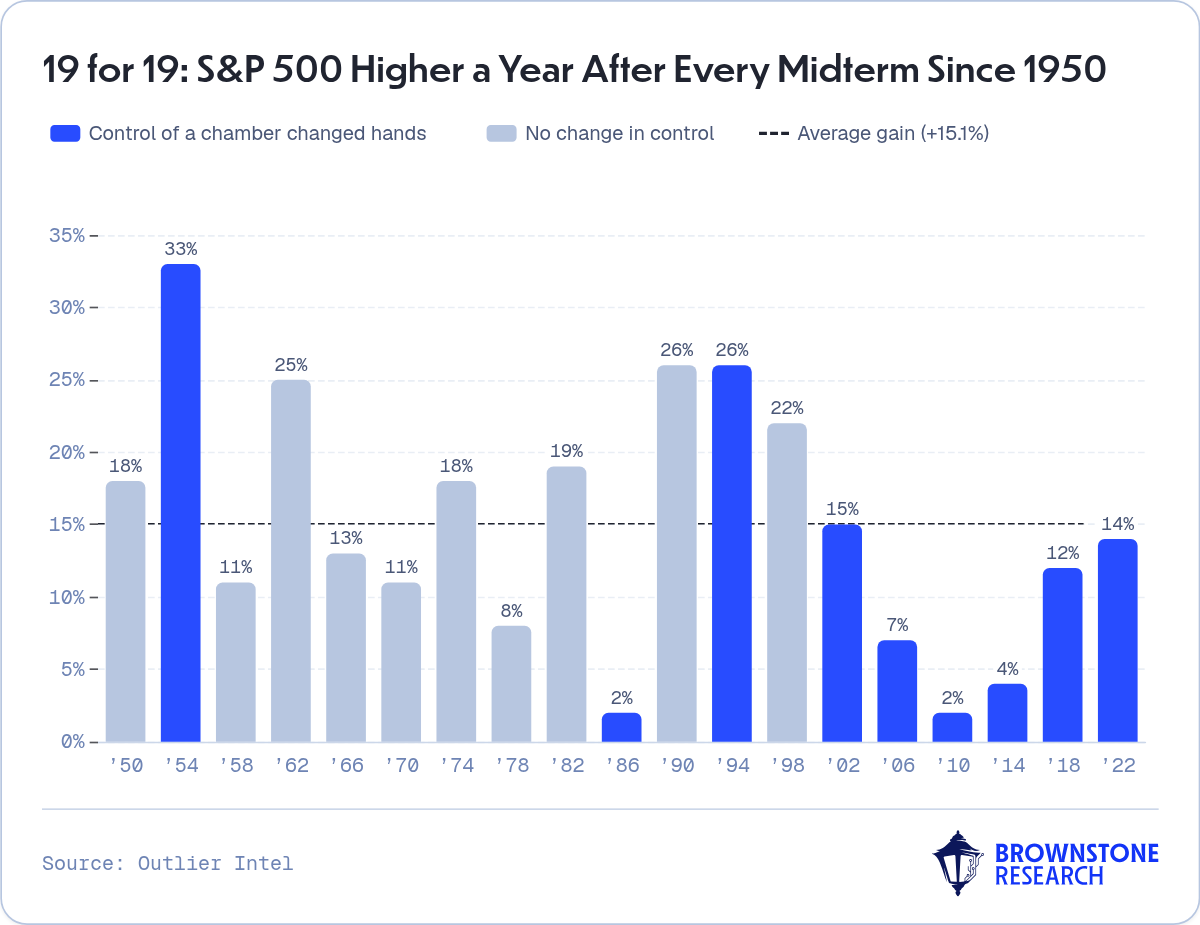
Since 1950, we’ve had 19 midterm elections.
In every case, the S&P 500 was higher one year later.
That’s 19 for 19, with an average gain of approximately 15%.
Nine elections changed control of at least one chamber of Congress. Stocks rose after every one of those elections, too.
Technology stocks have performed even better.
Since 1990, the Nasdaq 100 has outperformed the S&P 500 in the year following all nine midterm elections. Its average gain was approximately 37%, compared with 14% for the S&P 500.
History isn’t a guarantee. But technology stocks have performed consistently despite decades of political uncertainty.
There’s one important catch…
The market doesn’t necessarily rally immediately after an election.
When the president’s party lost at least 25 House seats, the S&P 500 declined an average of 1.3% during the following month.
Three months later, the average return improved to 5.8%.
At six months, it reached 13.1%. After one year, the average gain was 13.9%.
The initial political reaction has historically been a poor guide to what happens over the following year. With that said, there is a legitimate political risk.
Texas is home to significant planned data-center capacity, and its incoming Democratic governor, Gina Hinojosa, has supported a pause on new development while lawmakers consider additional rules.
Communities are concerned about electricity prices, water consumption, and infrastructure demands.
Those concerns are real.
But there’s a difference between slowing construction and eliminating demand for computing power.
And other states are dying for the business.
Consider Louisiana. In July, Meta expanded its planned AI data-center investment in Richland Parish to more than $50 billion, with 5 gigawatts of computing capacity.
Or West Virginia, where state leaders announced a 20-year strategy to attract data centers while establishing rules for their development.
These aren’t hypothetical opportunities. States are already competing for billions in AI infrastructure investment.
Projects facing regulatory obstacles may be delayed, redesigned, or redirected to more welcoming locations.
That could affect equipment orders and revenue timing for AI suppliers. But it doesn’t mean the demand disappears.
Yesterday was painful. And the volatility might not be over. Ballots can change the rules. They can change where data centers get built and which industries Wall Street favors.
But ballots don’t buy chips, fill order books, or generate earnings.
Businesses do.
And ultimately, that’s what matters.
Recommended Links

Washington’s 20th Wealth Window Just Opened. The Next One? 2030
Since 1950, a major event in Washington has opened a rare wealth-building window 19 times. Every time, investors came out ahead 12 months later. Now the 20th window is open… and billions of dollars could surge into the market about every 11 days. Hedge fund legend Larry Benedict, who went 20 straight years without a losing year, says each surge could hand everyday Americans a chance at YEARS of gains in a matter of days. And he’s giving away the ONE three-letter ticker he trades to play it, completely free. Click here to get it before December 9.

This “Penny Tech Trade” on Nvidia Increased 4,445% in Two Days
Recently, Nvidia's stock went down. But a brand-new kind of trade on Nvidia, costing less than $1 per contract, increased 4,445% (from 2 cents to $1) in just two days. Do you know another trade on Nvidia this year that has increased 40x? On Microsoft, the stock went nowhere for 12 days. “The Penny Tech Trade” increased 952% over two weeks. They're called “Penny Tech Trades.” This Veterans Day, at 8 p.m. ET, Jeff Brown and Larry Benedict will show you exactly how they work, on camera, with their own money. Click here to save your free spot.
This Is What Fiscal Dominance Looks Like

Joe Withrow
Senior Analyst
The plumbing of the financial system just flashed a warning… and almost nobody noticed it.
Specifically, bank reserves have fallen to their lowest level of the year. These reserves are the cash that commercial banks keep at the Federal Reserve (the Fed).
These reserves are the mechanism that allows banks to settle with each other. When money moves between banks, it’s just reserves moving between different accounts at the Fed.
More importantly, these reserves are a liquidity buffer. Should the system face any headwinds – or an outright crisis – reserves act as ammunition to ward it off.
Reserves peaked this year at $3.143 trillion in the week of July 15. But now bank reserves are down to $2.894 trillion. That’s about $249 billion gone in less than four months.
So where did the money go?
The answer: straight into the government’s checking account.
The Treasury General Account (TGA) is the Treasury’s cash balance at the Fed. On July 15, it held about $756 billion. Now it’s up to $999.7 billion. That’s a gain of roughly $243 billion.
When we see a move like this, we need to ask – where did that $243 billion come from?
The answer, often, is from the Fed’s overnight reverse repurchase (reverse repo) facility. In recent years, when the Treasury needed to increase its cash in the TGA, a big share of it came out of the Fed’s reverse repo facility.
What’s important to note here is that draining the Fed’s reverse repo facility does not pull liquidity out of the financial system because that cash is already outside bank reserves.
However, we can see that the Fed’s balance sheet has barely moved recently. It’s sitting at about $6.75 trillion.
That means the TGA’s gain came out of bank reserves almost dollar for dollar. This represents money that the Treasury borrowed from institutional investors.
This has the effect of draining liquidity from the financial system. And it’s likely a big reason we saw the Nasdaq and Bitcoin fall in tandem in October.
You may be wondering why the Treasury needs the cash.
The culprit is the U.S. government’s approximate $2 trillion fiscal deficit and a budget that now includes over $1 trillion in interest expense.
Don’t take my word for it. Here’s the Treasury’s own accounting of where the government’s most recent fiscal year, which ended in September, landed:
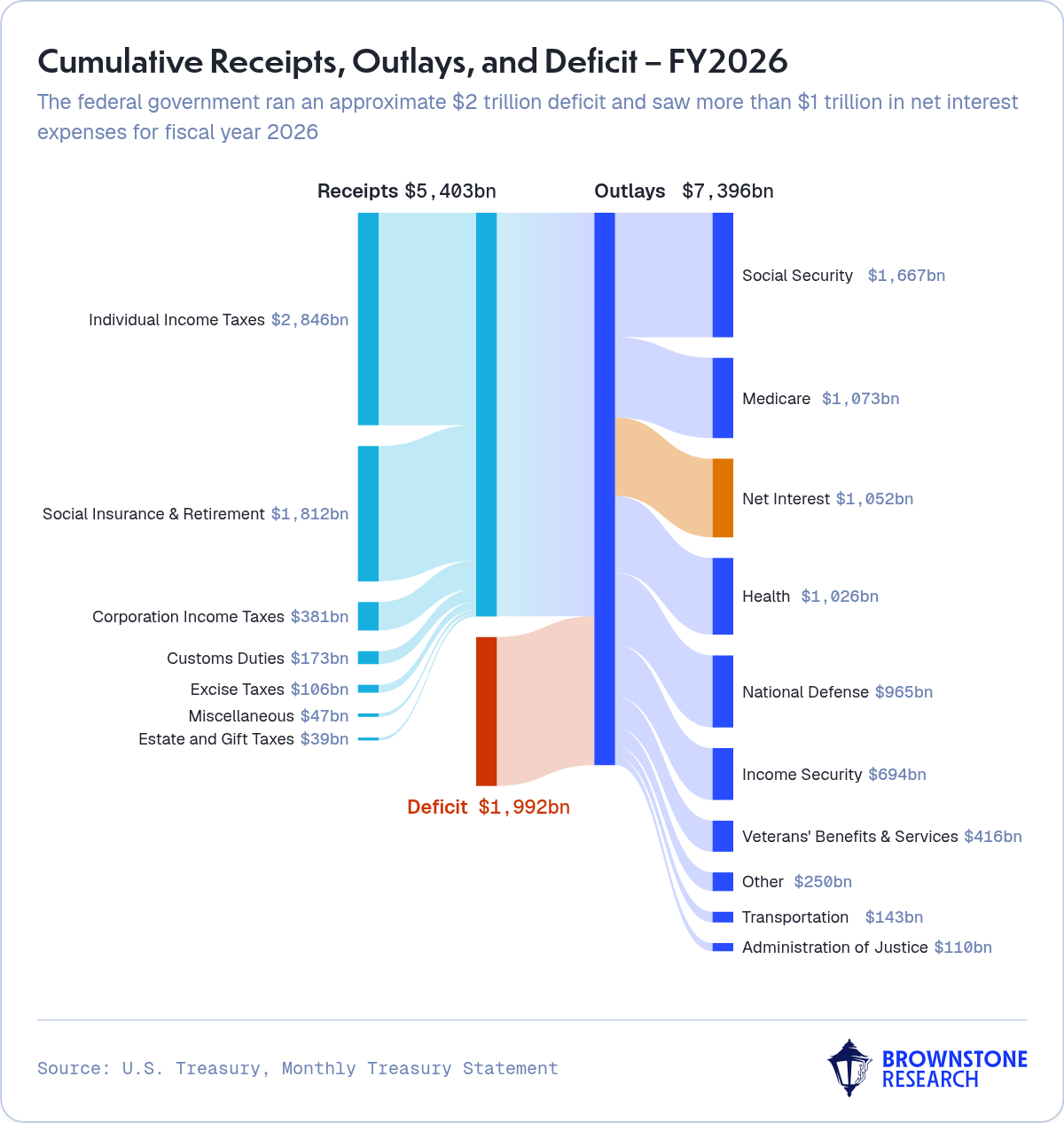
Simply put, the Treasury’s financing needs are soaking up excess liquidity from the market.
That’s fiscal dominance, a condition where the financing needs of the government start to dictate liquidity in the private market.
If we want to know where liquidity-sensitive “risk assets” are going, we need to keep an eye on the Fed’s reverse repo facility and the TGA. Those money flows will give us a read on liquidity in the marketplace.
The FDA Prepares for the Era of Personalized Medicine

Feruz Kurbanov
Senior Analyst
In recent editions, I’ve been covering several regulatory changes coming out of the Food and Drug Administration (FDA). In short, the FDA is making some much-needed changes to how it assesses new drugs and accounts for some special situations. The impact these changes could have on biotech and life sciences could be far-reaching.
And there’s one more initiative that should be on your radar…
The FDA is proposing a new way to regulate one of the most unusual ideas in modern medicine: gene-editing treatments that may need to be slightly different for every patient.
Traditionally, the FDA would evaluate one drug candidate that would be chemically identical for each patient. But we’re entering an era of personalized medicine. As the name suggests, that means treatments that are tailor-made based on the patient’s genetic factors. And, obviously, the FDA can’t evaluate every single variant. So, what’s the answer?
On October 27, the agency issued draft guidance explaining how a company could potentially receive one approval covering a family of closely related gene-editing medicines rather than conducting a completely new development program every time the genetic target changes.
The problem is especially important for ultra-rare genetic diseases. Some disorders are caused by mutations in a single gene, but different patients may carry different mutations within that same gene. A CRISPR or other gene-editing treatment may therefore need a slightly different guide or editing component for each patient.
The FDA’s proposed solution centers on something it calls an Individualized Feature Space, or IFS.
A company would first define the scientific boundaries within which its gene-editing product can safely vary. The basic editing technology, manufacturing process, and overall design might remain the same. Meanwhile, one component, which is the genetic guide telling the editor where to cut or repair DNA, could change from patient to patient.
Several representative versions could then be studied clinically as part of one development program.
Once the overall product is approved, a new patient-specific version that remains within those predefined regions could potentially be added without running another full clinical trial. Instead, the developer would perform laboratory testing to show that the new version edits the intended DNA target, has adequate activity, and does not create unacceptable unintended genetic changes. The FDA could then review that new variant as part of the existing approved product family.
Imagine having a highly tested delivery vehicle and gene-editing machine, while changing only the “address” that tells the system which mutation to repair. If scientists already understand the platform well, repeating years of animal and human testing for every new address may add enormous cost without necessarily providing equally valuable new information.
This proposal does not mean personalized gene-editing treatments would escape careful review.
The FDA would still require strong evidence that the original product family is safe and effective, that manufacturing remains consistent, and that each new version performs properly in laboratory testing. The guidance is also still a draft and could change before becoming final policy.
The broader significance is considerable.
Modern genetics is increasingly identifying diseases so rare that the traditional pharmaceutical business model does not work. If every mutation requires its own independent drug-development program, many patients may never receive a treatment simply because there are too few of them to justify the cost.
The FDA’s proposal suggests a different future.
One carefully validated gene-editing platform could potentially produce many closely related personalized medicines. Combined with the agency’s broader Rare Disease Framework, this could help move gene editing from treatments designed for relatively large genetic-disease populations toward therapies for increasingly small groups and perhaps eventually even individual patients.
Continue following Brownstone Research
Add Brownstone Research as your preferred source on Google to see our latest stories in your feed.
 Add as a preferred source
More stories like this
Read the latest insights from the world of high technology.
-
-

Institutional Capital Is Having a Fit
This latest bout of volatility is an excuse for institutional investors to lighten their positions, lock in 2026 bonuses,...
-

The Fed Holds Steady…For Now
Rather than trying to decode what Fed officials say, follow currency trends for clarity on what the market actually...