




Making Sense of the Tech Wreck
AI hardware is shedding leverage as a tree drops its leaves, but leaves come back.


Rather than trying to decode what Fed officials say, follow currency trends for clarity on what the market actually expects.

The Fed held its rate steady on Wednesday.
That surprised no one. The implied probability of keeping the federal funds rate unchanged was north of 90% heading into the meeting.
But the latest inflation readings suggest the Fed may soon have to resume hiking.
Yesterday brought the latest reading of the Personal Consumption Expenditures (PCE) Price Index, the Fed’s preferred inflation gauge. It showed consumer prices rising 3.6% year over year.
That was in line with expectations, but it’s nowhere near the Fed’s 2% inflation target… and consumer inflation hasn’t been below target for over five years.
The Fed sometimes holds off on rate hikes over concerns about economic growth. But it doesn’t have that excuse right now.
The advance estimate of third-quarter GDP came in at 3.4%, ahead of the 3.2% consensus estimate. Hardly the stuff recession fears are made of.
Investors parsed every word from Fed Chair Kevin Warsh at his post-meeting press conference for clues on the pace and size of further rate hikes.
Investors trying to make sense of it all often look to the stock market’s reaction. The S&P 500 is essentially yawning at the news, with little movement following the Fed and Warsh.
Other forces are pushing the S&P around anyway, including earnings releases from megacap AI companies such as Alphabet (GOOG).
But if you’re looking for the clearest picture of the market’s take on monetary policy, I would suggest looking at currency markets (foreign exchange, or forex). After all, the currency market trades $9.6 trillion a day on average… more than any other market.
When money moves in forex, you need to pay attention. And two of the biggest drivers of forex volatility are interest rate differentials and the outlook for central banks.
Interest rates are a fundamental part of currency trading, acting as a relative valuation tool.
Capital flows to where it can earn the best return. So countries with relatively high interest rates tend to attract capital (and see their currencies appreciate), while countries with low rates often see their currencies weaken.
The outlook for rates can also drive currency pairs, with hawkish or dovish Fed pivots playing a big role.
The U.S. Dollar Index (DXY) is a popular way to measure the dollar against a basket of other major currencies, including the euro, British pound, and Japanese yen.
The DXY chart below offers some clues on how investors are reading the latest Fed meeting.
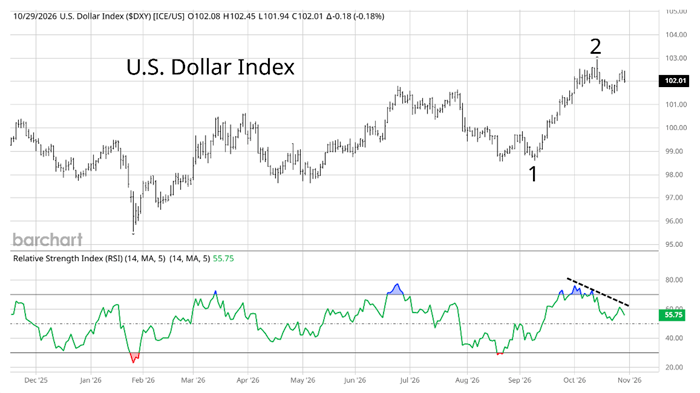
The dollar started rallying at point “1,” which aligned with shifting expectations that the Fed would start hiking rates… which the central bank did at its September meeting.
DXY’s rally stalled out at “2” near the 103 level, which is being tested again this week. But the dollar is reversing lower off that level just as a negative momentum divergence emerges.
The Relative Strength Index (RSI) is making a lower high (dashed line) on this latest test of 103. That shows fading momentum.
If DXY reverses lower from here, that could reflect a more dovish rate outlook in the forex market. Rather than trying to decode what Fed officials say, follow currency trends for clarity on what the market actually expects.
If the dollar pulls back further as fears over the pace and size of rate hikes ease, that could spell relief for the stock market and the AI trade, which has been under pressure for much of the past month.

After SpaceX placed a series of orders with one little-known supplier, its shares surged more than 1,000%. Now Larry Benedict believes Elon’s latest plan could ignite another overlooked company. See the ticker before the crowd catches on.

The federal government is set to trigger a limited time profit window on November 4. This profit window has opened every four years WITHOUT FAIL since 1950. You could potentially collect wins as big as $1,245… $950… and $1,325 nearly every single week. The last time it happened, “Market Wizard” Larry Benedict helped his readers make over $100,000 in just 12 months. If you’d like to know how… Watch Larry’s special presentation FOR FREE before this window closes.

Utility companies are paying more for uranium than at any time in nearly two decades… and the stock market is acting as if it doesn’t notice.
Uranium is the fuel that powers nuclear fission reactors. Like other commodities, it is priced in the commodity markets.
But unlike most commodities, uranium doesn’t trade on a public exchange. Instead, most of it changes hands through contracts that buyers and sellers negotiate privately. That opaqueness is one reason investors can sometimes miss interesting changes in the commodity.
Have a look at uranium’s spot price (the darker blue line) against the long-term contract price:
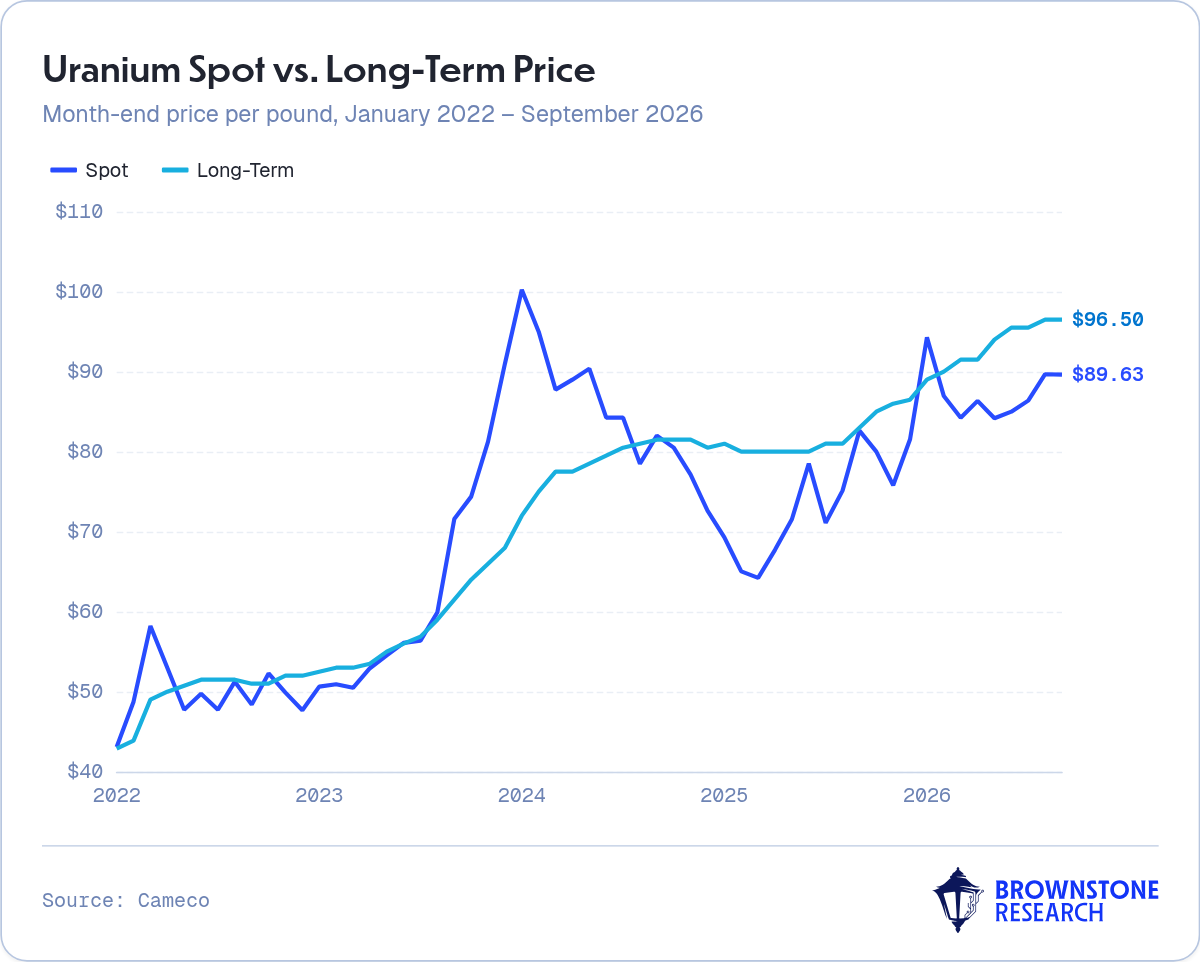
Uranium currently trades around $90 per pound in the spot market. But here’s the thing – utilities aren’t paying the spot price. They’re locking in long-term supply contracts at a considerable premium.
The long-term contract price sits around $97 per pound. That means utilities are committing to pay nearly 8% more than spot.
That’s the highest long-term contract price on record, topping the $95 peak from 2007. It tells us that utilities are worried they won’t be able to secure enough uranium in the future, so they’re paying extra for it now.
This isn’t exactly a surprise. The supply side shows why they’re worried.
Paladin Energy’s Langer Heinrich mine in Namibia produced 1 million pounds of uranium last quarter. That’s down 19% from the prior quarter, and the slowdown came as the company’s unit costs rose 19%.
Clearly, there’s strength in the physical uranium market, and we should expect prices to remain elevated. But there’s a disconnect…
In the equity markets, though, uranium stocks have been beaten up. The mining stocks are currently trading near their 52-week lows.
Then there’s the Sprott Physical Uranium Trust (SRUUF). It’s not a mining company. It’s a trust that buys and stores physical uranium.
As I write, the Sprott Physical Uranium Trust holds about 81.7 million pounds of uranium, worth around $7.4 billion at the spot price. That gives SRUUF a net asset value (NAV) of $21.61 per unit.
Yet SRUUF trades around $19 per unit – an 11% discount to the value of the uranium it holds.
So, utilities are committing to pay nearly 8% more than the current spot price… but investors can get it at an 11% discount. This points to a major disconnect between the physical market and the equity market.
They can’t both be right for long.
Either the utilities that need the fuel are overpaying… or the stock market is underpricing uranium.
With reactors being brought back online in the U.S., new reactor builds planned across the world, data centers demanding more power, and physical supply already struggling to keep up… I tend to think the equity market will have to catch up to the physical market sooner or later.

For decades, Alzheimer’s disease was treated only after memory problems and other symptoms had appeared.
But that’s changing…
Scientists now better understand the biological changes behind Alzheimer’s, which can begin many years earlier. Amyloid plaques, abnormal tau proteins, and other signs of disease may accumulate in the brain long before a person realizes anything is wrong.
That raises an important possibility: What if Alzheimer’s could eventually be treated before significant memory loss begins?
The FDA is now preparing for that future.
On October 22, the agency launched the Alzheimer’s Prevention Accelerator, the first major initiative under a broader neuroscience program called the Neuroscience Advancement and Innovation Nexus.
The goal is to develop better scientific and regulatory approaches for medicines intended to prevent or delay Alzheimer’s disease rather than simply slow it after symptoms appear.
Prevention creates a difficult clinical-trial problem.
If a patient already has memory loss, researchers can measure whether a drug slows further decline. But imagine treating a 65-year-old who feels completely healthy yet has early biological signs of Alzheimer’s.
If that person still has normal memory three years later, did the medicine work, or would the person have remained healthy anyway?
Proving prevention using traditional clinical endpoints could require enormous trials lasting many years.
That is why the FDA wants researchers to rethink which patients should enter prevention trials and which endpoints should be used at different stages of disease.
Biomarkers could become particularly important. These are measurable biological signs of Alzheimer’s, such as amyloid accumulation seen on brain scans or abnormal forms of tau protein detected in blood.
Instead of waiting years for dementia to develop, researchers may eventually be able to measure whether a treatment changes a biomarker that reliably predicts future cognitive decline.
Blood tests could make this approach even more practical.
Today, confirming Alzheimer’s biology may involve expensive PET scans or spinal-fluid testing. New blood tests can measure proteins such as phosphorylated tau and may eventually help identify people who appear healthy but are already developing Alzheimer’s-related changes.
In the future, prevention could involve a sequence such as blood screening, confirmation of disease risk, early treatment, and continued biomarker monitoring.
The FDA isn’t saying that biomarkers alone are enough to prove that an Alzheimer’s prevention drug works. But the agency has previously said that surrogate endpoints may sometimes be appropriate in very early Alzheimer’s disease, as long as they are scientifically convincing and reasonably likely to predict meaningful clinical benefit.
The initiative also reflects a broader change in FDA thinking.
Earlier this month, the agency announced a separate framework for rare diseases, recognizing that illnesses affecting only a few hundred patients cannot always be studied using the same trial designs as diseases affecting millions.
Alzheimer’s creates almost the opposite problem: enormous numbers of people may be at risk, but the disease develops so slowly that conventional trials can take many years.
The emerging principle is simple.
The scientific standard should remain high, but the way evidence is generated may need to fit the disease.
For Alzheimer’s, that could mean earlier treatment, biomarker-defined patients, new trial endpoints, and better diagnostic tools.
If this approach works, the goal may no longer be simply slowing dementia after it appears, but preventing or delaying memory loss before patients ever realize the disease has begun.
Add Brownstone Research as your preferred source on Google to see our latest stories in your feed.
 Add as a preferred source
Read the latest insights from the world of high technology.
AI hardware is shedding leverage as a tree drops its leaves, but leaves come back.

On the surface, it makes some sort of sense. But this argument misses two things…

In South Korea, individual stock traders have an unusual nickname: gaemi, the Korean word for ants.