




Attack of the “Ants”
In South Korea, individual stock traders have an unusual nickname: gaemi, the Korean word for ants.


On the surface, it makes some sort of sense. But this argument misses two things…

Editor’s Note: Don’t forget to sign up for Jeff Brown’s strategy session this Wednesday at 10 a.m. ET.
He’s discussing the details of a California-based company’s “AI superchip” that he believes is set to shake up the AI industry… potentially causing previous winners in the AI space to fall hard and sending a new crop of AI stocks higher. Just go here to sign up.

Over the past couple of weeks, we’ve seen a lot of fear, uncertainty, and doubt (FUD) enter the headlines. And with the rise of FUD, we’ve seen AI stocks falter.
One of the more nuanced arguments the AI bears are making is that the cost of tokens has fallen by about 50% in recent months. And they say that will lead to falling revenues and a slowdown in the buildout of AI data centers…
AI models process information in small pieces called tokens. These can represent words, parts of words, or other data. Developers often pay based on how many tokens their applications use.
Axios shared the below data, which helps make this argument. It shows that token prices have fallen sharply.
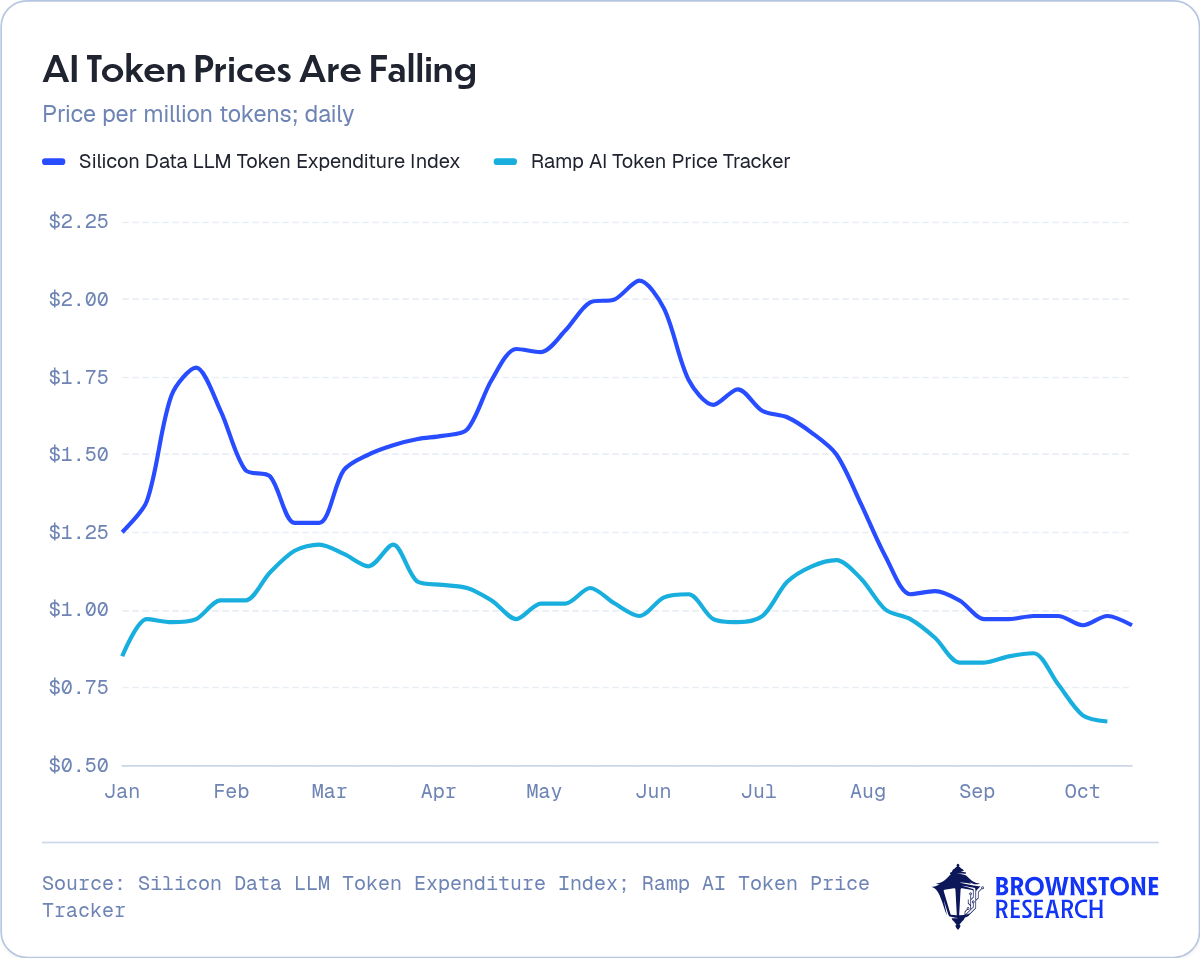
On the surface, it makes some sort of sense.
Lower token prices could mean less revenue for each token sold. That could mean the frontier labs generate less revenue. And that, apparently, “raises questions about the strength of an AI boom fueled by supposedly bottomless demand for computing power.”
But this argument misses two things…
First, the Axios article acknowledges that business spending on tokens has been flat even as token prices have halved. What that implies is that token usage has doubled. I’m not sure how that’s a complication for compute demand.
Second, this alone tells us little about profits. If the cost of delivering those tokens falls faster, a provider can charge less while keeping more of each dollar.
And the technology driving those costs lower keeps improving.
In June, CoreWeave completed its first bring-up and validation of Nvidia’s Vera Rubin system. Nvidia says the platform can deliver up to a tenfold reduction in cost per token compared with Blackwell under its stated workload assumptions. AMD is also targeting lower token costs with its Helios systems. And the custom silicon produced by hyperscalers is becoming more efficient every year.
Better chips, faster memory, and improved software allow providers to deliver more useful work from their infrastructure.
Consider a simple hypothetical example. A provider charges $10 for work that costs $8 to deliver, leaving $2 before research and other company expenses.
If better technology lowers that cost to $4, the provider could cut its price to $7 and keep $3. The customer pays 30% less. The provider keeps 50% more.
And as prices go down, customers often use more of the service. We’ve seen a version of this before.
In his 2015 shareholder letter, Jeff Bezos reported that Amazon Web Services had cut prices 51 times. Cheaper cloud computing helped make it practical for businesses to rent computing power instead of buying and maintaining their own equipment. And that was when the AWS business really took off.
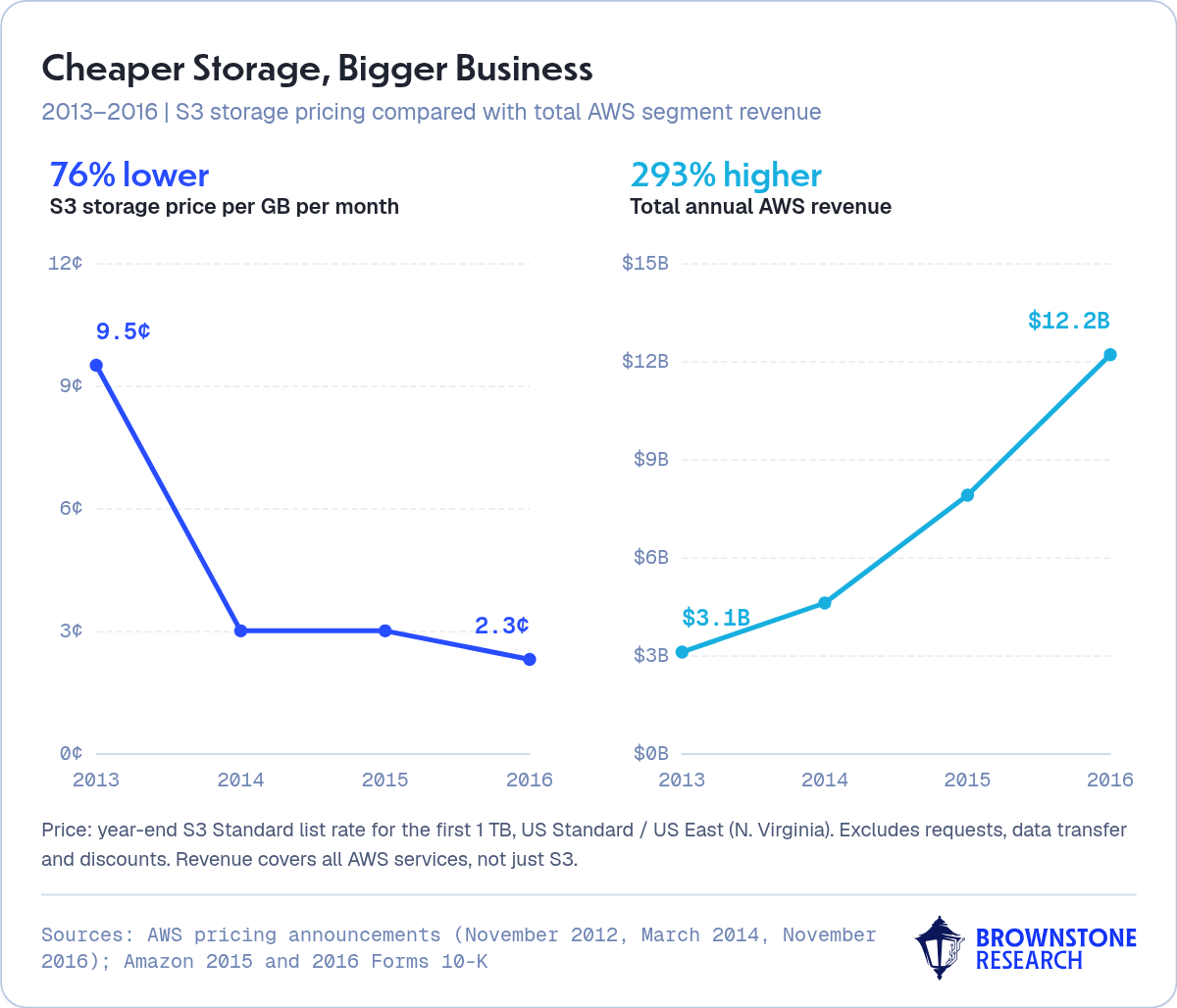
In 2016, AWS revenue rose 55% to $12.2 billion. Operating income more than doubled to $3.1 billion. Amazon attributed profit growth primarily to increased customer usage and greater efficiency, which outweighed price cuts and higher infrastructure spending.
Note: This year AWS is expected to make $171 billion in revenue and $62 billion in operating income. This shows how long and how far a trend can go if it gains mass adoption.
AI could follow a similar path. As useful tasks become cheaper, more businesses can afford to automate them.
That won’t guarantee profits for every AI lab. Competition, research spending, and infrastructure costs all impact the bottom line. But falling token prices alone don’t tell us whether a business is getting stronger or weaker.
It’s important to be able to read between the lines. Remember that headlines are meant to get your attention and make the news outlet money. They aren’t there for investors to make more money.
The opportunity lies in companies that lower costs and turn cheaper AI into greater adoption. Cheaper AI can make the market bigger. AWS already showed us how powerful that can be.

Homes could heat and cool for pennies, and cars could charge for almost nothing. AI data centers would run day and night. The energy savings would be like writing a $4,000 check to every American man, woman, and child… every year. A machine with the power to do all of that was just confirmed in the lab. Google, Goldman Sachs, and Nvidia are heavily invested. Now, the president may even take a personal stake. Former tech executive Jeff Brown names the company behind it – free. Watch this video to learn more.

A new AI superchip 50 times faster than Nvidia's could reshape everyday life. Imagine an AI agent that books all your appointments, "clones" you at work, and more. Beginning on October 28, these changes could be driven by a new AI firm that could make you 1,000% on your investment if you buy now, BEFORE it goes mainstream. Get the full story here (including a free stock pick from an AI expert who recommended Nvidia before it rose 35,000%).
Investors are breathing a sigh of relief…
The 10-year Treasury yield most recently peaked at 5.31% on October 5. The 30-year topped at 5.67% two days later. But since then, longer-term rates have pulled back quickly.
The jump in yields stirred fears in the equity market. That’s because Treasurys set the “risk-free rate of return” used to value future corporate earnings. When that rate rises, those earnings become less valuable, all else equal. That drives valuations lower.
High rates also present competition for capital. High-grade bonds such as U.S. Treasurys tend to be much less volatile than stocks. When interest rates go up, bonds look more attractive to investors, especially considering risk.
That’s why the recent pullback in bond yields is spelling relief for the average stock. It may not seem like a relief rally looking at the AI trade, but the average stock in the S&P 500 has been rallying since the start of October… roughly the same time bond yields turned lower.
But investors shouldn’t grow too comfortable with the bond outlook. One reason is fundamental, and the other is technical.
Let’s start with the fundamentals. Inflation is a fundamental driver of bond yields. Fixed-rate bonds pay a set amount of cash. When inflation rises, the real value (purchasing power) of those future interest and principal payments drops… so investors demand higher yields to compensate.
And the most recent inflation data wasn’t pretty. The Consumer Price Index (CPI) for the month of September was reported at 3.7% year over year versus expectations for an increase of 3.6%. The Producer Price Index (PPI) was especially worrisome, with a headline increase of 6.3% compared with estimates for 5.3%. Here’s the chart comparing CPI and PPI.
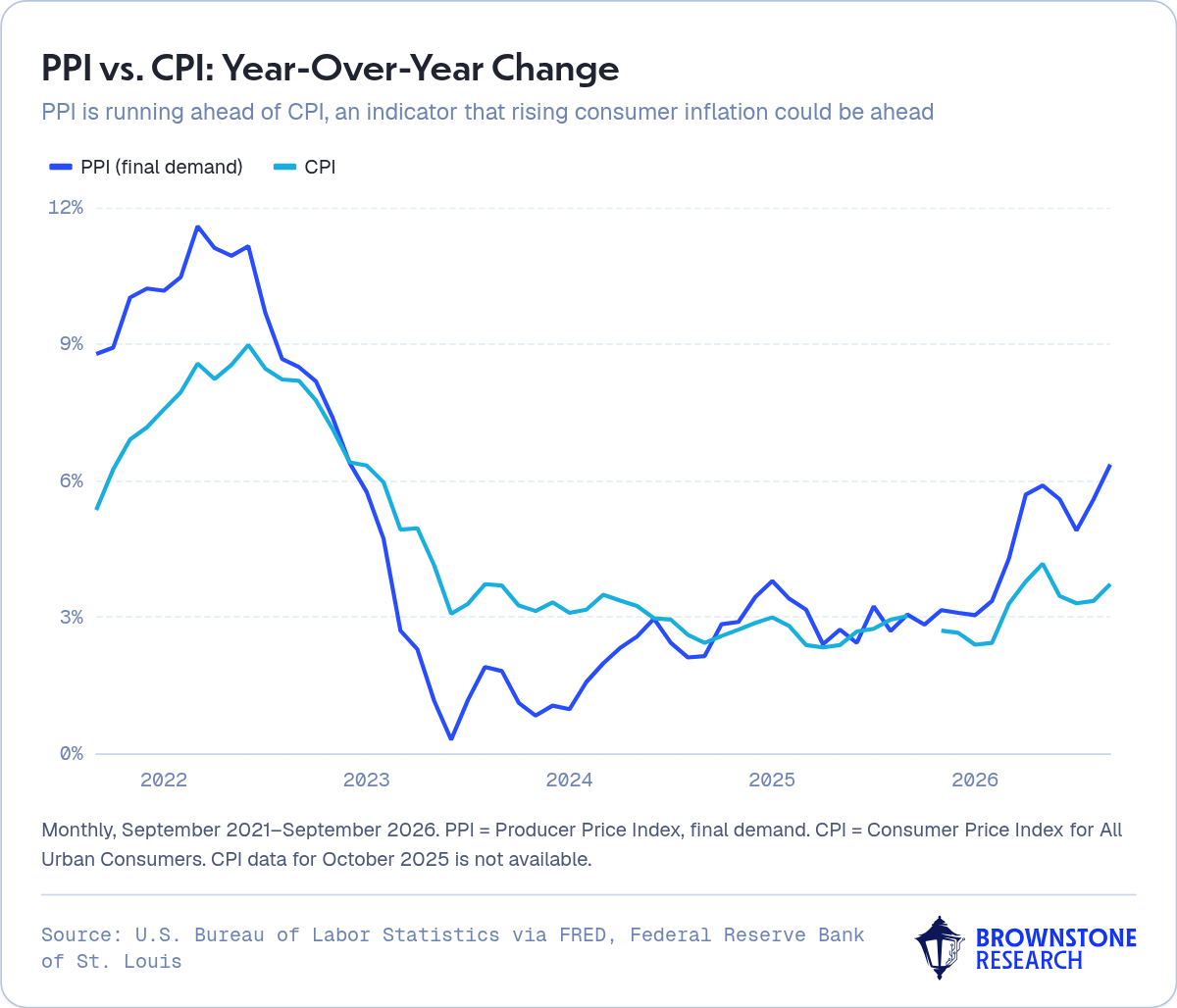
PPI has accelerated to the highest level since 2022 and often leads the CPI. That keeps the trend of higher inflation intact, which is a fundamental force that could push yields higher.
Bond prices are also nearing a key level, which we can track with the iShares 20+ Year Treasury Bond ETF (TLT) that tracks long-term bond prices. Here’s the TLT chart.
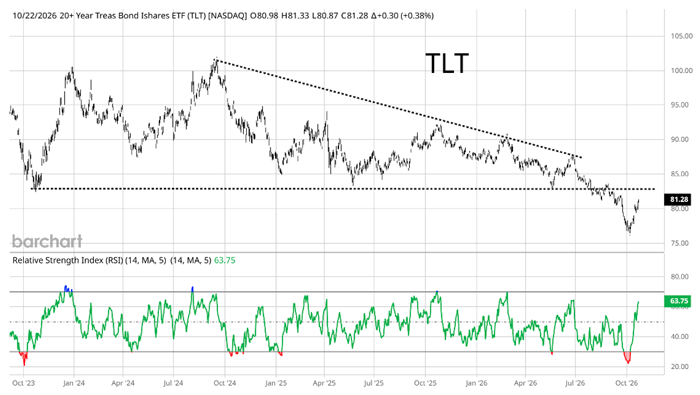
TLT broke down from a bearish descending triangle pattern that formed over several years, shown with the dashed lines. That breakdown coincided with the jump in bond yields. But the sell-off in bond prices got stretched too far with the Relative Strength Index (RSI) hitting the most oversold level in three years.
That sparked the relief rally in bond prices and the recent drop in yields. But that’s bringing TLT back toward a key level. Glance back at the chart and you can see that TLT is rallying back toward the breakdown level from the triangle pattern.
The $82–$83 price zone should now serve as a resistance area. You should also watch for the RSI to extend into overbought territory above the 70 level on any test of resistance.
With inflation pressures on the rise, that becomes a logical spot to watch for a reversal lower in TLT and for the sell-off in bond prices to resume.

The dream of every central bank critic could be coming true – we might actually end the Fed.
And if it happens, it won’t be by congressional decree. It will be because the proliferation of stablecoins, tokenized assets, and lending protocols makes the Fed’s tools obsolete.
The Fed’s power comes from the effectiveness of the transmission mechanism – the chain of cause and effect that produces a desired outcome.
If the Fed wants to tamp down inflation, it might hike its key rate. Because other rates key off it, longer-term rates should rise, too. Borrowing becomes more expensive. People do less of it. Inflation eases.
In theory, that’s the transmission mechanism.
But the Fed’s policies “work” only if the market listens.
What happens when the market ignores the Fed?
The European Central Bank (ECB) recently published a 73-page working paper called “DeFi-ying the Fed? Monetary policy transmission to stablecoin deposit rates.”

The authors pulled five years of data from Aave, the largest decentralized finance (DeFi) lending protocol, covering USDC, USDT, and DAI across its v2 and v3 versions on Ethereum. They then charted the rates against every Fed move from January 2021 to January 2026.
What they found should have been a bigger story.
Between March 2022 and July 2023, the Fed raised rates 11 times, a total of 525 basis points. DeFi rates went the other direction, falling from 2.5% to as low as 0.5%.
Then, between September and December 2024, the Fed cut rates by 100 basis points.
DeFi rates tripled, from 3% to 9%.
Put another way, for these assets, the Fed’s transmission mechanism looks broken. The Fed can do what it wants… digital assets aren’t listening.
So, if DeFi rates aren’t listening to the Fed, what are they listening to?
The gap between DeFi rates and Fed rates is highly correlated with the price of Bitcoin.
Borrowing climbs when traders expect Bitcoin and Ether to rise, because they borrow stablecoins to buy more. It falls when they expect losses, because they unwind their loans.
The paper’s own model has a variable for the expected return on risky crypto assets, and that variable, not the fed funds rate, dominates the short-run outcome.
They label this the “leverage channel” – a friction that can “delay, weaken, or even invert” the transmission of monetary policy.
We can think of it this way…
If the market thinks it can earn 10%, it will borrow at 8%… regardless of what the Fed does. The opposite is also true.
And while this phenomenon appears confined to digital assets, it will only become more prevalent as more assets become tokenized and move onchain. The paper hints at the consequences when it asks, “What would be the critical size of DeFi beyond which it would represent an interest rate controllability challenge?”
Translation: How long until central bankers lose control altogether?
Add Brownstone Research as your preferred source on Google to see our latest stories in your feed.
 Add as a preferred source
Read the latest insights from the world of high technology.
In South Korea, individual stock traders have an unusual nickname: gaemi, the Korean word for ants.

The GPUs are being deployed in a timely manner. What isn’t arriving fast enough is the electricity to power...