




AI Is Hungry
The GPUs are being deployed in a timely manner. What isn’t arriving fast enough is the electricity to power...


In South Korea, individual stock traders have an unusual nickname: gaemi, the Korean word for ants.

Editor’s Note: Jeff Brown has his eye on a “superchip” 50 times faster than Nvidia’s that he believes could shake up the AI race.
He’s getting into all the details in a morning broadcast next Wednesday, October 28, at 10 a.m. ET. You can go here to sign up to add your name to the guest list.

U.S.-based AI stocks have been volatile lately. And a big reason traces back to a surprising place – South Korea.
In South Korea, individual stock traders have an unusual nickname: gaemi, the Korean word for ants.
It’s fitting. Individually, an ant is tiny. But put millions together, all moving in the same direction, and they become a powerful force.
A lot of the money moved into Samsung and SK Hynix – two Korea-based companies that make up about half of the weighting in the KOSPI, the country’s benchmark index. Both are also key links in the global AI supply chain because they make high-bandwidth memory.
The KOSPI spiked, pulling even more money into leveraged ETFs. What’s crazy about leveraged ETFs is that they’re more than a 2x bet. As traders buy the ETFs, the issuer must buy more shares to maintain the 2x leverage it offers. That creates an upward feedback loop.
Fast-forward to early summer, when things turned bad. The unwind was fast and furious. As stocks dipped, the math for the leveraged ETFs flipped. The ETFs now had to sell stocks to maintain that 2x leverage. And selling big stocks such as SK Hynix and Samsung pushed the KOSPI even lower.
So what happened next?
This programmed selling triggered massive automated margin calls on millions of retail investors who had bought in with borrowed money.
I’ve said it before and I’ll say it again: Leverage feels great on the way up but horrible on the way down. Brokers forced an estimated $1.4 billion in liquidations to protect their loans. That set off a cascade that spilled into U.S. markets.
It got so bad that the International Monetary Fund (IMF) warned about excessive AI asset concentration. It called for global limits on AI leveraged derivatives and ETFs.
In late July, South Korean officials publicly apologized – something they rarely do. Earlier that month, regulators froze new leveraged ETF listings and tripled the cash deposit required to trade them.
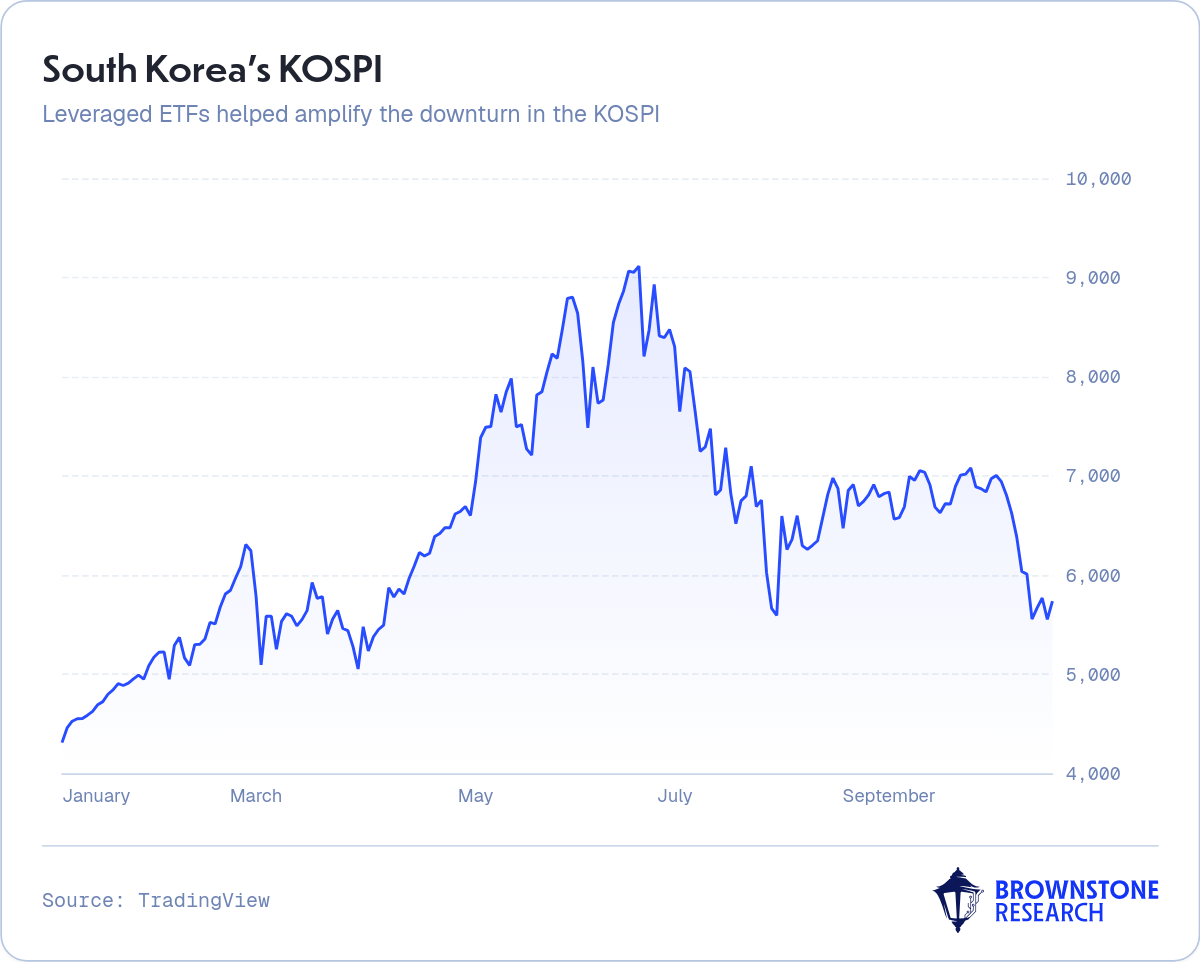
On October 13, the IMF sounded the alarm in its Global Financial Stability Report. It called out massive retail leverage as a potential trigger for a larger tech unwind. The authors pointed to Asian equity markets “that exhibit high betas to a proxy of global AI equity returns” as the most at risk.
Then, on October 15, the KOSPI plunged 7.57% in a single day. Circuit breakers tripped, and forced liquidations followed.
This is where Korea bled into the U.S.
Many U.S. hedge funds don’t just hold U.S. technology stocks. They also hold big positions in global leaders such as Samsung and SK Hynix. When those Korean stocks collapsed, fund managers faced steep losses. They use margin, too, and were forced to cut leverage.
That means you sell whatever you can, not what you want. And what you can sell is the biggest and best large- and mega-cap tech stocks.
You know the names. Nvidia, AMD, Broadcom, Marvell, Microsoft, Alphabet, Meta – all got smacked.
But keep some perspective…
Nvidia doesn’t suddenly sell fewer processors because someone in Seoul gets a margin call. Microsoft’s cloud infrastructure doesn’t disappear because a hedge fund needs cash. Broadcom’s networking technology doesn’t become less useful because traders dump semiconductor stocks.
Of course, these companies face real risks. Customers can cut spending. Competition can intensify. Earnings expectations can prove too optimistic.
But forced selling isn’t the same as deteriorating fundamentals.
The ants may have shaken the market, but they haven’t stopped the revolution.

The man who called the bottom of the 2020 crash to the day and recommended seven stocks that all went on to double is now unveiling his newest prediction for the stock market. An “AI Superchip” 50 times faster than Nvidia's could soon create a new order in the market. See his write-up and how you could make 10 times your money if you position yourself by October 28.
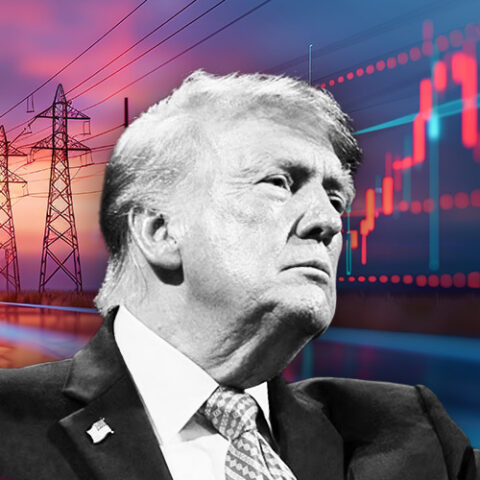
Jeff Brown is giving away the name and ticker of one stock – free. It’s a company behind a huge AI energy breakthrough… And it’s going public sometime this winter. President Trump is even expected to take a personal stake… You can claim a stake before it hits the open market. And Jeff Brown will give you the name of the stock, for free. Click here to get the free ticker symbol.

Long-term uranium prices just hit an all-time high, but you wouldn’t know it by looking at uranium stocks…
Uranium’s long-term contract price closed September at $96.50 a pound. That is the highest month-end reading in Cameco’s pricing data, which goes back to 1996.
The long-term price differs from the spot price, which is what most investors know. Spot is the price for near-term delivery, typically within a few weeks or months. So spot is driven mostly by one-off purchases from producers covering shortfalls and by traders speculating on the commodity.
The long-term contract is a whole ’nother beast…
This is the price utilities agree to pay for multiyear supply, with deliveries years in the future. That makes the long-term contract a good gauge of sustained, multiyear demand for uranium.
Why is this happening now?
As Nick Rokke covered last week, Google and Constellation Energy recently announced a 20-year agreement covering 890 megawatts of upgraded nuclear capacity, backed by more than $4.3 billion of investment. The goal is to help power Google’s AI data centers.
Utilities are returning to the market, too. Duke Energy (DUK) just issued a request for proposals for 400,000 pounds of uranium a year for five years. Not long ago, an order that size would have been filled within weeks.
Supply is the other half of the story.
Since 2020, the uranium price has roughly tripled, yet annual mine production has risen by only about 60 million pounds – mostly from restarts of idled mines. The United States produces less than 5% of the uranium it uses. And Russia supplied about 26% of the enrichment services U.S. reactors bought last year.
So massive new demand is slamming headfirst into supply that hasn’t kept up. You’d think uranium stocks would be soaring.
But they’re not…
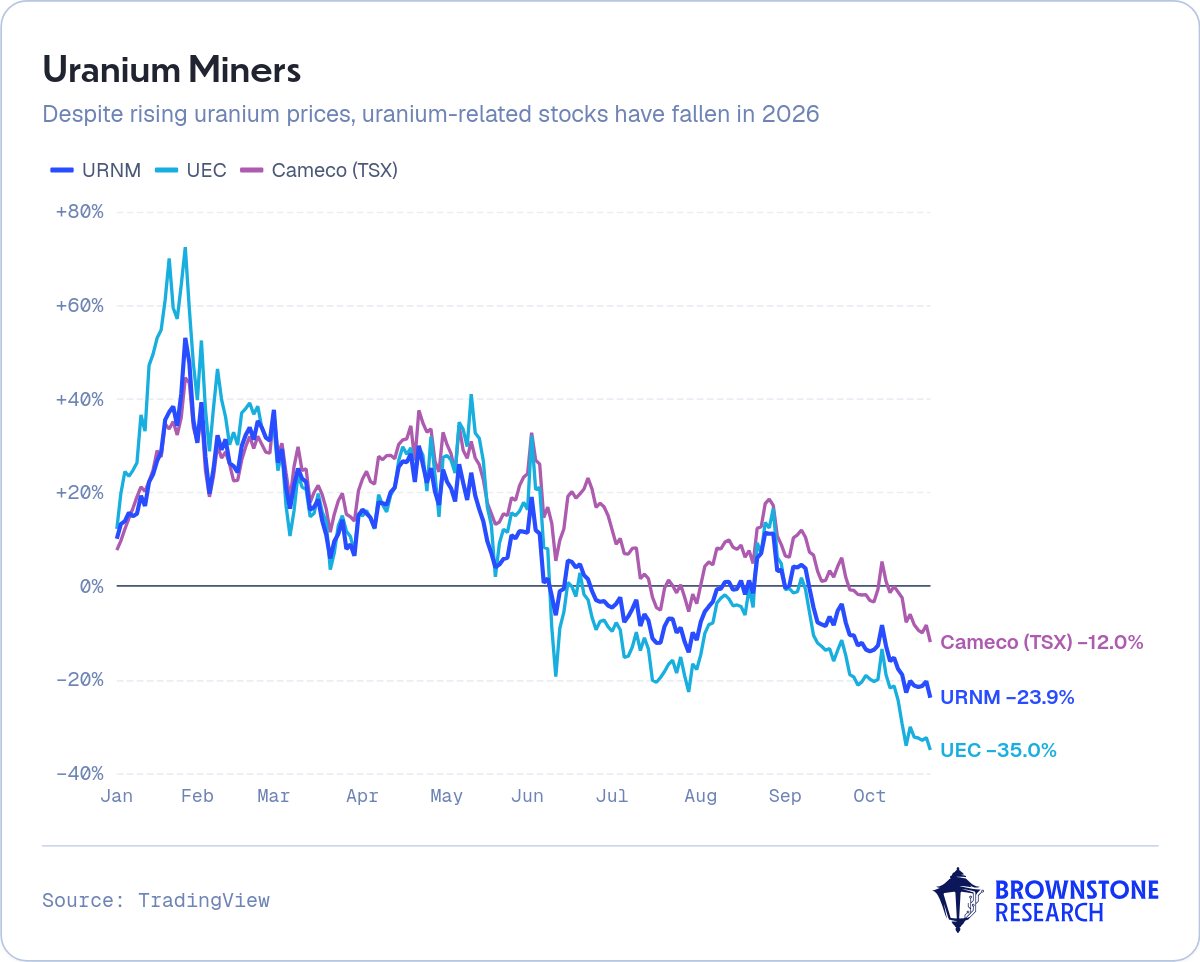
The Sprott Uranium Miners ETF (URNM) is down about 24% on the year. Cameco, one of the world’s largest uranium miners, is down about 12%. Uranium Energy Corp. (UEC) is the hardest hit – down about 35% in 2026.
What gives?
The answer starts with how miners get paid.
Most of Cameco’s uranium sells under long-term contracts signed years ago, at prices that don’t fully track the spot market. In the second quarter, Cameco’s average realized price was just $67.79 a pound, while uranium’s spot price traded in the mid-$80s.
Because of this, Cameco is also holding back supply, which it calls “contracting discipline.” That means lower revenue and earnings… which the market hates, even if it’s only temporary.
There’s also a timing mismatch.
TD Cowen’s line is that hyperscalers “need megawatts in 2027 rather than gigawatts in 2037.” In other words, new nuclear reactors won’t deliver power for at least several years. And as Jeff covered on Wednesday, these data centers simply can’t wait that long. So they’re turning to stopgap solutions such as natural gas turbines.
What does this mean for investors?
The commodity and the stocks are answering different questions. The record price of uranium says the market is tight. But uranium stocks won’t benefit from that tightness until previously signed contracts roll off the books.
This is a material gap in the market. When the commodity market prices one thing and the equity market prices another, that spells opportunity.
Uranium stocks aren’t going to close that gap overnight. But for patient investors, it’s only a matter of time before the uranium companies’ fundamentals catch up with the new market reality.

For decades, drug development has largely followed the same basic model: Recruit large numbers of patients, randomly assign them to an experimental treatment or a comparison treatment, and then determine whether the new medicine produces a statistically convincing benefit.
That approach works well for common diseases such as diabetes or high blood pressure, where thousands or even millions of potential patients are available. It’s much harder when a disease affects only a few hundred people worldwide. Now, the U.S. Food and Drug Administration (FDA) wants to fix that.
On October 14, the FDA launched its Rare Disease Framework Initiative, an effort to make rare-disease drug development more flexible and predictable.
While each rare disease may affect only a relatively small number of people, together these diseases create a massive problem.
About 30 million Americans live with one of thousands of rare diseases, yet only about 5% of recognized rare conditions currently have an FDA-approved treatment. Many rare diseases are serious and progressive, and many affect children, leaving families with few or no treatment options.
As I mentioned, one major problem is the small number of patients available for clinical trials.
Imagine a disease that affects only 500 people worldwide. Some may already be too sick to participate, others may be children, and patients may be scattered across dozens of countries. Running several traditional trials involving hundreds of people may be practically impossible.
Researchers may also know relatively little about how the disease naturally progresses, making it harder to define what a successful treatment looks like.
The FDA’s proposed framework aims to address these realities.
Regulators want to make greater use of innovative clinical-trial designs, new statistical methods, disease biomarkers, and other forms of scientific evidence when traditional trials aren’t realistic.
The agency also wants patients and families involved earlier in drug development because they can help regulators understand which symptoms matter most. And they can help gauge what level of risk may be acceptable when a disease is severe and no effective treatment exists.
Outside disease experts may play a larger role when FDA reviewers evaluate extremely uncommon conditions.
The initiative could also change how the FDA approaches manufacturing.
Gene therapies and other rare-disease medicines can be extraordinarily complicated and expensive to produce, particularly when the eventual patient population numbers only in the hundreds or thousands.
The FDA says it wants to use more risk-based approaches to manufacturing reviews and inspections while still requiring companies to show that their products are consistently made and safe for patients.
But this does not mean the FDA is abandoning its standards or promising easier approvals.
Companies will still need convincing evidence that their medicines are safe and effective. The change recognizes that convincing evidence may look different depending on the disease.
A treatment for millions of patients can reasonably be tested differently from a therapy for a genetic disorder affecting only a few hundred children.
The broader significance can be substantial.
Modern science is identifying the genetic causes of more rare diseases and creating technologies such as gene therapy, RNA medicines, and gene editing that may finally make some of them treatable.
But scientific progress matters little if the regulatory system can’t realistically evaluate those treatments.
The FDA’s new initiative seeks to bring regulatory rules closer to the realities of rare diseases while preserving the basic requirement that new medicines actually help patients.
Add Brownstone Research as your preferred source on Google to see our latest stories in your feed.
 Add as a preferred source
Read the latest insights from the world of high technology.
The GPUs are being deployed in a timely manner. What isn’t arriving fast enough is the electricity to power...


There’s one metal named in the procurement rules that hasn’t seen a major deal…yet.