




Bessent Finds His Buyer
Fortunately for Bessent, there’s one group of buyers with a voracious appetite for short-term U.S. debt.



There’s one metal named in the procurement rules that hasn’t seen a major deal…yet.


A major deadline is looming, and it could change the face of global trade…
On January 1, 2027, new Department of War (DoW) procurement rules go into effect. The policy restricts the purchase of several critical metals such as rare earths and tungsten from nations including Russia, Iran, and China.
That last name is the most important…
Currently, China supplies nearly 70% of the world’s rare earths and almost 80% of its tungsten. And in just a few months, that will be cut off from America’s defense supply chain. This looming deadline is a big reason we’ve seen several massive deals for critical metals recently.
In July 2025, MP Materials (MP) – the owner of America’s only operational rare earths mine, Mountain Pass – signed a multibillion-dollar commitment with the DoW. The agreement included a $150 million loan to expand MP’s facilities, a 10-year commitment from the DoW to purchase 100% of the company’s magnet production, and a $400 million equity investment to boot.
Then, just last month, another deal was signed covering tungsten.
DoW announced a purchase agreement with a tiny company in Lewiston, Maine, called The Elmet Group (ELMT). The department said it will buy up to $2 billion worth of tungsten metal to feed defense applications such as tank armor and rocket components. It also committed $450 million to restart an idled tungsten mine in Nevada, which will supply ore to feed Elmet’s manufacturing operations.
It’s not a coincidence that the very metals singled out in the new procurement rules are the ones now seeing multibillion-dollar deals. But there’s one metal named in the procurement rules that hasn’t seen a major deal…yet. That would be tantalum.
Tantalum is extremely heat-resistant, melting at temperatures above 3,000 degrees Celsius (just under 5,500 degrees Fahrenheit) – nearly triple the temperature needed to melt gold.
That makes tantalum ideal for high-temperature defense applications such as rockets and jet engines. It’s also used in important tech components such as temperature-regulating capacitors in data centers.
But unlike rare earths and tungsten, America has virtually no tantalum supply within its borders. In fact, the metal is only found in a few places on Earth, with 85% of supply coming from Africa.
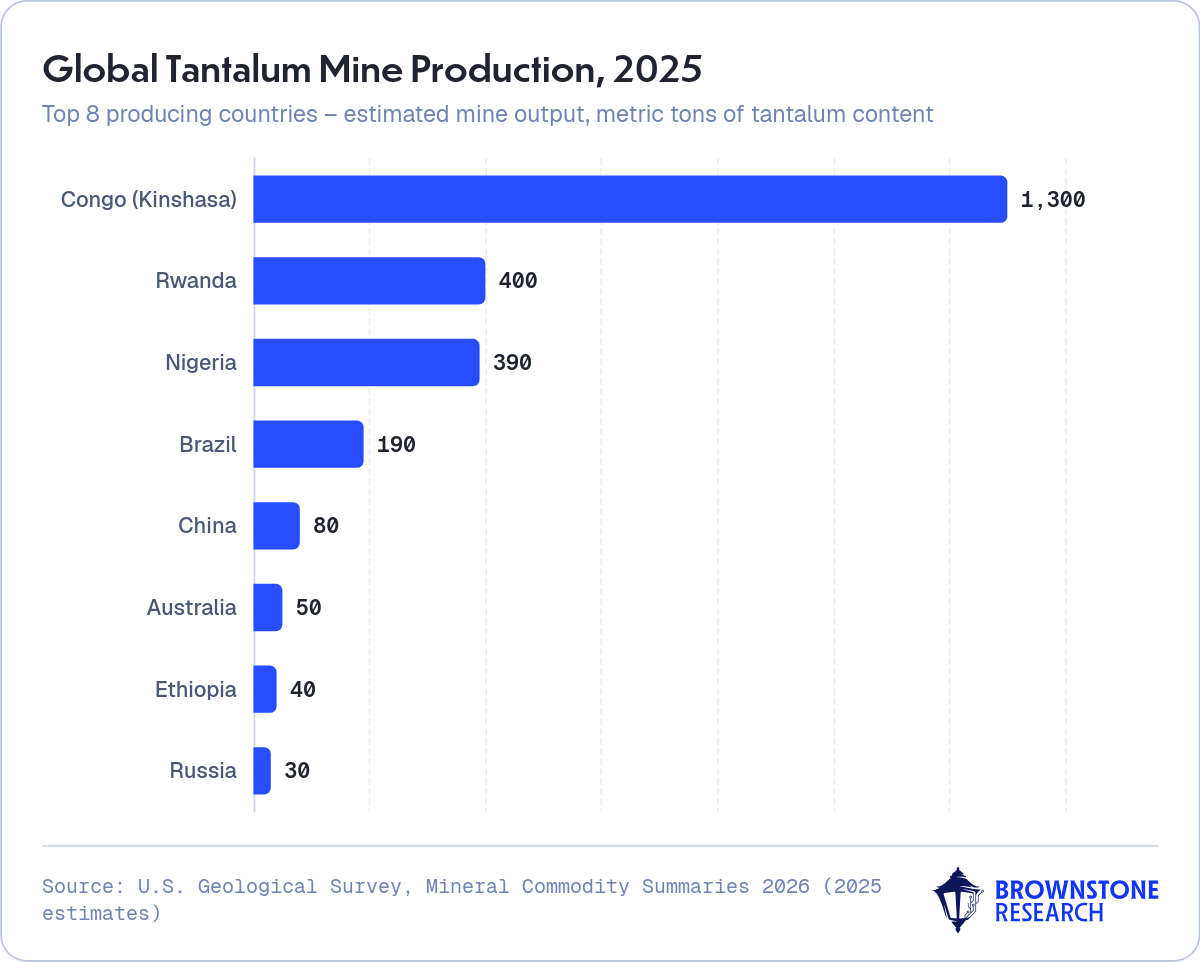
The difficulty with African tantalum is that production is spread over countless mines, many of which are small operations run by local miners. Also, many of Africa’s tantalum-mining districts are rife with conflict, especially the Democratic Republic of Congo. Those conflicts have forced Western buyers to steer clear of Africa’s “blood” minerals.
And that leaves only one option – Brazil.
Brazil’s critical metals have been a major target for U.S. government funding. The Trump administration has been pushing to make Brazil a major part of its Project Vault strategy. In February 2026, White House officials told a press briefing that Brazil was “an essential partner in critical minerals.”
All this matters because Brazil is in the midst of a presidential election. As I write, Flávio Bolsonaro is expected to defeat incumbent Luiz Inácio Lula da Silva when voters go back to the polls on October 25.
Bolsonaro has said he favors closer ties with America and cooperation on critical minerals deals. His election would cement Brazil as a go-to critical minerals supplier…and likely lead to a multibillion-dollar agreement for tantalum.
By the end of this month, Elon Musk is about to shock the world again. He’s predicting this NEW opportunity will be 180 times bigger than the SpaceX IPO… And will unleash enough wealth to make every household in America $2.38 million. Click here now.

He’s been waiting four years for this moment… and it’s finally here…
Jeff just revealed this huge AI secret, and it could have huge implications for your wealth, starting this coming Tuesday, October 20.
Click here to see the details.
The AI trade has been bruised…
First came OpenAI’s revenue miss. The company reported an annualized run rate of $50 billion. That was about $20 billion short of previous analyst estimates for up to $70 billion.
The difference is being blamed on an accounting discrepancy, but it scared investors into second-guessing the return on AI infrastructure spending.
Then came comments from the CEOs of Broadcom and Intel, both of whom have a front-row seat to AI infrastructure spending. They both sounded the alarm on another AI bottleneck – capital.
The jump in interest rates around the world is making capital more expensive at a time when AI projects are increasingly being funded with debt.
Broadcom CEO Hock Tan said “what I think might be the biggest constraint is capital” at a recent event in Singapore.
That bottleneck could get worse going forward…
On Wednesday, we got the latest reading of the Consumer Price Index (CPI). The reading showed consumer prices rising 3.7% year over year. That was higher than the expected 3.6%. The much-watched core CPI printed 2.6% year over year. Again, above estimates of 2.5%.
The very next day, we got the latest data from the Producer Price Index (PPI), and it was downright hot.
The PPI isn’t as familiar as the CPI. As the name suggests, it tracks prices for the companies delivering the products and services that are measured in the CPI. It’s often a leading indicator of consumer inflation as these rising producer prices eventually end up on store shelves.
Topline PPI was 6.3% year over year against estimates of 5.3%. Core PPI increased 5% over the past year. Estimates were between 4.4% and 4.6%.
All else equal, rising inflation leads to rising rates…leads to expensive debt…and the AI capital bottleneck gets worse.
As you might expect, AI-related stocks didn’t take the news well. The VanEck Semiconductor ETF (SMH) is down nearly 15% in just nine trading sessions.
But the sell-off could be setting up a mean-reversion trade in the most beaten-up names…and a rebound in one country ETF that’s exposed to it all.
The iShares MSCI South Korea ETF (EWY) has become a proxy for the AI trade. That’s because of two companies held in the ETF: Samsung Electronics and SK Hynix.
Both companies supply high-bandwidth memory and specialized DRAM chips used in AI processors. Surging demand is pushing revenues and earnings higher. Their market valuations have followed along, with the companies making up a combined 45% weighting in EWY.
As the AI trade goes, so goes EWY.
Here’s the chart:
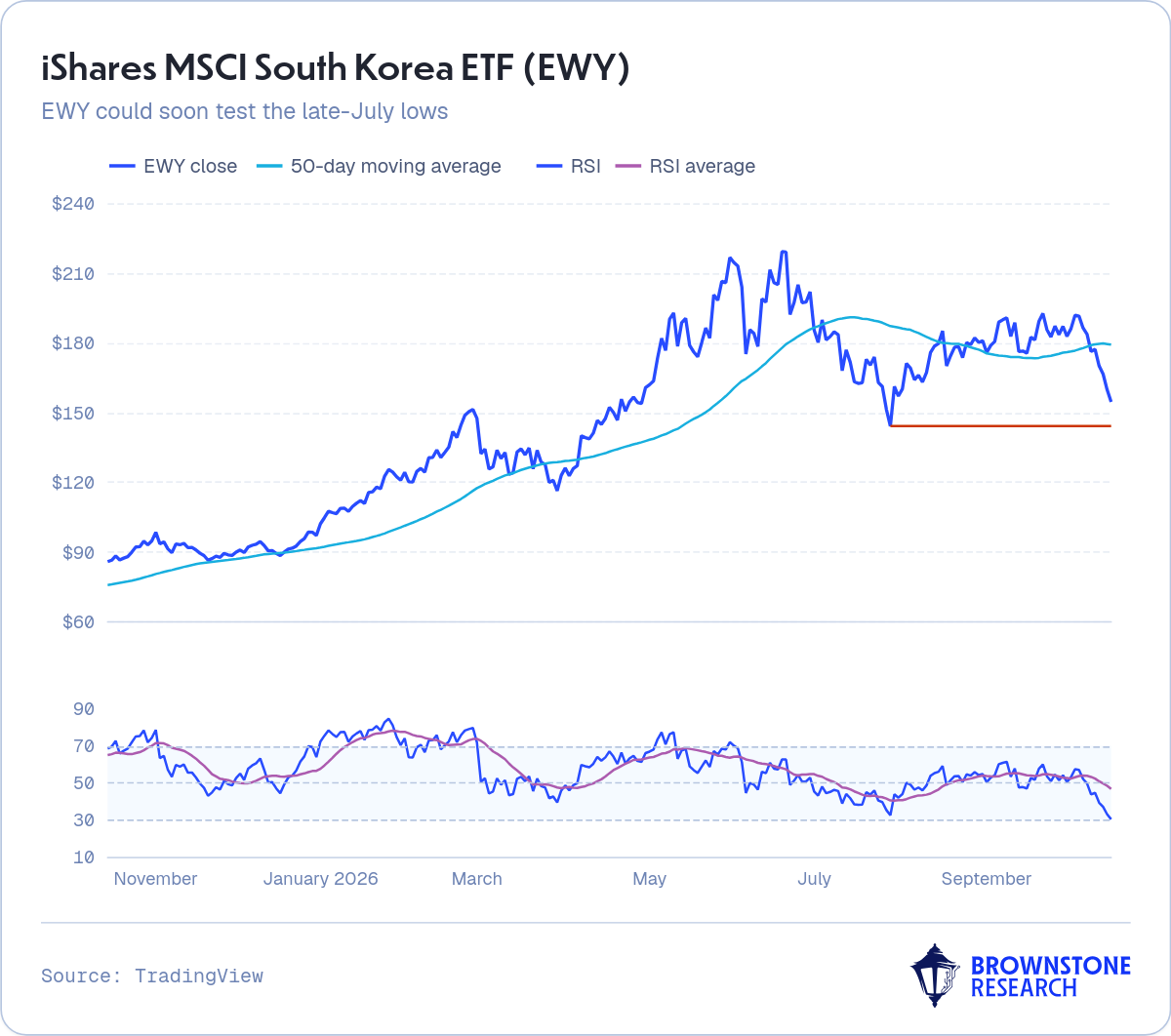
EWY started off the year on a tear. The ETF gained 125% on the year through June before pulling back. Following a low and rally since the end of July, EWY is dropping with the rest of the chip sector and is down 20% since the start of October.
But there are signs that the down move has gone too far while price support comes into play. EWY is extended 15% below its 50-day moving average (MA – blue line) while the Relative Strength Index (RSI) is hitting the lowest level since April 2025. Both conditions show EWY is extremely oversold and could snap back higher.
At the same time an oversold condition is emerging, price support from the lows in late July is coming into view. You could structure a trade by buying EWY at these levels and placing a stop loss just beneath the July lows around $140. That’s about 9% downside from current levels.
If a rebound sends EWY back to test the 50-day MA like the move off the July low, that’s 17% upside.
The AI trade may have taken a beating lately…but there are always trading opportunities if you know where to look.

As Clint just covered, the AI trade was bruised recently. And higher borrowing costs derailing the AI buildout is a big concern. One company feeling the sting of higher rates is CoreWeave.
The company rents AI chips to customers and funds much of its growth with debt. Some bonds issued in April at a 9.75% interest rate now trade near 80 cents on the dollar, with yields above 15%.
That does not mean the interest rate on those bonds has jumped to 15%. CoreWeave still pays the 9.75% coupon. It means investors demand a higher return to own them. The value of those bonds has fallen, which boosts the yield.
This could make new borrowing more costly. A project funded with more expensive debt needs a higher level of profitability to cover interest. If the numbers no longer work, an operator may have to scale back.
The fear then spreads.
If CoreWeave builds fewer data centers, could orders shrink for Nvidia (NVDA), AMD (AMD), and their suppliers? It’s a fair question. But one heavily indebted borrower does not set the budget for the entire AI industry. And for businesses flush with cash, this could actually work in their favor.
The hyperscalers – Amazon (AMZN), Google (GOOGL), Meta (META), and Microsoft (MSFT) – have established businesses helping fund their expansion. Microsoft alone generated nearly $183 billion in operating cash flow in its fiscal year ended June. It spent $116 billion on property and equipment and still had roughly $67 billion left. That leaves it far less reliant on new borrowing.
And the high levels of operating cash flow lead to different borrowing terms. Alphabet raised $3.5 billion through five-year bonds at a fixed 4.875% interest rate. For some context, the five-year U.S. Treasury yields about 4.9% as I write. That implies Alphabet is as creditworthy as the U.S. government itself.
Higher rates matter. But these companies have far more room to keep building than the headlines suggest. The investment case does not depend on a return to near-zero interest rates. It depends on these companies earning strong returns from the capacity they add.
Demand tells the same story. Microsoft’s latest report showed Azure revenue up 43% year over year, with customers still needing more capacity than it could supply. That gives it a reason to keep investing.
This week, ASML (ASML) and Taiwan Semiconductor Manufacturing (TSM) reinforced the message. ASML raised its sales outlook and said customers want to place orders for 2029 and 2030. TSMC reported 41% revenue growth in U.S. dollars. I’ll cover those results next week.
This is nothing more than a shakeout. It’s Wall Street’s way of using fear, uncertainty, and doubt (FUD) to cause a quick drop in share prices. And that volatility can shake individual investors out before the next leg higher… and let the institutions get a better cost basis on new purchases.
We should remain focused on strong businesses and the infrastructure AI needs. I believe the long-term opportunity remains intact. And patient investors who own those companies will continue to profit.
Add Brownstone Research as your preferred source on Google to see our latest stories in your feed.
 Add as a preferred source
Read the latest insights from the world of high technology.
Fortunately for Bessent, there’s one group of buyers with a voracious appetite for short-term U.S. debt.

Stocks were climbing out of bear territory, but then the bond market spoke up.

These factories will cost billions before even a single working chip is produced…