



The Next Target of “Project Vault”
There’s one metal named in the procurement rules that hasn’t seen a major deal…yet.


We sweated through summer. Now we shiver.
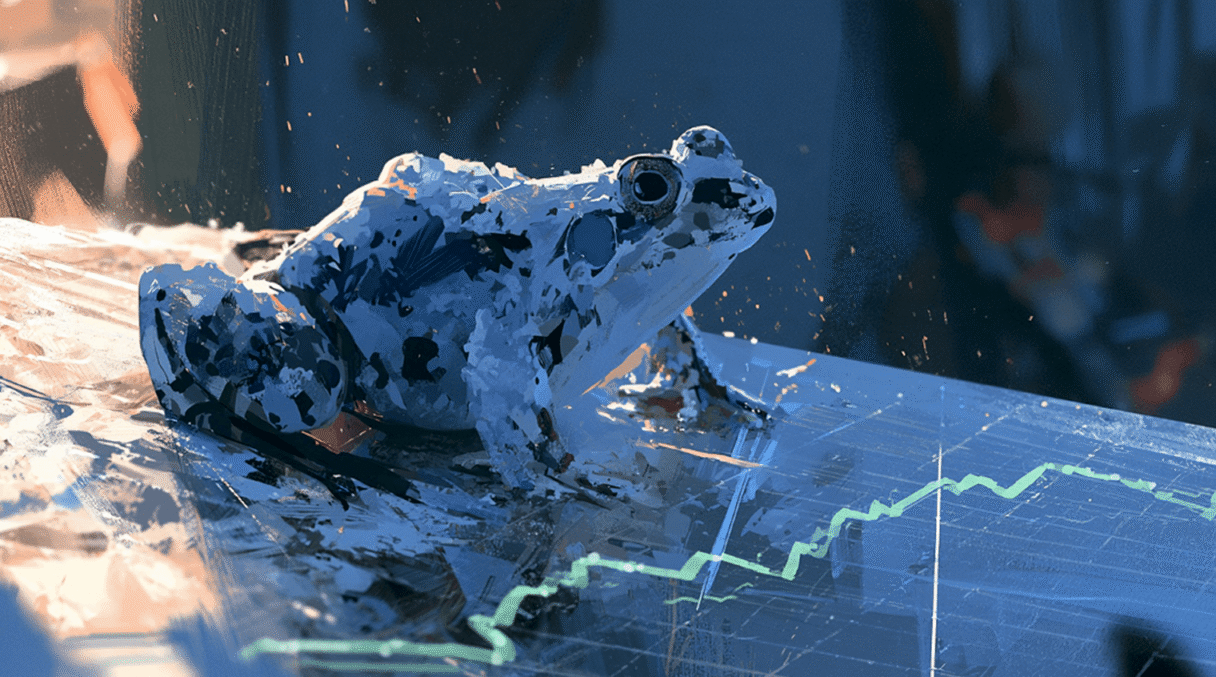

Each fall in Alaska, the wood frog lets itself freeze. Up to 60% of its body turns to ice and its heart stops. Pretty much dead, it can stay that way for seven months. But first it goes through 10 to 15 freeze-and-thaw cycles. Each one builds up glucose that works like antifreeze. Come spring, its heart starts again.
The market has been playing frozen frog all summer.
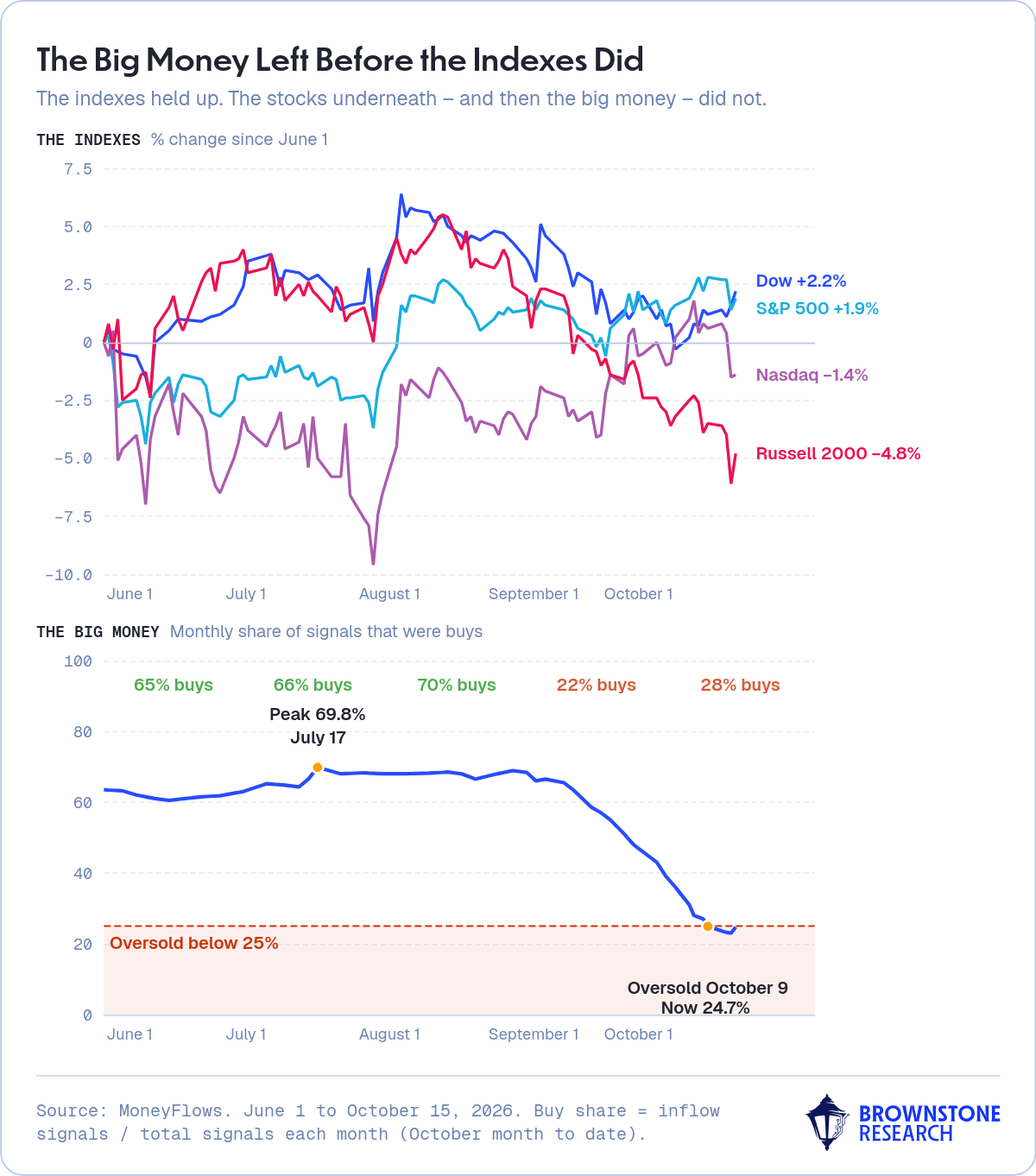
Since June 1, the S&P 500 is up 1.9%, sitting within 1% of its October 6 record. The Dow is up 2.2%.
Underneath, however, it’s been frozen. The Russell 2000 is down 4.8% since June 1. Of the roughly 5,300 stocks we track, 56% haven’t made a new 52-week high since July 1. And 50.8% are in a bear market, down 20% or more from their highs.
Even this year’s leaders cracked. The big chip and AI hardware names peaked in late June and have since fallen 23% to 42%. Now 90% of chip equipment stocks are in a bear market, even though the group is still up a median 65% this year.
The flows add a twist. Big money kept buying all summer. In June, July, and August, inflows made up 65% to 70% of our unusual-activity signals. Then September hit, and big money pulled the handbrake. Inflows fell to just 22% of signals, the worst month of the year.
Two things are controlling that handbrake.
The first is rates. Wednesday’s CPI report came in hot. In Thursday’s report, producer prices rose 6.3% from a year ago. The 10-year Treasury yield hit about 5.19% before easing to 5.085%. Traders now see a Fed rate hike in two weeks as close to a coin flip.
Higher rates squeeze borrowers. FINRA margin debt hit a record $1.50 trillion in June, then fell $84.8 billion in July, the biggest monthly dollar drop on record, as hedge fund Situational Awareness faced margin calls. It bounced 2.6% in August to $1.45 trillion. Borrowed money sells early to avoid margin calls.
The second thing holding the handbrake is the midterm election on November 3. Prediction markets give Democrats a 63% chance of sweeping both chambers. A Republican Senate with a Democratic House sits at 29%. A Republican sweep is just 9%.
History says getting the election behind us matters more than who wins. I looked at every midterm since 1990. The S&P 500 was higher six months, nine months, and one year later every time.
The average one-year gain was 14.8%. That includes 2006, when Democrats took both chambers under a Republican president (+6.9%), and 2018, when they took the House (+12.4%).
Like our frozen frog, the market had to go through its ugly cycles first. The summer fade, the September flush, and last week’s deleveraging look like damage, but they’re building antifreeze.
We sweated through summer. Now we shiver. But the thaw is coming.

Elon Musk is on record predicting this new opportunity is set to be 180 times bigger than the SpaceX IPO. That IPO minted 4,400 millionaires overnight. If this is 180 times bigger… Just imagine how many more Americans will become millionaires. Will you be one of them? Click here now.
A drilling crew near the Grand Canyon just confirmed what the International Energy Agency calls enough energy to meet global electricity demand 140 times over. Google signed a 15-year deal, and Bill Gates wrote a $100 million check. On October 20th, Washington hands this resource an edge no other energy source has. One company sits at the center. Get the name before October 20th >>

Six years. Eleven nuclear reactors. Three states. More than $4.3 billion in investment.
That’s what it will take for Constellation Energy (CEG) to squeeze another 890 megawatts of generating capacity out of its nuclear fleet. After all that work, the additional capacity will amount to less than a single gigawatt… roughly the output of one large nuclear reactor.
Google is helping make it happen through a 20-year power purchase agreement. And even though the first power increase won’t happen for about two years, this is one of the faster ways to add nuclear power.
Google says upgrading these plants can deliver new capacity years sooner than building a reactor from scratch. Even with that head start, the work will stretch into the next decade.
That tells us hyperscalers need much more power for their AI data centers than we are currently generating and planning to add.
Tech companies can design more powerful chips, develop better models, and commit trillions of dollars to data centers. But those facilities cannot earn the revenue their owners expect until the electricity arrives.
The deal, announced October 6, supports upgrades at 11 nuclear units in Illinois, Pennsylvania, and New Jersey. The industry calls these projects “uprates.” They improve equipment such as turbines, steam generators, and control systems so an existing plant can produce more electricity.
Google’s role is to serve as a long-term customer. Its commitment to buy power gives Constellation the revenue certainty needed to invest billions in the work. In return, Google helps secure the dependable electricity its growing business needs.
The companies also signed a separate 15-year agreement covering 2,700 megawatts from existing generation. That helps secure access to power, but it does not add another 2,700 megawatts to the grid.
That brings the two agreements to a combined 3,590 megawatts, with only 890 megawatts of expanded capacity.
As the AI industry grows, signing contracts for existing electricity will only take us so far. We need to produce more of it.
Right now, the power source of choice for data centers needing electricity immediately is natural gas. But this is still a fossil fuel and produces some carbon emissions. Plus, the lead time for large natural gas turbines is reaching five years.
Meeting the power needs requires a mix of generation, storage, and grid equipment. Nuclear is valuable because it can provide large amounts of steady output with low operating emissions.
The opportunity extends to the businesses that supply and support these power projects.
More generation requires turbines, plant upgrades, maintenance, and fuel. Delivering that power requires transformers, substations, switchgear, and transmission lines.
This is why electricity infrastructure is a long-term investment theme. The growth of AI creates physical needs that must be met before the technology can reach its full commercial potential.
Google’s agreement is a major step forward.
Its cost and timeline also show how much more investment lies ahead.

Recently, I shared the news of Karl Deisseroth, Peter Hegemann, and Georg Nagel receiving the 2026 Nobel Prize in Physiology or Medicine. Their pioneering work on optogenetics more than earned that recognition.
But there’s one more pair of Nobel laureates who are worth knowing about. As I’ll show you, their work could have far-reaching implications for biotechnology and life sciences.
The 2026 Nobel Prize in Chemistry was awarded to French chemist Henri B. Kagan and Japanese chemist Kenso Soai. The two helped solve one of chemistry’s oldest puzzles: why molecules that can exist in two mirror-image forms often end up favoring just one.
Specifically, their focus was on “non-linear effects and autocatalysis in asymmetric organic synthesis.” That sounds complicated. But the concept is actually simple… and enormously important for biology and medicine.
Many molecules come in two versions that resemble our left and right hands. They contain exactly the same atoms connected in exactly the same way, but their three-dimensional shapes are mirror images.
Chemists call these molecules “enantiomers.” In an ordinary laboratory reaction, both versions may be produced in roughly equal amounts.
But living organisms are different.
The amino acids used to build our proteins overwhelmingly favor one version, while biological sugars favor another.
This preference, called “homochirality,” has puzzled scientists for more than a century.
Kagan made an important breakthrough in 1986. Scientists had assumed that if a catalyst contained only a small excess of one molecular “hand,” the product should show roughly the same small excess.
Kagan demonstrated that this was not always true. Chemical interactions could amplify that small advantage, producing much more of one enantiomer than expected. In other words, chemistry could take a slight imbalance and make it much larger.
Soai went even further. He discovered a remarkable type of reaction called “asymmetric autocatalysis,” in which the product of a reaction helps make more copies of itself.
Even more importantly, the favored molecular version becomes increasingly dominant with each cycle. Later versions of the reaction showed that an almost unimaginably tiny initial imbalance could eventually produce material that was more than 99% “one-handed.”
It’s the chemical version of a small snowball rolling downhill and becoming an avalanche.
Here’s why all of this matters for biotech and medicine…
Our enzymes and drug receptors are three-dimensional and themselves chiral, so two mirror-image versions of the same drug can behave differently inside the body.
One may provide the desired treatment while the other may be weaker, be inactive, or produce different effects.
Modern drug developers carefully control and test molecular “handedness” rather than treating two enantiomers as automatically equivalent.
For biotechnology companies developing small-molecule medicines, this chemistry influences both drug discovery and manufacturing.
Researchers must determine which three-dimensional version of a potential drug interacts best with its biological target, while process chemists need efficient methods to manufacture that form at large scale and high purity.
Kagan’s discoveries helped chemists understand how asymmetric catalysts can amplify selectivity, while Soai showed just how powerful molecular self-amplification can become.
These new discoveries could help chemists control reactions in the laboratory and allow pharmaceutical companies to make safer and more precise medicines.
What began as a fundamental question about molecular symmetry has become part of the foundation of modern medicinal chemistry.
It’s just one more bit of evidence that we truly are living through a golden age for biotechnology.
Add Brownstone Research as your preferred source on Google to see our latest stories in your feed.
 Add as a preferred source
Read the latest insights from the world of high technology.
There’s one metal named in the procurement rules that hasn’t seen a major deal…yet.
Fortunately for Bessent, there’s one group of buyers with a voracious appetite for short-term U.S. debt.

Stocks were climbing out of bear territory, but then the bond market spoke up.