




AI Is Hungry
The GPUs are being deployed in a timely manner. What isn’t arriving fast enough is the electricity to power them.

From The Editor
Editor’s Note: A sea change is coming for AI…
That’s the message from Jeff Brown. He believes a new “superchip” 50 times faster than Nvidia could shake up the AI race in ways few are predicting. If he’s right, certain stocks could crash while others soar higher.
To share his entire investment thesis, Jeff is going live on Wednesday, October 28 with an important strategy session. You can learn more right here.
In this issue
01
Going “Behind the Meter”
Jeff Brown
02
Taiwan Semis Continues to Surge
Nick Rokke
03
Bitcoin’s Biggest Buyers Have Left the Building… for Now
Ben Lilly
Going “Behind the Meter”

Jeff Brown
Founder and CEO
For the first few years of the race, the story of artificial intelligence was a story about graphics processors.
Who could get enough of Nvidia’s GPUs to train a superior AI model, and who couldn’t?
That’s no longer the binding constraint.
The GPUs are being deployed in a timely manner. What isn’t arriving fast enough is the electricity to power them.
Connecting a new large data center to the power grid now routinely takes at least five years. And there have been reports of tech companies being told that new grid connections would take up to eight years to complete.
Meanwhile, America’s top AI companies are operating on a completely different timeline.
For starters, AI model generations are now turning over in a matter of months. Every second counts.
Plus, it is enormously expensive to have a data center sitting idle. Industry estimates put the cost of just a one-month delay at $20 million to $25 million for every 100 megawatts of computing capacity. That’s factoring in lost revenue, construction costs, and penalties.
This is a structural and fundamental industry bottleneck.
Demand for AI compute compounds on a 12-month cycle. But the supply of grid power expands on a multiyear cycle. No amount of money closes that gap.
That’s why the largest technology companies on Earth are doing something they never needed to do before. They are going “behind the meter.”
In other words, they are generating their own electricity on site, right next to the data center instead of drawing it from the utility grid.
Meta (META) described this shift in plain terms. Management said that the company would prefer to use the power grid… but it cannot wait. On-site power generation is the only way to remain competitive in today’s landscape.
The numbers are getting very large, very quickly.
Capital expenditures (capex) on AI infrastructure from large technology companies are projected to climb from $390 billion in 2025 to more than $1.2 trillion in 2027. That’s a 3x increase in just two years.
And one industry research firm estimates that U.S. data centers will have 25 to 30 gigawatts of behind-the-meter generation installed by 2030. For perspective, that’s roughly the output of 25 to 30 large nuclear reactors… and almost none of it existed three years ago.
As a result, lead times for new industrial gas turbines have exploded. For one popular turbine model, the wait went from about 24 months in late 2025 to more than 41 months this summer.
And some manufacturers are now quoting more than four years’ lead time. In other words, if a hyperscaler decided today to buy its own turbines, it might not get them until 2030.
Simply put, the companies that will win this phase of the AI buildout are the ones that can continue to scale their power capacity.
Recommended Links

Announcing the '$20 Supercomputer'
Beginning on October 28, a radical new form of AI could handle everyday tasks for millions of people and send one California company up 1,000%. Hailed by Nvidia's CEO as "the new computer," this AI agent could book your appointments, fight your insurance-claim battles, and more. A new AI superchip 50 times faster than Nvidia's could dominate the story. Find the full details here.

Live… From Inside Cybercab
I’m about to get into this Cybercab… and it’s going to take me to what Elon Musk called… “The most epic AI project ever.” Click here and come with me on this ride… Because this is all part of Elon Musk’s $320 trillion masterplan.
Taiwan Semis Continues to Surge

Nick Rokke
Senior Analyst
Contrary to what many believe, semiconductor companies such as Nvidia (NVDA) and Advanced Micro Devices (AMD) don’t make their own chips.
Of course, these companies design their own products. But the task of manufacturing the finished chip falls to semiconductor fabricators. And in the world of chip fabs, no company is more important than Taiwan Semiconductor Manufacturing (TSM).
Taiwan Semis commands about 90% of the market for advanced semiconductors. For that reason, the company’s earnings are a useful barometer for global chip demand. And the company’s recent earnings show that demand isn’t slowing.
Last month, the company reported August revenue growth of 53.3% from a year earlier. Sales also rose 10% from July.
That is an impressive pace for the world’s leading contract chipmaker. And its expansion plans suggest that management is preparing for years of demand ahead.
Reports surfaced late last month that TSM is evaluating a second U.S. campus, potentially near Dallas. The reported plan calls for six advanced chip factories, with an investment that could exceed the $265 billion planned for Arizona.
The board has not approved the project, but the direction is clear. TSM wants to build more advanced chips in the United States. Its long-term goal is to locate 30% of its leading-edge capacity here, reducing its reliance on production in a single region.
The company is also moving ahead in Taiwan. TSM recently completed development and validation of its A16 manufacturing process. In September, the Central Taiwan Science Park Bureau confirmed that TSM is accelerating the second phase of its expansion there, with A14 production expected to begin in the second half of next year.
A14 is TSM’s next generation of 1.4-nanometer chip technology. These advances are designed to deliver more computing power while using less energy. Both are essential as AI systems grow larger and electricity becomes a greater constraint.
TSM continues to invest in both the technology and the factories required to meet years of heightened demand. That tells us the AI trend may have stalled in recent weeks, but the run is likely far from over.
Bitcoin’s Biggest Buyers Have Left the Building… for Now

Ben Lilly
Senior Crypto Analyst
Bitcoin’s biggest buyers have left the building… for now.
Digital assets looked poised for a historic fourth-quarter rally after the SEC and CFTC provided the industry with new regulations last month.
Then the calendar flipped to October and the market ran headfirst into a wall of selling.
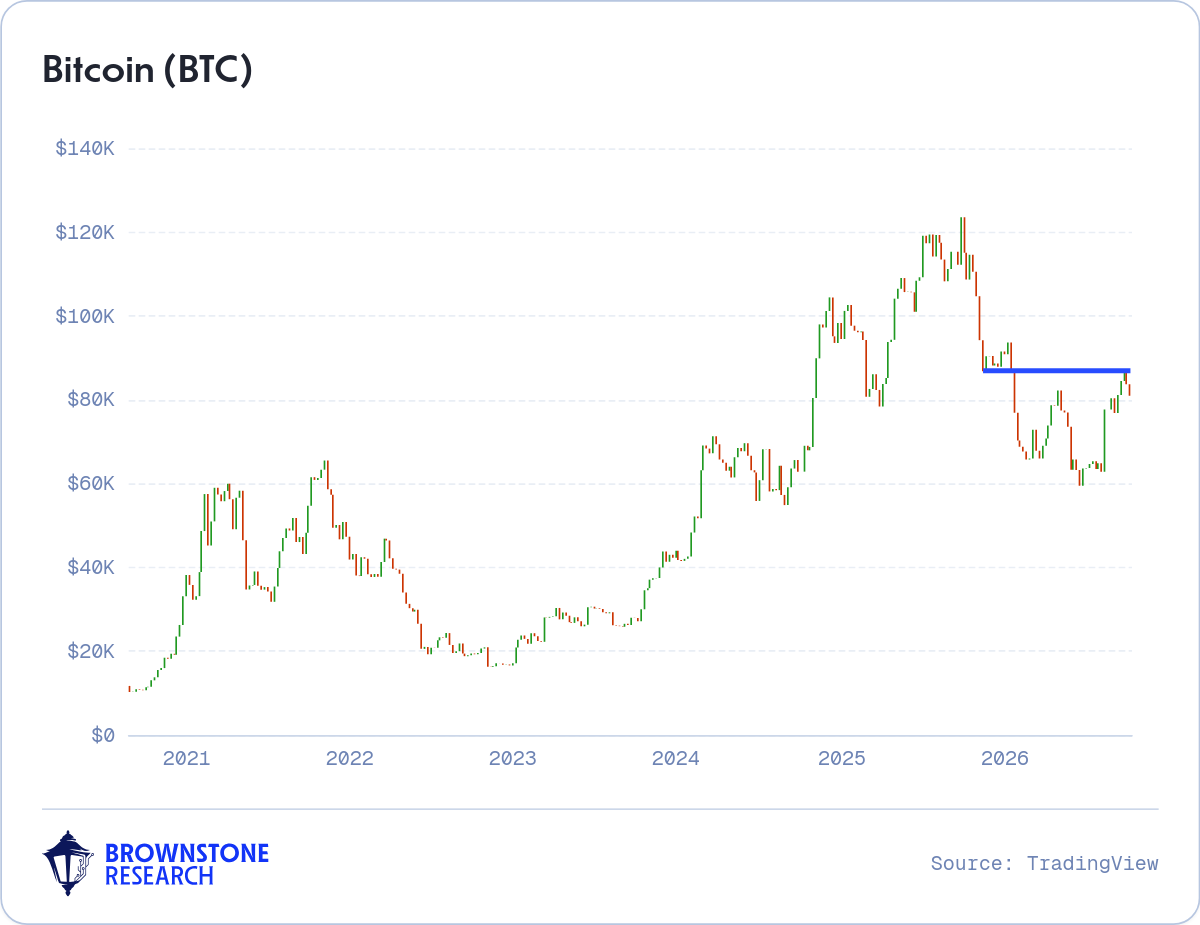
This has led to Bitcoin’s price being rejected from the $87,000 yearly open resistance level we outlined a couple of weeks back.
The largest sellers in recent weeks have been Bitcoin spot ETFs.
These ETFs are the primary vehicle institutions use to access BTC exposure, which makes them one of the clearest windows we have to view their directional bias.
And right now, that window is showing us that for the first time in months, their bias is stacked to the downside.
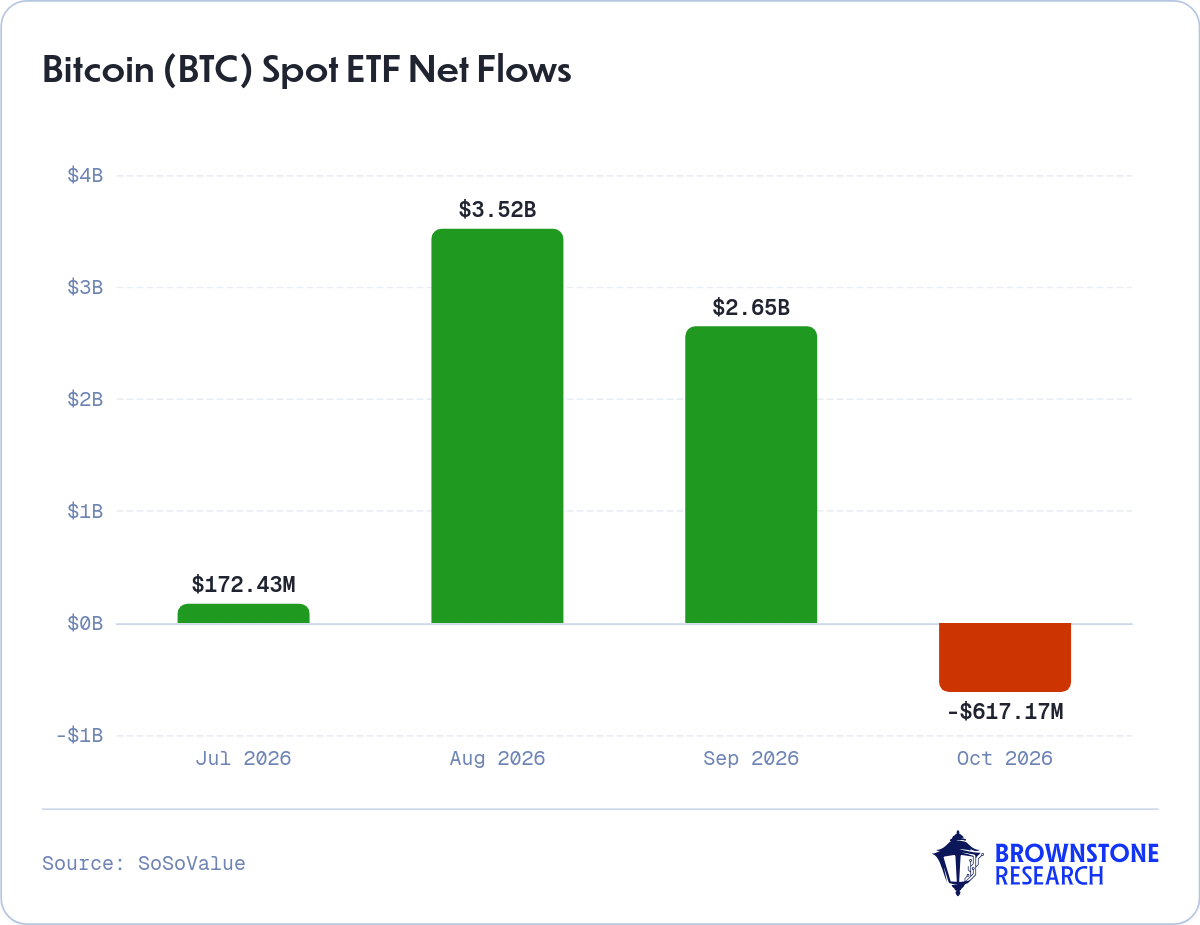
Between October 1 and 16, these ETFs sold off more than $617 million worth of bitcoin in aggregate.
This trend was bucked temporarily when they recorded $526.7 million of net inflows on Monday, but we’ll need to see that behavior continue through the end of the month to say for certain that the worst is behind us.
A big contributor to this dearth of buyers is risk appetite… or lack thereof.
Bitcoin and digital assets are still viewed as being risk-on assets by institutional fund managers. When liquidity is flowing and rates are steady or falling, assets such as Bitcoin typically catch a bid.
But the reverse is also true. When traditional markets come under stress and forced selling begins, Bitcoin and other cryptocurrencies are among the first positions institutions sell.
Some of the anxieties trace back to the AI trade…
Last week, a Financial Times report revealed that Anthropic, the company behind Claude, carries a sub-investment-grade BB+ “junk” rating on the debt that backs its massive chip financing deals.
The rating had been assigned quietly back in June and went unreported while the company raised $35 billion from lenders, with Wall Street banks now preparing another $60 billion package on top of it.
Elsewhere, cloud providers such as CoreWeave saw their bonds come under deep stress as investors began questioning whether the AI capex boom can generate the cash flows needed to service the mountain of debt financing it.
These were both symptoms of credit market stress.
It’s something we can visualize by looking at high-yield credit spreads, which have hit multiyear highs.
These spreads measure the extra compensation investors demand to hold risky corporate debt instead of safe U.S. Treasurys.
When markets are calm and liquidity levels are high, this spread stays tight because investors are comfortable holding risk for higher yield. When liquidity dries up, investors demand a much larger premium to take on that risk, and the spread widens.
This makes it one of the cleanest real-time gauges of stress in the financial system.
With that in mind, have a look at where we are today…

And the widening has been concentrated in one sector above all others… AI-linked debt.
Credit stress will act as a headwind for Bitcoin for the time being. But it’s not as if we’ve never seen this before.
We saw something similar in late 2014, when Bitcoin traded lower into the end of the year before reaching an early January 2015 bottom.
And in 2018, when Bitcoin found its cycle low in December.
As well as in 2022, when BTC bottomed in November.
All those previous cycle lows formed about 18 months before the next halving event.
That timing makes the market’s current inflection point even more curious because we are now about 18 months ahead of April 2028’s halving event…
And it means any large deviations to the downside between now and early 2027 could represent a final pre-halving opportunity for those who missed out on the summer discount.
Continue following Brownstone Research
Add Brownstone Research as your preferred source on Google to see our latest stories in your feed.
 Add as a preferred source
More stories like this
Read the latest insights from the world of high technology.
-
-

The Next Target of “Project Vault”
There’s one metal named in the procurement rules that hasn’t seen a major deal…yet.
-

Bessent Finds His Buyer
Fortunately for Bessent, there’s one group of buyers with a voracious appetite for short-term U.S. debt.