




The Fed Holds Steady…For Now
Rather than trying to decode what Fed officials say, follow currency trends for clarity on what the market actually...


This latest bout of volatility is an excuse for institutional investors to lighten their positions, lock in 2026 bonuses, and then buy back in at lower levels looking forward into 2027.


Institutional capital is going through one of its occasional fits with regard to AI infrastructure spending.
Last week:
None of the financial media stated the most obvious fact… these companies can afford the investment in AI infrastructure. All of them have made the decision to forgo short-term quarterly results for long-term benefit.
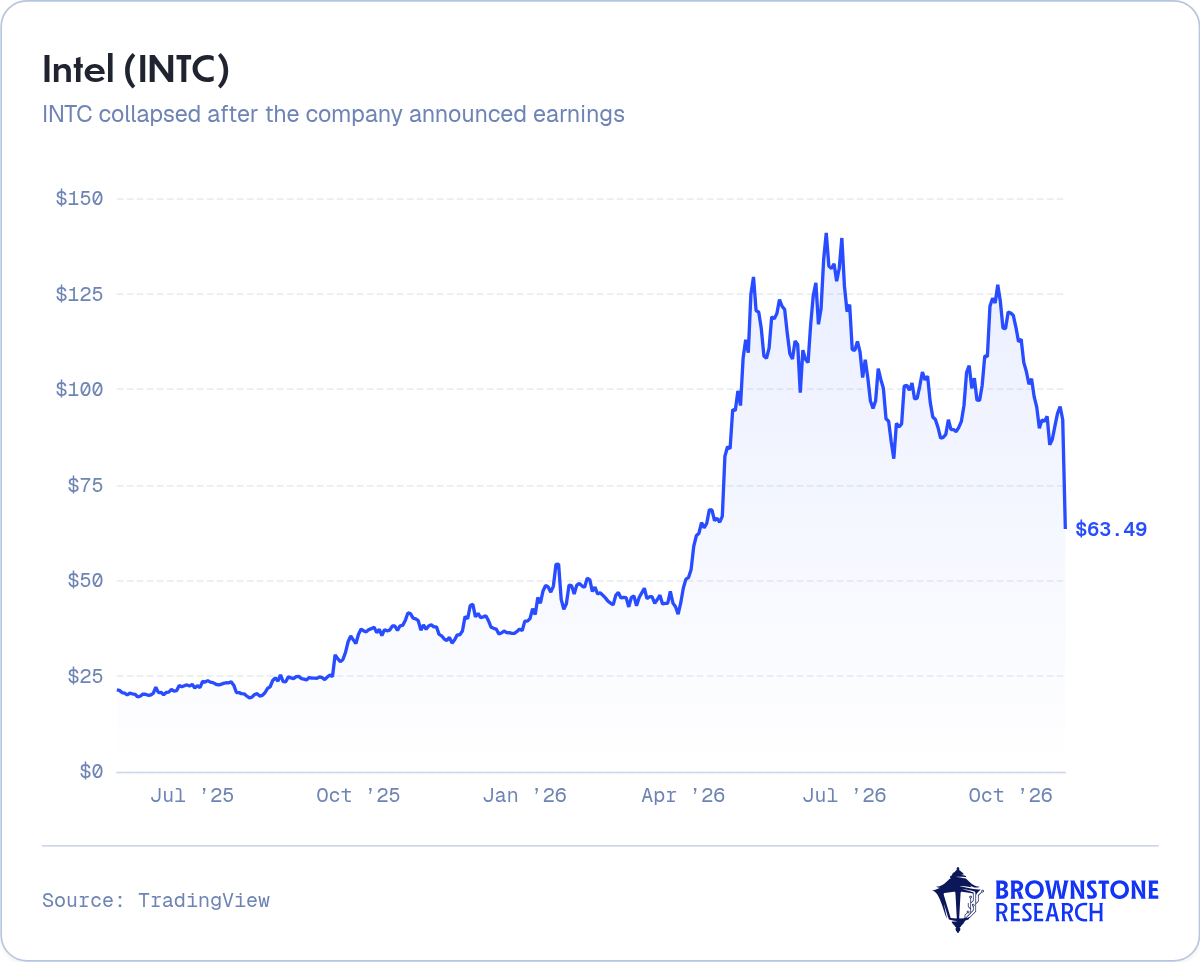
Intel (INTC) was also rightfully gutted, currently down about 50% from September highs. Intel’s PC unit has been directly impacted by higher memory prices, as well as memory shortages for PCs. And the company will continue to need heavy research and development spending for years if there is any hope for it to recover some kind of leadership position in CPU technology and semiconductor fabrication services.
The reality is that all of these companies know that if they don’t invest heavily right now, they will be at a significant competitive disadvantage with respect to artificial intelligence.
This latest bout of volatility is an excuse for institutional investors to lighten their positions, lock in 2026 bonuses, and then buy back in at lower levels looking forward into 2027.
We should expect that it will be a bumpy market for the next two or three weeks. And it’s worth keeping in mind that 2027 has all the makings of an incredible year for investing.

Elon Musk's new patent protects a new invention that could rewrite the future of wealth forever. It's a radical new form of AI Jeff Brown calls "M.A.G.I…" One so revolutionary that Elon called it an "infinite money glitch." Click here to see the details because he believes this is a once-in-a-generation opportunity to potentially create wealth on a scale most people can't even comprehend.

A once forgotten American company is about to step into the heart of the race to build the next generation of AI. Larry Benedict believes November 30 could change how Wall Street sees it forever. See the ticker before it makes headlines.

By now, you’ve likely heard the news.
Last week, a hacker gained access to Binance, the world’s largest offshore crypto exchange, and stole over $6 billion of funds from the platform.
The attack was roughly four times larger than the 2025 hack of $1.46 billion, which happened on Bybit.
Of the total sum stolen, stablecoin issuers reacted fast enough to freeze nearly half the haul. Tether, Circle, and others locked roughly $2.8 billion in place that can ultimately be recovered.
That mitigates the damage. But it still leaves a net loss more than twice the size of the previous biggest hack in history.
Fittingly, the same culprits appear to be behind both.
Blockchain investigators at TRM Labs have attributed the attack to TraderTraitor, which operates under North Korea’s Lazarus Group. This is the same state-sponsored hacking syndicate behind the Sony Pictures breach, the Bangladesh central bank heist, and 2025’s Bybit theft, the previous record holder.
Their entry point appears to have been a compromised laptop belonging to a Binance DevOps engineer. From there, the attackers staged the operation in advance, then manipulated Binance’s transaction-signing system into approving transfers straight to addresses under their control.
Now, the two things every reader should understand…
First, this was not AI breaking cryptography.
We’ve seen that fear making the rounds lately. But this was a human-in-the-loop failure, not a machine cracking the math.
The attackers compromised an engineer’s laptop. No private keys were cracked. The cryptography underpinning Bitcoin and Ethereum remains secure and unbroken.
Second, this is not a crypto failure. It’s a human failure, no different from past episodes such as the collapses of FTX and Mt. Gox.
Centralized exchanges are walled gardens sitting on top of crypto, permissioned databases with human administrators who hold access to user funds. This makes them the perfect targets for these attacks.
The irony is that the more permissioned and centralized a system is, the more vulnerable it is to exactly this kind of attack. Centralization creates a single door for thieves to pick.
With all that said, there’s no denying that this is bad PR. It’s bad for Binance, and it’s bad for the asset class in general. It will create at least a near-term overhang on crypto prices.
But it’s worth remembering the bigger picture. All the bullish themes we regularly cover – the tokenization of assets, the proliferation of stablecoins, bringing mainstream finance onto permissionless rails – are still alive and well.
There’s also the calendar to consider.
In Bitcoin Will Hit $251,000, we walked through the four-year cycle and showed that Bitcoin’s bear-market lows have landed 513 to 542 days before the next halving in each of the last three cycles.
With the next halving estimated for April 2028, that window puts the cycle low right around the midterms. History says that from next week forward, prices should march higher over the next couple of years.
This news is a setback for digital assets, not a nail in the coffin.

AI stocks took another gut punch last week…
Alphabet (GOOGL) dropped 12.6% on Thursday. ServiceNow (NOW) collapsed 27%. Amazon and Intel reported after the bell and both sold off hard. Naturally, the headlines are saying: The AI trade is dying!
I’ve heard this one before.
Over the summer, forced liquidations at Situational Awareness dragged AI stocks lower until Nvidia (NVDA) reported and crushed the negativity in a single evening. The narrative was there, but the death wasn’t.
Here’s what’s really happening: “Investors” are tired of paying for spending. Alphabet and Amazon are pouring so much into data centers that free cash flow went negative. Intel plummeted 30% Friday on a shrinking PC business and weak guidance. But looking at the AI parts of those reports:
This isn’t a dead theme… this is a bearish consolidation before the next bull leg higher.
And I believe that leg is coming.
The money isn’t leaving tech… it’s swapping.
Last week, software stocks showed 27 unusual inflows against just seven outflows. Internet and data services (home of Google and the AI cloud operators) saw one inflow against 16 outflows. Over the past month, the median software stock is up 13.6% while the median chip equipment stock is down 17.4%.
Remember the “SaaSpocalypse”? Software was supposedly finished. Now 15 of the 20 top-ranked stocks in our tech universe are software companies.
Here’s what almost no one is talking about. While chip stocks get crushed, analysts are raising their numbers. Among chipmakers worth $1 billion or more, 66% have seen quarterly earnings estimates rise over the past month. Only 16% have seen them fall. Yet 82% of those same stocks are in a bear market.
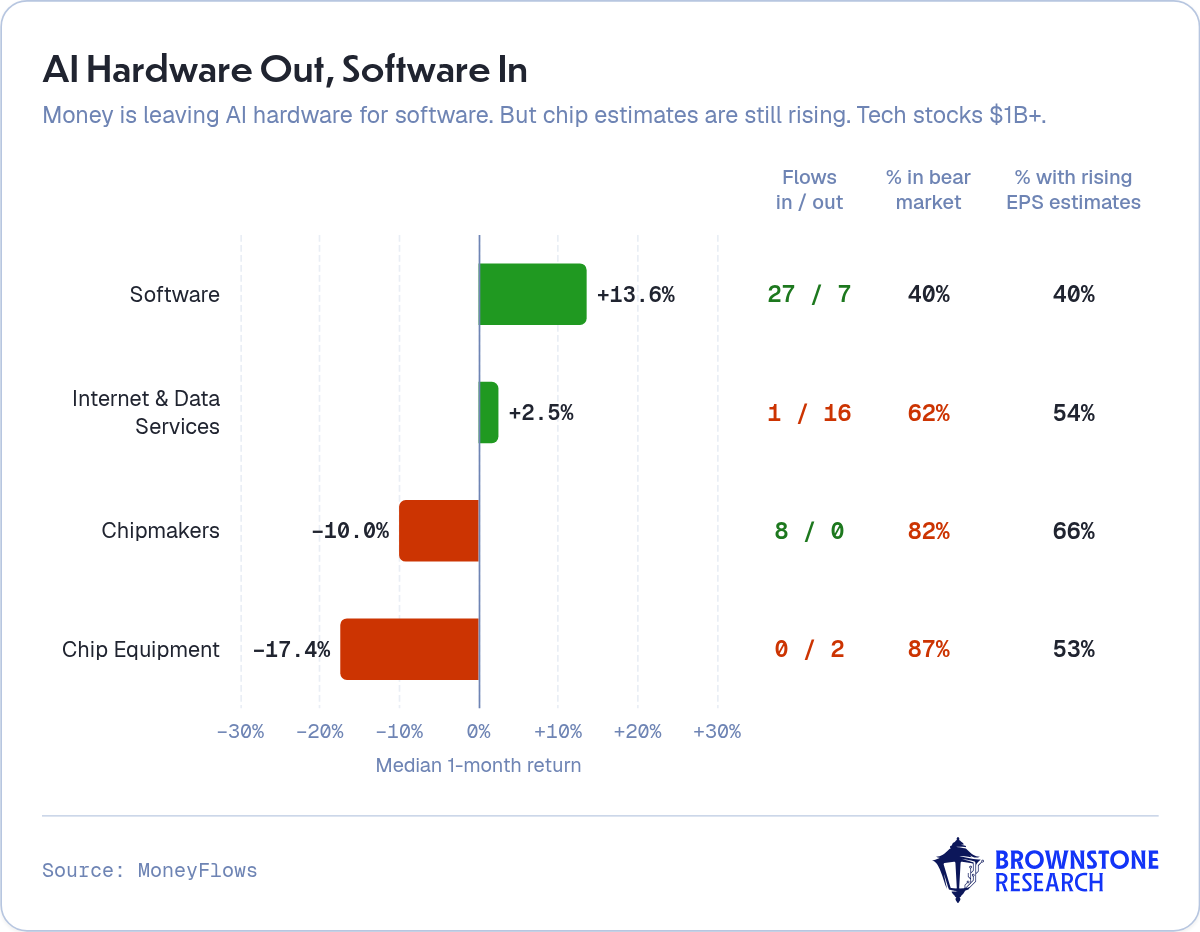
Prices are falling while earnings estimates are rising. That sounds like opportunity to me.
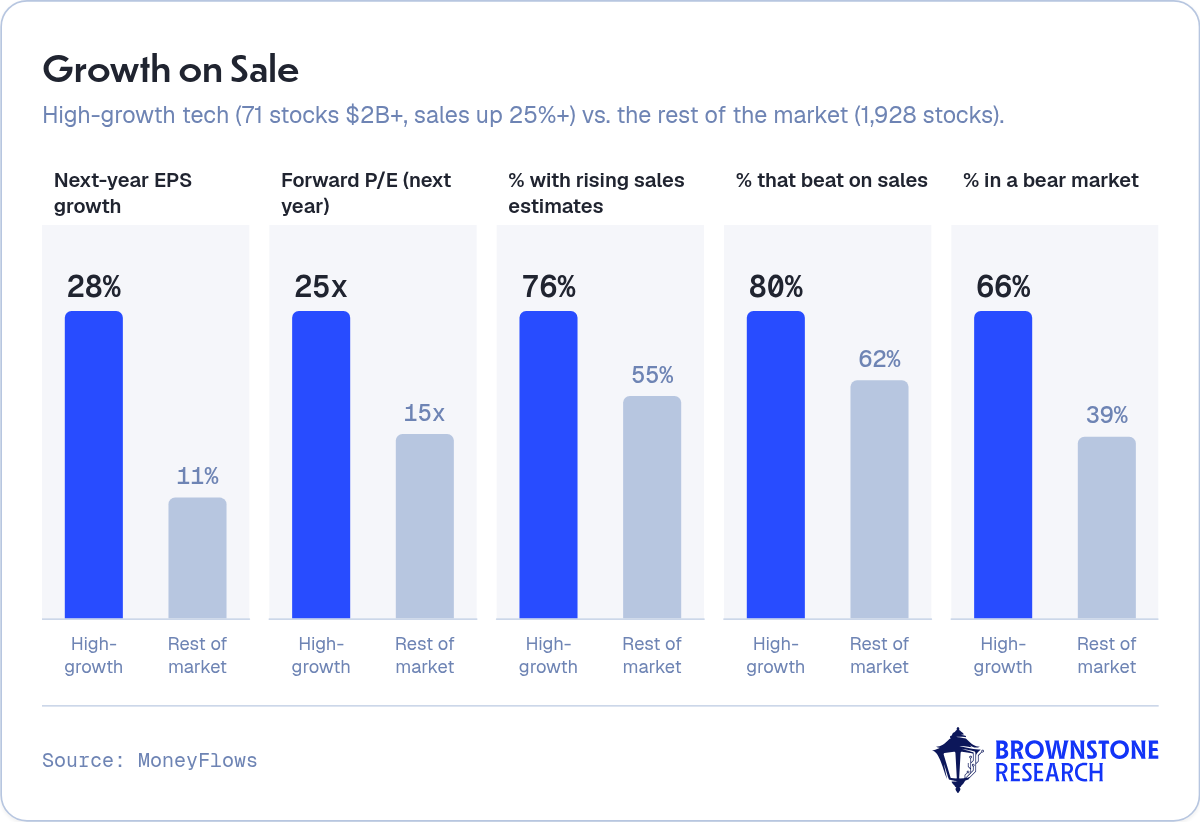
Looking at every tech company worth $2 billion or more that’s growing sales 25% or faster… there are 71 of them in my data.
Analysts expect earnings to grow 28% next year, vs. 11% for the rest of the market. They trade at 25 times forward earnings, so you pay less per point of growth than for the average stock. Three out of four have rising sales estimates. Four out of five beat on sales last quarter. And two out of three are in a bear market.
Growth is on sale.
That brings me to the calendar…
The midterms are Tuesday, and history is screaming bullish.
Since 1950, the S&P 500 has been higher 12 months after all 19 midterm elections, with an average gain of about 15%. Tech does even better. Since 1990, the Nasdaq 100 has been higher one year after every midterm Election Day. That’s 9 for 9, with an average gain of 38.1%, and it beat the S&P 500 all nine times.
My belief in these themes hasn’t wavered. Only the mood has. And moods, unlike data, don’t last.
Add Brownstone Research as your preferred source on Google to see our latest stories in your feed.
 Add as a preferred source
Read the latest insights from the world of high technology.
Rather than trying to decode what Fed officials say, follow currency trends for clarity on what the market actually...

AI hardware is shedding leverage as a tree drops its leaves, but leaves come back.

On the surface, it makes some sort of sense. But this argument misses two things…