



The Midterm Hangover
Yesterday was bruising, but the selling started long before Election Day...


None of the AI infrastructure companies I heard from last week said anything other than business as usual.

Editor’s note: Most trades cost more than you’d expect to risk. On Wednesday, November 11th at 8 p.m. Eastern, Jeff Brown and Larry Benedict will show you a different kind of trade. They call them “Penny Tech Trades,” and every one costs less than $1 per contract. One on Nvidia went from 2 cents to $1 in 2 days, while the stock was down. They’ll place real trades with real money, live on camera, and show how each one works. Every attendee receives free trade ideas, no strings attached. Add your name to the guest list with one click right here.

Last week was gut-wrenching.
On Thursday, the Nasdaq fell 5.5%, the worst one-day drop since the “Liberation Day” panic of April 2025. Many individual stocks tied to the AI trade fared even worse.
The catalyst was Tuesday’s election. Whatever you think drove the blue wave, AI data centers are taking the brunt of it in the market. Candidates saw that people don’t want AI data centers built next door. They ran on it and it worked.
As Jason pointed out on Friday, we should take the local backlash seriously.
But let’s put it in context. Texas accounts for about 26% of the planned data center buildout in the U.S. It’s ground zero for this fight.
And the pause everyone is suddenly worried about? It’s already been in place.
Back in August, outgoing Republican Gov. Greg Abbott paused grid connections for large data centers while state officials reviewed the projects. Texas hit the pause button months ago. The market is reacting to it now.
Yes, Democrats will control both the House and the Senate come January. But there’s only so much they can do over the next two years.
Could they push a nationwide moratorium on large data centers? Sure. Sen. Bernie Sanders and Rep. Alexandria Ocasio-Cortez introduced exactly that bill this spring. But it would almost certainly meet President Trump’s veto. And overriding a veto takes a two-thirds majority in both chambers. Democrats aren’t close to that.
That means the buildout is moving, not stopping.
If new data centers can’t get going in former hotspots such as Texas, Ohio, and Georgia – all three just elected Democratic governors – they’ll go somewhere else.
And plenty of places want them.
In August, West Virginia rolled out a 20-year plan to draw data centers. Developers pay for their own power, and half of the tax revenue goes toward cutting the state income tax.
Will data center operators have to jump through more hoops now? Sure. But the buildout will still happen. Just listen to the companies doing the building.
None of the AI infrastructure companies I heard from last week said anything other than business as usual.
On Wednesday night, photonics leader Coherent (COHR) beat expectations, grew revenue 50%, and guided next quarter well above Wall Street’s numbers. Management now expects pro forma revenue to grow more than 60% this fiscal year.
The stock fell with the rest of the sector on Thursday anyway.
That same day, data center developer Core Scientific (CORZ) delivered a beat-and-raise quarter and told investors it does “not expect the election results to affect our existing operations or delivery timelines.”
The numbers haven’t changed. The contracts haven’t changed. Once again, the only thing that’s changed is sentiment.
It’s impossible to say how far this souring in sentiment can run. And it’s painful to watch our positions fall. But sentiment is fleeting. Eventually, the fundamentals take over.
Don’t let a bad week shake you out of great businesses. Stay invested. Stay focused.

"I first recommended Nvidia at 66 cents. But right now, a brand-new kind of trade is generating far bigger returns from technology than any other type of trading or investing strategy I know of. Every trade costs less than $1 per contract. One on Nvidia increased 4,445% in two days, while the stock was down. One on Apple increased 733%... One on Microsoft increased 924%... This Veterans Day, at 8 p.m. ET, Larry Benedict and I are going to trade our own money on camera, so you can see exactly how it works." — Jeff Brown. Click here to join Jeff and Larry, free.

The last time this Washington event happened, more than $600 billion flowed into the market over the next 12 months. Handing everyday Americans a chance to potentially pocket tens of thousands of dollars. Now Larry Benedict, the hedge fund legend who went 20 straight years with zero losing years… Says the window of opportunity is open again… and billions could surge into the market as soon as December 9. And he’s giving away the ONE three-letter ticker you need to get in front of it. Click here to get Larry’s ticker FREE.

With Democrats sweeping the House and Senate, the chances of advancing pro-crypto legislation over the next two years just took a major hit. That’s the headline.
One of the most important races for crypto was the Ohio Senate seat, which Sherrod Brown won.
Brown chaired the Senate Banking Committee from 2021 through 2024, the years when crypto companies were losing bank accounts and the SEC was suing exchanges instead of writing rules. He was Gary Gensler’s most reliable defender in the Senate. And in September 2023, he told regulators to use their existing powers against the industry rather than wait for Congress.
That’s why the crypto super PACs spent more than $40 million to remove him in 2024 and about $55 million trying to keep him out this year. It wasn’t enough.
Brown is the likely next chair of the Senate Agriculture Committee. That committee oversees the Commodity Futures Trading Commission (CFTC), and therefore Bitcoin and every other digital commodity. It is one of the two Senate committees that decide what digital asset legislation looks like.
The other is Senate Banking, where Elizabeth Warren will likely take the gavel. We’ve spilled plenty of ink on what Liz thinks of the industry, so we won’t repeat it here. Suffice it to say she’s not a fan.
The expected direction in 2027 and 2028 is guardrails.
Expect inquiries into the Trump family’s crypto holdings, into the 21 national trust charters the Office of the Comptroller of the Currency handed out, and into the SEC and CFTC for moving as quickly as they did this year. Warren will have subpoena power, and boy, does she know how to use it.
But it’s not as if we haven’t been here before…
In an almost eerie parallel, the last midterm elections in 2022 saw a similarly unfavorable environment for digital assets. In November of that year, FTX collapsed. Bitcoin, the bellwether asset for the market, fell to around $15,500 – a 78% drop from its all-time high a year earlier.
But here’s what happened next:
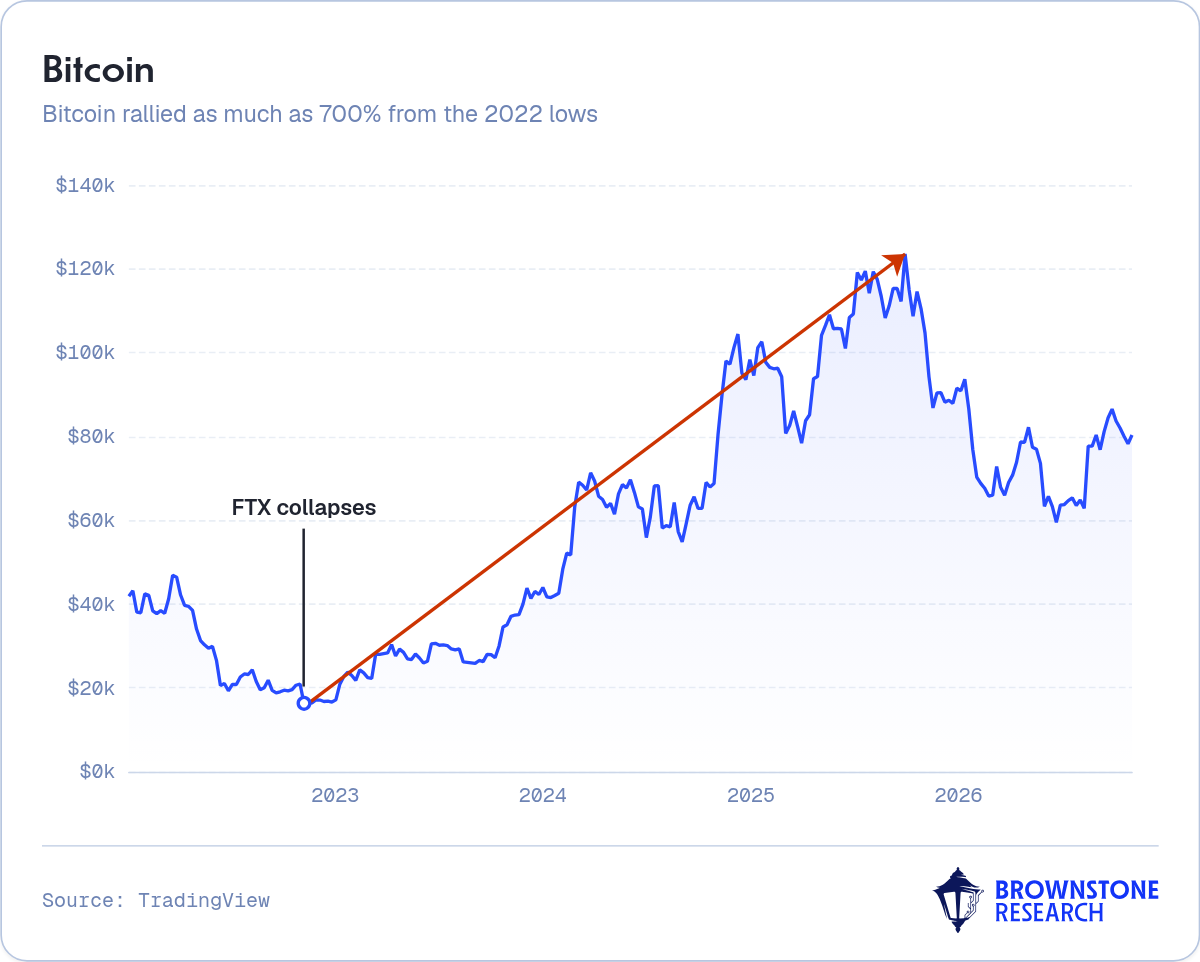
It wasn’t a miracle. It was the cycle.
Bitcoin’s bear-market low has landed 513 to 542 days before the next halving in each of the last three cycles. With the next halving estimated for April 2028, that window points to the first or second week of November 2026. Right now, in other words.
With newly hostile committee chairs and the largest hack in the industry’s history, the bottom once again feels like it’s fallen out. Nobody wants to own digital assets.
They probably should.
Because we’re going higher.
There’s never been a better time to trade prediction markets.
Platforms such as Kalshi and Polymarket offer simple yes-or-no contracts on real-world events. Will the Fed hold rates at its next meeting? Will inflation print above a certain number? Will oil settle inside a specific range today? Each contract’s price reflects the crowd’s current odds, and a winning contract pays out $1.
Buy at 70 cents and the contract pays a full dollar if you’re right. Your maximum loss is known the moment you enter the contract. There are no margin calls, no unlimited downside, and no waiting months or years for a thesis to play out.
Prediction market volumes are exploding, reaching $123 billion in October across more than 640 million transactions. That’s a 54% increase from September’s record and is the first time volumes have crossed the $100 billion mark in a single month.
Midterm elections are delivering a boost as well. Kalshi alone reported $1.4 billion in midterm election volume. Across prediction market platforms, 28,000 midterm markets have been opened.
While the stock market is melting down, Larry and I are showing our subscribers how to profit from prediction market events. We flagged a contract on whether the Senate would change hands. The risk-reward looked strong.
As the Nasdaq-100 slid into its third correction this year, we closed out that position for a 35% gain in just two days.
Across all closed positions, we’ve racked up an average gain of 25% with a holding period of just two days – along with a 91% win rate.
As with any market, the key to successfully navigating prediction markets is to have a trading plan with sound risk management guidelines.
With prediction markets, there are three things you must do when evaluating a contract. First, when it comes to finding an event to trade, start with liquidity.
Trading illiquid stocks can hit you with higher transaction costs from bid/ask spreads. Meanwhile, prices are subject to wild volatility. Prediction markets work similarly. You want to target events with a minimum level of liquidity and activity so you can get in and out at reasonable prices.
Second, make sure you understand the details of an event.
When you buy a stock, you’re hoping for one outcome – a rising share price. In contrast, prediction market events can have nuances in what counts as a successful outcome.
Take an event tied to the price of oil, for instance. What oil benchmark is being used to measure the price (such as WTI or Brent)? Or if the price is tied to a futures contract, which monthly expiration?
You should also understand the contract’s settlement date and its rules for settling disputes. Grasp those details before you put money into a trade.
Finally, and perhaps most important of all, you need a sound risk management strategy.
The price you pay to enter a contract is what you stand to lose – whether that’s $50, $5,000, or more. Proper position sizing is critical to staying in the game over the long term.
With the right edge and a plan in place, prediction markets are becoming an attractive venue to trade and escape stock market volatility.
Add Brownstone Research as your preferred source on Google to see our latest stories in your feed.
 Add as a preferred source
Read the latest insights from the world of high technology.
Yesterday was bruising, but the selling started long before Election Day...


This latest bout of volatility is an excuse for institutional investors to lighten their positions, lock in 2026 bonuses,...