



Bessent Finds His Buyer
Fortunately for Bessent, there’s one group of buyers with a voracious appetite for short-term U.S. debt.



For most of human history, light had one job….

By Jason Bodner, Founder, Outlier Intel
For most of human history, light had one job.
It helped us see.
Today, we ask it to do something infinitely more difficult.
We ask it to carry civilization.
Hidden beneath our streets and oceans are millions of miles of glass no thicker than a strand of hair. Inside them, pulses of light travel at astonishing speeds, bouncing through perfectly engineered pathways that lose almost none of their strength over hundreds or even thousands of miles.
This technology is only getting started…
Modern optical systems split light into dozens, and increasingly hundreds, of individual wavelengths. Each color becomes its own independent communication channel, allowing a single fiber to transmit extraordinary amounts of information simultaneously.
Imagine replacing a single-lane country road with a superhighway containing hundreds of lanes, without widening the road by a single inch.
That’s what modern photonics has accomplished.
And now, engineers are pushing even further.
Researchers are developing hollow-core fiber, replacing solid glass with microscopic tubes filled primarily with air.
Because light travels faster through air than glass, these fibers promise lower latency and greater efficiency. It may sound like a small improvement, but when financial markets, cloud computing, and artificial intelligence all depend on fractions of a second, small improvements become enormous advantages.
Then there’s silicon photonics.
For decades, computers have relied on electrons moving through copper. Increasingly, however, engineers are integrating lasers, waveguides, and optical circuits directly onto silicon chips. Instead of constantly converting electrical signals into optical ones, future processors will increasingly communicate using light itself.
In other words, computers are beginning to speak the language of photons.
And perhaps the most fascinating frontier lies ahead.
Researchers around the world are working on optical computing, systems that perform calculations using light rather than electricity.
Instead of pushing billions of electrons through increasingly crowded circuits, future computers may manipulate beams of light to solve complex mathematical problems with extraordinary speed and efficiency.
The market is taking notice…
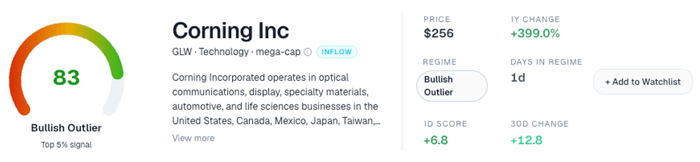
Corning (GLW) recently closed at an all-time high. The company once known for glass cookware has transformed into a giant in the fiber optic space and is up approximately 200% year-to-date and more than 400% over the last twelve months.
At Outlier Alpha, my quantitative-based research service, our proprietary model has consistently ranked GLW among the top 5% of signals we receive on more than 4,000 stocks.
Source: Alpha Watch
The technologies that change the world are often the ones quietly enabling everything else.
Shipping containers transformed global trade.
Electrical grids transformed industry.
The internet transformed communication.
Fiber optics, and the broader field of photonics, may ultimately prove to be another one of those foundational technologies.
Not because it captures headlines every week, but because nearly every technological revolution now depends upon it.
By Ben Lilly, Senior Crypto Analyst, Brownstone Research
Over the next four weeks, Congress will decide the future of crypto…
Will the future of finance be built in the U.S.? Or will America forfeit that advantage to rivals like China?
Here is what’s happening…
The CLARITY Act is the bill that will finally give digital assets a rulebook in America. And it’s stalled at the goal line.
It’s a piece of legislation that draws a clear distinction on which digital assets fall under CFTC’s or the SEC’s jurisdiction. It also gives clear guidance on how to build protocols, issue assets, and the filing requirements for broker dealers.
The Act gives a greenlight for big money to participate.
For years, pension funds, banks, and large asset managers have been unable to allocate to the digital asset industry simply because there were no clear regulatory guidelines.
CLARITY removes the uncertainty.
Additionally, it upgrades our financial system.
The old and inefficient plumbing that currently runs on 67-year-old COBOL code is opaque, subject to slow settlement, bankers’ hours, and a middleman every step of the way.
It’s archaic, and overdue for disruption from transparent, round-the-clock blockchain rails.
Those are the stakes. And we’re coming down to the 11th hour to realize that future.
Crypto policy reporter and D.C. insider, Eleanor Terrett, said last week that GOP lawmakers are feeling a fresh sense of urgency. It’s a similar sentiment we hear from our contacts in D.C.
They want CLARITY passed and are feeling the heat from the White House to get the job done this summer.
Senators left town for July 4 and will return the week of July 13.
This leaves about 20 working days before the long August break. That’s four weeks to move the bill through the Senate and back to the House. That’s why Senator Cynthia Lummis of Wyoming said the bill’s final text will drop on or just before July 4. And they look to move the bill towards a vote as soon as possible.
For the bill to pass, it’ll need 60 votes on the floor. Republicans hold 53 seats, so a minimum of 7 Democrats will need to cross over for the bill to advance. The bill had two Democrats vote to advance it out of committee, which means it’s right at the cusp.
However, two big issues are losing votes…
They are the ethics guidelines and a recent objection from various law enforcement organizations.
We’ve been covering these debates in our free Chain of Thought newsletter each week, with Trump’s Crypto Sideshow and A Shot Across the Bow for the Banks, and these will likely be the last issues resolved.
Despite the remaining issues, the desire to get this over the finish line is there… a16z’s Head of Policy, Miles Jennings, says the tight clock could force a deal.
Solana Policy Institute president Kristin Smith agrees. She points to support for the bill on both sides of the aisle, and the fact that pressure is most often what makes politicians move.
And the timing for this big, final push could not be more perfect.
Think about everything that we’ve been covering here in First Signal the past few weeks…
Bitcoin at historic discounts from a Power Law level, the crypto fear and greed index reaching unprecedented levels of fear, and the massive spike in put skew.
Every one of those are signals we see near or at the bottom. And the signals keep stacking up.
That is creating confluence for a powerful reversal if CLARITY Act gets over the line this summer.
We’ll be watching closely….
By Feruz Kurbanov, Senior Analyst, Brownstone Research
Biotech buyouts are back…and in a big way.
According to a recent Financial Times analysis, large pharmaceutical companies have already announced around 23 biotech acquisitions worth about $94 billion in 2026.
That is an impressive amount considering the year is only halfway over and is already approaching the total value of all biotech acquisitions completed during 2025.
After several years when higher interest rates, falling biotech stock prices, and cautious investors slowed dealmaking, confidence is finally returning.
Large drug companies are once again willing to spend billions of dollars to acquire promising biotechnology businesses with the hope of bringing the next generation of medicines to patients.
The important question: Why now?
One reason is that many of the world’s largest pharmaceutical companies are facing what is known as the “patent cliff.”
Over the next several years, patents protecting many of their biggest blockbuster medicines will expire, allowing lower-cost generic or biosimilar competitors to enter the market.
That means billions of dollars in annual revenue could disappear unless those companies replace those products with new medicines. Buying innovative biotech companies has become one of the fastest ways to rebuild their future pipelines.
However, the patent cliff is only part of the story.
Large pharmaceutical companies are also trying to position themselves in the fastest-growing areas of medicine, including cancer, autoimmune diseases, obesity, gene therapy, and other cutting-edge technologies that could shape healthcare for years to come.
An interesting development is that pharmaceutical companies are no longer waiting until experimental drugs reach the final stages of development before making an acquisition.
Instead, a growing share of the money is being invested in companies whose medicines are still in Phase II clinical trials or even earlier. In fact, roughly 60% of the value of biotech acquisitions announced this year has gone toward companies with Phase II or earlier programs.
This suggests that buyers are becoming more confident in the quality of modern biotechnology research and are willing to accept more development risk in exchange for the opportunity to secure highly valuable medicines before their prices climb even higher.
Another important reason the buying spree is happening now: Big pharma has money to spend.
Many of them generated record profits over the past several years and continue to hold enormous cash reserves. Industry analysts estimate that the sector has more than $2 trillion of potential financial capacity available for future acquisitions.
At the same time, biotechnology company valuations remain below the record highs seen during the pandemic years.
This creates an attractive opportunity for large drug makers to purchase innovative businesses at prices they believe offer long-term value. As competition for the best biotechnology assets increases, companies are moving more quickly to secure promising treatments before rival bidders have the chance.
These biotechnology mergers and acquisitions reflect growing confidence that scientific innovation is accelerating and that the next generation of breakthrough medicines is already emerging.
For investors, researchers, and patients alike, this trend is encouraging. It suggests that capital is flowing back into biotechnology after several difficult years.
In Monday’s First Signal, Jeff Brown said that the biotech winter had “thawed.” And it would appear spring is right around the corner.
Add Brownstone Research as your preferred source on Google to see our latest stories in your feed.
 Add as a preferred source
Read the latest insights from the world of high technology.
Fortunately for Bessent, there’s one group of buyers with a voracious appetite for short-term U.S. debt.

Stocks were climbing out of bear territory, but then the bond market spoke up.

These factories will cost billions before even a single working chip is produced…