




Bessent Finds His Buyer
Fortunately for Bessent, there’s one group of buyers with a voracious appetite for short-term U.S. debt.



The market isn't waiting for diplomats to finalize every detail.

By Jason Bodner, Founder, Outlier Intel
“Ships of the World, start your engines. Let the oil flow.”
That was President Trump’s message on Truth Social following the announcement of a peace deal between the United States and Iran on June 14.
Oil listened.
Brent crude, which had been trading near $95 with a sizable conflict premium built into prices, quickly fell into the low $80s and has since broken below $80. A risk premium that took months to build disappeared in a matter of days.
The flows reflected that shift immediately. Energy posted the weakest reading in our data last week with -55 net inflows, by far the worst-performing sector.
The market isn’t waiting for diplomats to finalize every detail. Investors are already repricing a world with less supply disruption risk.
The sector rotation underneath the surface is perhaps the most interesting development.
Financials led all sectors last week with +41 net inflows. The buying spanned banks, capital markets firms, insurers, and retail brokers — a broad re-rating of the sector.
That kind of participation usually signals improving confidence in the economic backdrop.
The timing makes sense. Remove a major geopolitical risk from the equation and investors immediately become more willing to allocate capital toward cyclical areas of the market.
Health care ranked second at +35 net inflows, led primarily by small- and mid-cap biotech and specialty pharma names rather than traditional defensive drugmakers.
That’s not defensive behavior.
That’s risk appetite wearing a lab coat.
Technology returned to positive territory at +15 net inflows after spending several weeks on the sidelines. Materials rebounded from recent weakness and industrials remained steady.
On the other side of the ledger, energy saw the largest outflows as oil prices fell. Real estate cooled significantly after leading all sectors last week, while staples and utilities drifted modestly negative.
Taken together, the message is clear.
Investors are rotating toward growth and capital allocation, not away from risk, as the data from Friday shows.
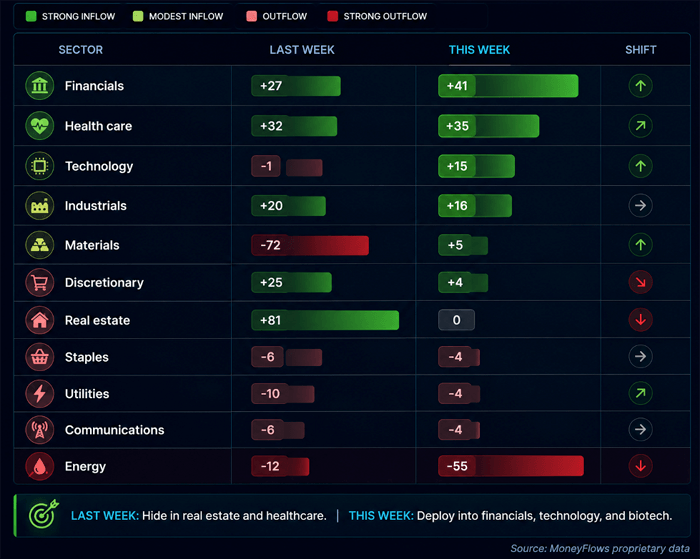
The peace dividend is real. Oil knows it. The flows know it.
The biggest opportunities won’t come from reacting to the headline itself.
They’ll come from identifying what that headline makes possible.
By Ben Lilly, Senior Crypto Analyst, Brownstone Research
A bank older than the telephone just staked its reputation on DeFi.
And the timing could not be more perfect…
Standard Chartered is a stalwart financial institution that rose to prominence at the peak of the British Empire. In the 19th century, it financed trade across Asia, Africa, and the Middle East.
In the more than 170 years since, it’s still going strong with nearly $1 trillion of assets under management.
Last week Standard Chartered initiated coverage on the digital asset UNI, the token behind the Uniswap decentralized exchange.
Today, UNI trades just under $3. But Geoffrey Kendrick, the bank’s head of digital assets, published a price target of $100 by 2030.
That is a 33x-plus move in just over three years. It is also more than 2x the token’s 2021 peak of $44.
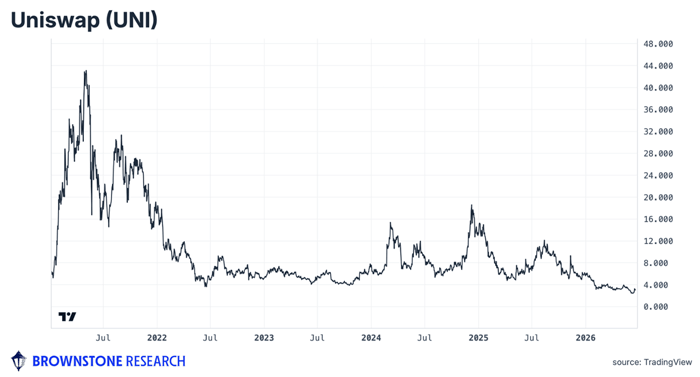
The centuries-old bank sees what we see.
Right now, there are around $330 billion worth of real-world assets (RWAs) on-chain. These are tokenized versions of things like dollars (stablecoins), bonds, commodities, stocks, and even real estate.
You can see the full breakdown by category below:
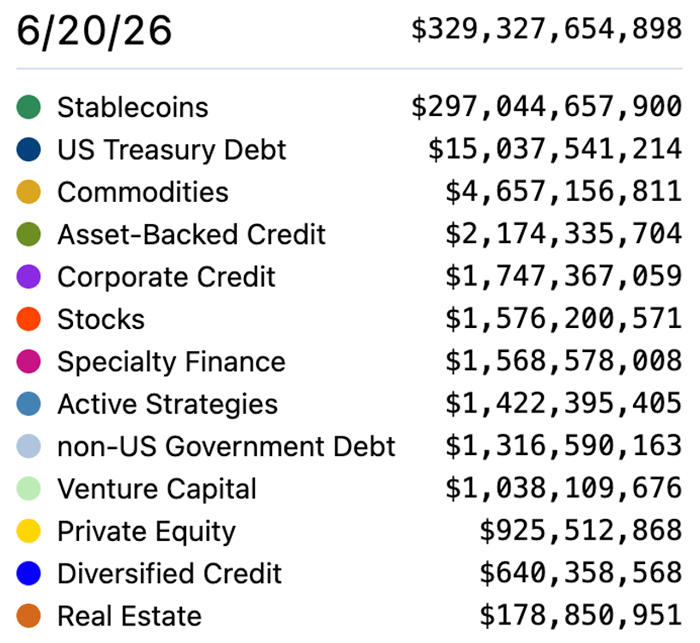
Source: rwa.xyz
As part of its UNI thesis, Standard Chartered predicts RWAs will grow to over $4 trillion by the end of 2028. That’s 1,100% growth in just over two years.
That matters for UNI because Uniswap is viewed as the institutional-grade on-chain exchange.
We got proof of this in February when BlackRock first made its $2.4 billion BUIDL fund tradeable on Uniswap’s request for quote (RFQ) solution, UniswapX. BlackRock also purchased an undisclosed amount of UNI token.
Standard Chartered also pointed out Uniswap’s reputation. The exchange has been operating for more than six years, making it a reliable venue to process large transactions. Additionally, Kendrick flagged that Uniswap is uniquely good at building deep, liquid trading pools that will be key for these new asset classes coming on-chain.
These are two features that can’t be easily replicated. And they give Uniswap a moat and a substantial head start in the race for RWA trading volume.
That’s the key…
Increased trade volume will produce more fees for Uniswap. And thanks to recent changes, these fees flow back to the UNI token.
This is a fundamental distinction that was not present during the 2021 highs.
Back then, UNI was a speculative token. It served as a voting chip, nothing more.
That changed late last year when Uniswap turned on its ‘fee switch.’ Now, a cut of every transaction on the platform goes toward buying UNI back on the open market and burning it. In that way, the process is very similar to traditional stock buybacks.
All this underscores what we have been stressing to readers the past few months: The digital asset market is down…but it is far from dead.
By Feruz Kurbanov, Senior Analyst, Brownstone Research
When a government agency reverses a major decision once, it’s news.
When it does it twice in the same week, something bigger is going on.
That’s exactly what happened recently with the U.S. Food and Drug Administration (FDA) — the government body responsible for deciding which medicines Americans can and cannot access.
Two small biotech companies, RegenxBio and uniQure, had both been told “no” by the FDA earlier this year.
Then, suddenly, the FDA changed its mind.
This goes far beyond two small biotech companies. To understand why, let’s start at the beginning.
RegenxBio (RGNX) makes a one-time gene therapy called Navsunli for a rare childhood disease called Hunter syndrome.
Think of Hunter syndrome as the body’s garbage disposal breaking down. Without a key enzyme, harmful sugar-like molecules pile up in the body’s tissues, causing delayed growth, organ damage, and cognitive decline in young children.
Only about 2,000 people worldwide have the disease.
Earlier this year, the FDA said “not yet” to Navsunli, demanding that RegenxBio run a bigger study with an untreated group of patients for comparison.
The FDA also challenged the specific biological measurement the company was using to track whether the drug was working.
For a disease this rare, running a large, traditional trial is nearly impossible. You simply can’t find enough patients.
uniQure (QURE) was in a similar bind. Its drug, AMT-130, is a gene therapy for Huntington’s disease — a devastating brain condition that slowly destroys a person’s ability to think, move, and speak.
In March 2026, the FDA told uniQure that the three years of patient data it had collected wasn’t enough to move forward with an approval application.
Like RegenxBio, uniQure was being asked to do more for a disease where “more time” often means patients suffering without any treatment options at all.
Then, something shifted.
In early June, patient advocacy groups — families, caregivers, and disease organizations — met directly with the new FDA leadership.
The message from patients was impossible to ignore.
Before the meeting, families affected by Hunter syndrome had staged a mock funeral outside the FDA’s offices.
It was raw, emotional, and it worked. Within weeks, the FDA reversed both decisions.
uniQure got the green light to apply for approval based on its existing data. RegenxBio was told its data was now sufficient too, and that the agency would review its resubmission on a fast-track basis.
So, what changed?
The science didn’t. The patient data was the same.
What changed was who was running the FDA.
The previous leadership had set a high bar — demanding more rigorous proof before approving drugs, especially those using newer methods of measuring effectiveness.
The new leadership appears to be striking a different balance: accepting a little more uncertainty in the evidence in exchange for getting potentially life-changing treatments to patients faster.
This is not a minor philosophical difference. It’s a fundamental choice about who bears the risk. Will it be patients who wait, or society that might approve something that later turns out to be imperfect?
These two reversals carry enormous meaning for the broader world of gene therapy.
Dozens of companies are working on gene therapies for conditions ranging from muscular dystrophy to blindness to sickle cell disease. And the new signals from Washington suggest that the agency is willing to be more flexible.
For patients and families living with rare diseases, this is genuinely hopeful news.
And for the companies racing to develop the next generation of gene therapies like we have in our Exponential Tech Investor and Early Stage Trader portfolios, the lesson is equally clear: Understanding the regulatory landscape is just as important as the science itself.
The FDA’s newfound flexibility may mark a turning point for the gene therapy field. If this approach continues, it could help bring more innovative treatments to patients while also encouraging investment and innovation across the biotechnology industry.
While many questions remain, these decisions are among the most encouraging regulatory developments the gene therapy sector has seen in years.
Add Brownstone Research as your preferred source on Google to see our latest stories in your feed.
 Add as a preferred source
Read the latest insights from the world of high technology.
Fortunately for Bessent, there’s one group of buyers with a voracious appetite for short-term U.S. debt.

Stocks were climbing out of bear territory, but then the bond market spoke up.

These factories will cost billions before even a single working chip is produced…