



Bessent Finds His Buyer
Fortunately for Bessent, there’s one group of buyers with a voracious appetite for short-term U.S. debt.



Second-quarter reporting season begins in earnest in mid-July…

By Jason Bodner, Founder, Outlier Intel
Seasonally, we’re in a quieter time…but it’s set to pick up.
Since 1990, June has historically been one of the flattest months for the S&P 500, and this year appears to be tracking that pattern.
July, however, has historically been one of the market’s strongest months, producing average returns of approximately 1.46%. That may surprise investors who still cling to the old “sell in May and go away” saying.
But with the AI trade regaining momentum, enthusiasm surrounding the recent SpaceX IPO still fresh, and overall market sentiment remaining constructive, I believe the path of least resistance remains higher.
And we are also approaching another important catalyst. That would be earnings season.
Second-quarter reporting season begins in earnest in mid-July. Historically, roughly 74% of S&P 500 companies beat earnings expectations and about 64% exceed revenue estimates.
Those are already healthy numbers. What caught my attention is what happened last quarter.
According to FactSet’s Earnings Insight report, 85% of S&P 500 companies exceeded EPS estimates. That was the highest percentage since the second quarter of 2021.
Think about that for a moment.
While headlines focused on tariffs, interest rates, political uncertainty, and Middle East tensions, corporate America quietly delivered one of its strongest earnings seasons in years.
The headlines will always provide reasons to worry. They always have.
But when I step back and look at the bigger picture, I see a world investing heavily in innovation, productivity, and technological advancement.
I see industries being reshaped in real time. I see entirely new markets being created before our eyes.
Do not lose sight of the forest for the trees.
If earnings continue surprising to the upside, investors may have another reason to remain constructive as we move through the summer.
By Larry Benedict, Founder, The Opportunistic Trader
Following the peace deal with Iran, markets expected the U.S. dollar (USD) to come under pressure.
After all, easing tensions in the Middle East led to a pullback in oil prices. Brent and WTI crude were recently trading 31% and 33.5%, respectively, below their wartime peaks. In theory, that will take some of the heat out of inflation and reduce pressure on the Federal Reserve to keep interest rates elevated.
Yet the USD has remained resilient.
The U.S. Dollar Index (DXY) was recently tracking around the 99.5 level – around 1.1% below its peak since the conflict in the Middle East broke out.
Check out the chart of DXY below…
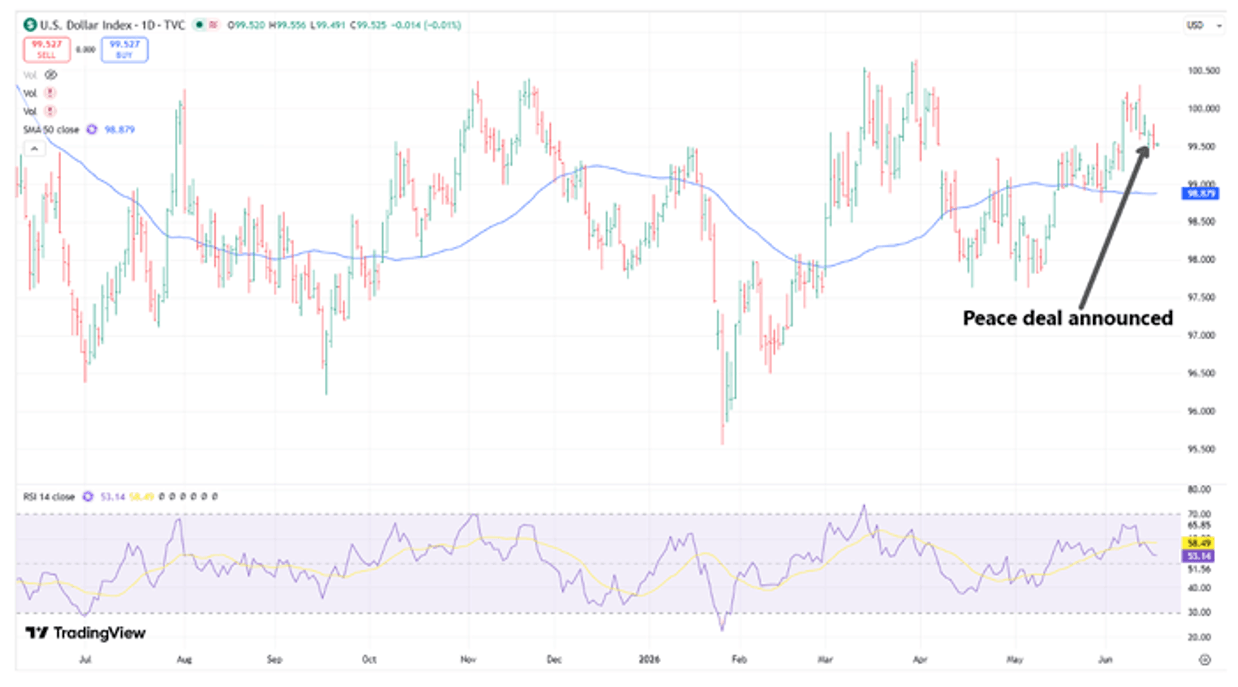
The geopolitical backdrop may have improved, but the resilience in the USD points to something fundamental in play.
Namely, the bond market isn’t convinced that the inflation battle has been won…
One of the major drivers of the USD is Treasury yields. As yields rise, global investors are drawn to U.S.-denominated assets, helping to push the dollar higher.
Yet despite the sharp fall in oil prices, U.S. 10-year Treasury yields have remained around 4.45%. That’s not far below their wartime high of 4.69%.
In short, if currency traders genuinely believed that the inflation threat had disappeared, we’d have seen a much bigger rally in bonds and a corresponding fall in yields.
But we’ve yet to see that unfold…
Against this backdrop, the U.S. economy continues to perform strongly. Jobs data remains positive, with both the manufacturing and services sectors expanding. And inflation in the Consumer Price Index (CPI) is running at 4.2% year-over-year.
This is not the kind of environment where you’d expect the Federal Reserve to cut rates. And indeed, new Fed Chair Kevin Warsh announced that America’s central bank had held steady on rates last week.
As long as inflation remains elevated and the economy continues to grow, Warsh may have little room to move rates lower — even a rate hike could be in the cards.
As I write, markets are putting a 38% expectation of rates being 0.25% higher by the end of the year, with a 33% chance of a 0.5% increase.
Those expectations are going to support Treasury yields. And that in turn should support the USD.
That’s why I’ll continue to watch the bond market closely. While others are focused on the peace deal and falling oil prices, Treasury yields are telling me that this still has some way to play out.
By Ben Lilly, Senior Crypto Analyst, Brownstone Research
The word came down…
Anthropic—creator of the Claude LLM—is restricted from exporting the technology outside the U.S.
More specifically: On June 12, the Commerce Department issued a directive restricting all foreign nationals from gaining access to Anthropic’s latest models, Claude Fable 5 and Claude Mythos 5.
For some context, these are the models that Anthropic predicted would cause a cybersecurity “reckoning”.
Before the rollout, Anthropic took the time to give large American companies early access via Project Glasswing. The idea is that the companies could stress-test their own code before the models were “unleashed.”
That, apparently, was not enough. The government now says Anthropic must obtain an export license for the models.
This presents a problem…
Anthropic cannot reliably filter its users by nationality. So, the company did something else. It temporarily pulled the plug on both models.
It’s an event that took many users of AI by surprise. Anthropic was seemingly rolling out this technology in a responsible manner. But in the view of the U.S. government, it was not responsible enough.
And here we arrive once again at a debate that digital asset investors know very well: permissioned, government-controlled walled gardens vs. open and permissionless ecosystems.
In the AI arena, this debate will only grow louder…
The only way a company like Anthropic could comply with this new directive is by gathering personal information and documents tying a user to a real-life individual.
This is no longer speculation.
Anthropic released new terms of service to its users last week.
It included this gem:

Source: Anthropic
We are now entering a world of permissioned AI use. And it’s fueling conversations around alternatives.
The leading frontier models from the likes of Anthropic, OpenAI, and Google are warehoused and controlled. The model, the data—all of it is behind lock and key. These AIs are, essentially, “closed.”
But there is another crop of competitors few have heard of. They operate with a permissionless, decentralized, and open-source ethos. Some of the names in this arena are Llama, DeepSeek, and Kimi.
The reason you probably haven’t heard much about these models is because they’re not really considered a competitive threat to the closed systems.
But something is beginning to happen…
In terms of performance, open models only lag closed models by a few months.
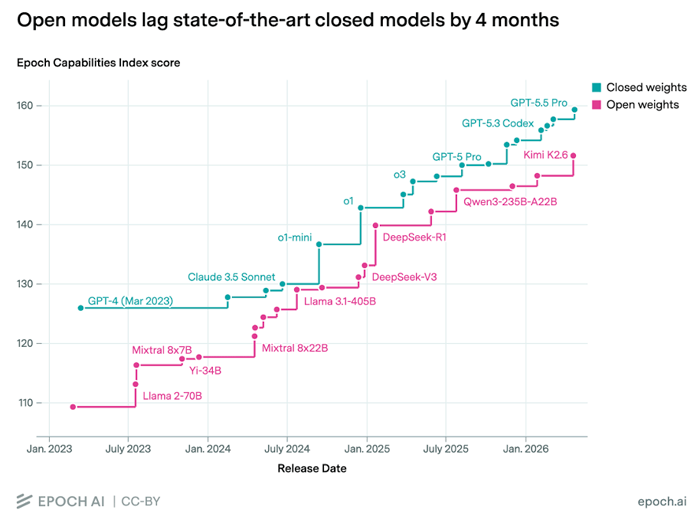
Source: Epoch.ai
This is significant considering the leading models are more than 40 times the price per input token than the leading open-weight model.
The gap is narrowing.
Any small adjustment to how these models are trained, source data, or incentivize contributors could close the gap entirely.
Very soon, AI users could face a choice: onerous controls forced on them from the closed models…or an open-source alternative that is just as good.
The resources to build and experiment with these decentralized solutions are all there. And it’s only set to grow. And the decentralized AI solutions that spring from this experimentation will not be asking you for your driver’s license or Social Security number.
It’s the permissionless ethos…and it’s coming to artificial intelligence in a big way.
Add Brownstone Research as your preferred source on Google to see our latest stories in your feed.
 Add as a preferred source
Read the latest insights from the world of high technology.
Fortunately for Bessent, there’s one group of buyers with a voracious appetite for short-term U.S. debt.

Stocks were climbing out of bear territory, but then the bond market spoke up.

These factories will cost billions before even a single working chip is produced…