



Bessent Finds His Buyer
Fortunately for Bessent, there’s one group of buyers with a voracious appetite for short-term U.S. debt.



The new regime arrived in under 48 hours, loudly, and got bought just as fast.

By Jason Bodner, Founder, Outlier Intel
Two stories played out last week.
The first is the one everyone saw.
A hotter-than-expected May jobs report on June 5 raised the odds the Fed keeps rates higher for longer. Semiconductor stocks extended a slide that started a day earlier, when Broadcom beat estimates but still drew margin concerns from a market that had priced in perfection.
Treasury yields jumped, growth got sold, and the Nasdaq Composite dropped 4.2% in a single session, its worst day in months. For about 48 hours, it looked like trouble.
The second story was running quietly underneath, and it had been for a while.
Capital flows had been sliding for six weeks before the selloff, even as the S&P kept grinding to new highs. Conviction was leaking out while prices kept climbing.
The June 5 drop wasn’t a bolt from nowhere. It was the moment price finally caught up to what the flows had been saying for a month.
The more interesting question isn’t why the market fell. It’s what happened after.
June 8 was a quiet digestion day. Then June 9 and June 11 produced the two strongest single-day inflow readings of the entire seven-week stretch. The reading from June 11 was the strongest of the year.
That same day, the Nasdaq ripped more than 2.5% and the S&P rallied nearly 1.8%. When markets are genuinely breaking, money leaves and stays gone. That’s not what this looked like. Buyers showed up fast, and in size, right at the bottom.
The rotation underneath was just as telling. Over the last five sessions, real estate and healthcare led with the strongest inflows, financials and industrials close behind, while materials saw the sharpest outflows by a wide margin.
The ETF data filled in the picture: gold, silver, platinum, palladium, bitcoin funds, Ethereum funds, even short-duration Treasuries and TIPS all saw money walk out the door in the same stretch that stocks wobbled.
That’s not the classic flight to safety. It’s closer to raising cash first and figuring out where to put it second.
The redeployment followed almost immediately…into high-dividend ETFs, REITs, regional banks, healthcare, and dividend aristocrats.
These are the kind of names you buy when you think the market is finding its footing, not when you think it’s falling apart.
The old regime was a market that looked calm on the surface while conviction quietly drained away for six weeks. The new regime arrived in under 48 hours, loudly, and got bought just as fast.
Even SpaceX’s debut fits the theme: In a week full of anxiety and headlines about everything that could go wrong, capital markets are still willing to write the largest check in history on a bet about the future.
What the flows confirmed wasn’t fear, it was appetite, rotating toward the parts of the market that benefit once a shakeout gives way to stabilization.
By Joe Withrow, Senior Analyst, Brownstone Research
Do you remember ‘SaaSpocalypse’?
If not, don’t worry. The market forgot it too.
For two years, a narrative quietly metastasized across Wall Street… the SaaSpocalypse was upon us.
The thesis was brutal in its logic. AI coding assistants like Claude Code, GitHub Copilot, Cursor, and ChatGPT were going to commoditize software development.
Fewer engineers would be needed. Enterprises would shed their various software as a service (SaaS) subscriptions. This caused a sharp selloff in most stocks even remotely associated with the SaaS business model.
Software was ‘dead,’ the thinking went. And to be sure, some are.
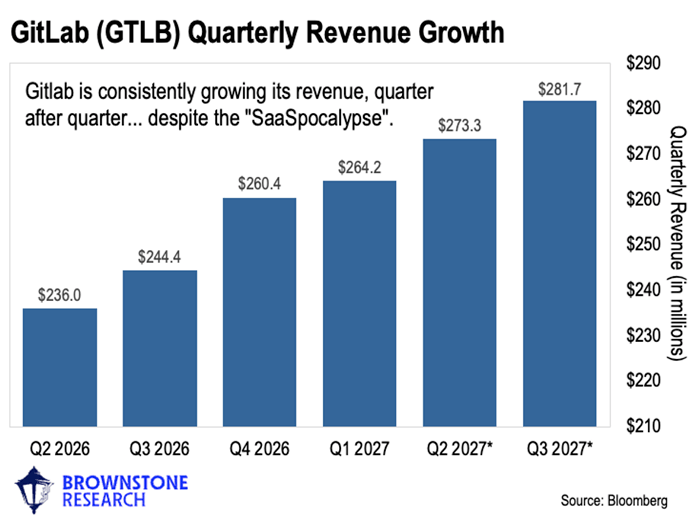
But those software companies that are leveraging AI productivity gains are demonstrating that SaaSpocalypse was way overblown. We can see that clearly if we look at GitLab’s quarterly revenue growth.
GitLab is a DevSecOps platform. It provides enterprise software that helps developers write code, run security scans, review work, and manage the entire software lifecycle.
If the SaaSpocalypse were all-encompassing and inevitable, it would show up with a company like GitLab first. But that’s not the case.
GitLab generated $264.2 million in revenue in its fiscal first quarter of 2027, which represents stellar year-over-year growth of 23%. And as we can see above, GitLab’s revenue growth is projected to accelerate over the next two quarters.
Clearly, GitLab is not a victim of ‘SaaSpocalypse’. In fact, the company just authorized a $400 million share buyback and announced a workforce reduction of 14%.
That last combination is where the real story lives — and where the SaaSpocalypse thesis breaks down for innovative companies that leverage AI.
Most software companies have structural gross margins of 70–80%. And during the ZIRP era (zero interest rate policy) of 2020–2022, free capital and a growth-at-all-costs culture drove many software companies to hire more employees than they needed.
Their strong economics absorbed it easily. These companies hired not because every seat was necessary, but because they could afford to, and because Wall Street rewarded a rising headcount as a signal of future growth. But when the interest rate cycle turned and multiples compressed, the bloat became visible.
But most companies weren’t able to cut their bloat initially. They needed a business justification, or else the market would take it as a sign of distress.
AI provided that justification. GitLab’s Duo AI product line is performing the work those excess roles were hired to do. The 14% reduction isn’t AI displacing essential workers. It’s AI giving management the cover to cut what was always unnecessary overhead.
The distinction matters enormously. This isn’t a hollowing-out story. It’s an operating leverage story.
The $400 million buyback running simultaneously confirms it. A company absorbing restructuring costs while returning that volume of capital is not in distress. It is in a strong financial position.
The market understood this. In a week when the Nasdaq fell nearly 4.2% and semiconductor stocks had their worst session since March 2020, GitLab’s share price rose over 20% from the week prior. That’s our signal that the market is catching on to the truth.
The SaaSpocalypse assumed AI would eat the software layer. What actually arrived was an AI-enabled margin expansion cycle. And GitLab is one of the cleanest early examples of what that looks like when the numbers hit the page.
By Clint Brewer, Senior Analyst, The Opportunistic Trader
Consumer inflation just spiked to its highest level in over three years, and the underlying driver is here to stay.
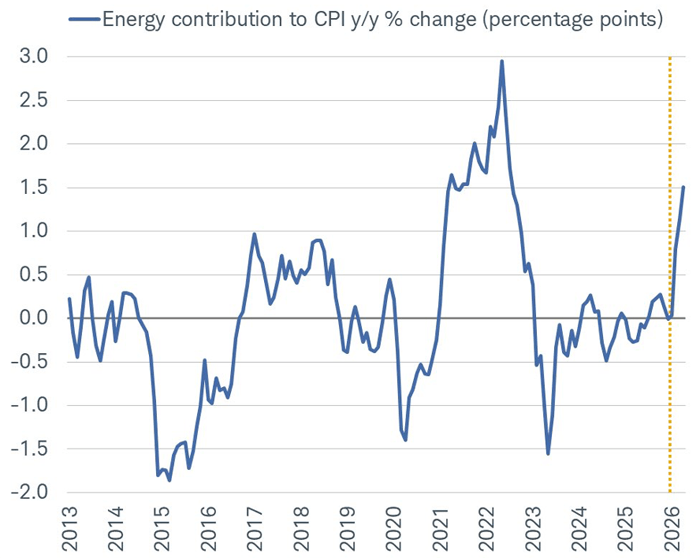
The Consumer Price Index (CPI) jumped by 4.2% in May, which was the highest level since April 2023.
Within the CPI report, soaring energy prices drove the bulk of the increase and accounted for over 60% of the rise in inflation. The chart below shows energy’s contribution to CPI.
Source: Charles Schwab, Bloomberg, as of 5/31/2026.
Gas prices rose 7% for the month and over 40% compared to last year. Diesel prices jumped 51% on a year-over-year basis.
That’s more than a frustration for consumers topping off the tank. Refined fuel—especially diesel—is essential for transporting all consumer goods. And as those logistics costs increase, they result in higher prices for all items people buy.
This all stems from the spike in oil prices following the outbreak of war between the U.S. and Iran. Oil prices have surged as much as 68% following the start of the war. And although oil has come off its peak, prices remain 56% higher on the year.
Before the war started, approximately 20% of the world’s oil consumption transited the Strait of Hormuz every day. But now tanker traffic and oil exports are at a crawl.
Given the impact of high energy prices, consumers and businesses alike are hoping for quick relief. Headlines keep teasing that a peace deal between the U.S. and Iran is within reach, and that exports of energy products through the Strait of Hormuz can resume.
But hopes are dimming for a deal anytime soon after Iran downed a U.S. helicopter, which drew retaliatory missile strikes. Since then, the president has said a peace deal could arrive any day. But we’ll believe it when we see it.
Here’s the thing…even if a peace agreement is struck today and tanker traffic through the Strait of Hormuz went back to pre-war levels, it would take months to restore oil production and for shipping flows to reach levels seen before the war.
In addition to restarting production, which takes time, there has been significant damage to oil infrastructure from Iran’s drone attacks. That includes strikes on Qatar’s Ras Laffan Industrial City that accounts for 20% of the global natural gas trade.
The head of the International Energy Agency said it could take two years to repair energy infrastructure and see output fully recover in the region.
At the same time, oil inventories are being quickly depleted. That’s because nations across the globe have blunted a further spike in energy prices by releasing oil inventories.
One estimate from the U.S. Energy Information Administration (EIA) shows global oil inventories plunging by a record 8.5 million barrels per day in the second quarter of 2026.
But the record drawdown of crude is leaving inventories at dangerously low levels. The EIA estimates that stockpiles among developed nations are at their lowest levels since 2003, which is when records began.
Now oil producers and energy trading companies are sounding the alarm. An executive from ExxonMobil recently warned that oil inventories were approaching “unheard of” levels and that prices could “shoot up.”
Oil trading company Trafigura said that the world had largely run through its buffers of fuel inventories.
Normalizing oil production and repairing damaged facilities will take time while inventories are also running at historic lows.
That means high oil prices and the impact on inflation are here to stay.
Add Brownstone Research as your preferred source on Google to see our latest stories in your feed.
 Add as a preferred source
Read the latest insights from the world of high technology.
Fortunately for Bessent, there’s one group of buyers with a voracious appetite for short-term U.S. debt.

Stocks were climbing out of bear territory, but then the bond market spoke up.

These factories will cost billions before even a single working chip is produced…