




The Hidden Bear
Sometimes, what you see depends on how you’re looking, not just what is there.



When institutional capital moves through theme ETFs rather than individual names, it signals conviction in the direction, not just the destination.

By Jason Bodner, Founder, Outlier Intel
It looks like capital is willing to take real risk again…
Parsing the data, capital flows were heavily inflow weighted last week. Buying was steady, broad, and confident.
The VXX, the volatility ETF that institutions use to hedge against drawdowns, was the only ETF outflow last week. Investors are actively selling their downside insurance.
Technology posted 132 inflows against 12 outflows, the most lopsided ratio in weeks. Industrials posted 69 against 11. Materials, which recently had zero inflows and fourteen outflows, completely flipped to 25 inflows and zero outflows. Consumer Discretionary, which had been bleeding for a month, also flipped from 9 inflows to 61.
The market is not just rallying. It is rotating into the trades that work when capital is willing to take real risk again.
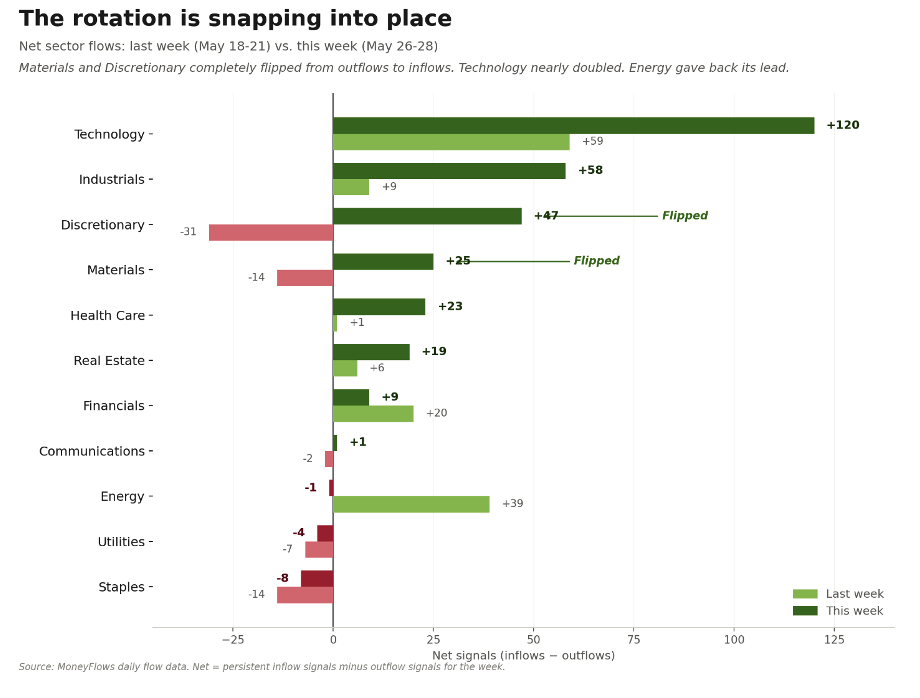
But here’s what’s interesting: Theme ETFs were gobbled up multiple days running.
That includes:
Momentum ETFs (MTUM, SPMO) and small-cap value ETFs (AVUV, IJR) joined them. Even leveraged international exposure caught a bid.
This is not stock picking. This is regime positioning. Eight distinct innovation themes are being bought simultaneously by allocators willing to commit through index vehicles. When institutional capital moves through theme ETFs rather than individual names, it signals conviction in the direction, not just the destination.
The setup matters because it tells you what kind of market we are in.
Capital is not just buying because there is nowhere else to go. Capital is buying themes—AI, space, semiconductors, cybersecurity, clean energy, innovation, biotech, data infrastructure.
Capital is selling its volatility hedges, flipping into materials and discretionary, and broadening leadership beyond the largest names.
This is regime positioning, and the historical record says regime positioning of this character has consistently been rewarded.
The mainstream commentary is worried about inflation, the Fed, and whether the rally has run too far.
The flows say something else.
The rally is just getting reorganized.
By Ben Lilly, Editor, Chain of Thought
The CFTC just gave the greenlight for Americans to trade crypto’s most popular product—perpetual futures.
Perpetual futures (sometimes called “perps”) let traders speculate on an asset’s price, long or short, without owning it. And unlike a standard futures contract, they never expire. Since they first launched on BitMEX back in 2016, perpetual futures have been crypto’s most widely used instruments.
Perpetual futures make up roughly 75% to 80% of all crypto trading volume. In 2025 alone, that figure accounted for tens of trillions of dollars.
But that massive market had always been off-limits to U.S. institutions and retail traders alike.
That’s because, for the past decade, U.S. law only allowed leveraged crypto trading on a registered exchange, which meant these products were off limits for Americans. So, the volume went offshore and stayed there.
But that changed Friday. Americans now have the greenlight to begin trading. Coinbase’s chief legal officer called it “a massive first for the industry.” Coinbase can now route U.S. customers into perpetual futures listed on Deribit, its offshore affiliate exchange.
The CFTC also approved prediction platform Kalshi’s BTCPERP contract, making it the first federally regulated Bitcoin perpetual in the country. And crypto exchange Kraken is planning its own launch within the next month.
This is important for one reason: It allows traders and money managers to attain directional price exposure without locking up the full value of a position.
Futures aren’t a sideshow. For much of institutional capital, they’re the main event, the layer where the big money manages its risk.
The benchmark COMEX gold contract trades the equivalent of nearly 27 million ounces a day, more than $100 billion changing hands daily. E-mini S&P 500 futures trades nearly $500 billion of notional value every single day. The Treasury futures market accounts for trillions each year.
This rule change now means funds and ETF issuers holding spot Bitcoin can hedge it in a regulated venue. It will enable them to run the same basis trades that hedge funds have been running in traditional markets for decades.
And that’s just the immediate implications…
Five years out, this will be remembered as the moment crypto crossed the chasm into a mature market.
Perps onshore open the entire institutional playbook of structured products, yield strategies, and the trillions of dollars that will inevitably chase after it.
By Feruz Kurbanov, Senior Analyst, Brownstone Research
Bristol-Myers Squibb (BMY) just made a huge announcement.
The global pharmaceutical giant struck a strategic deal with Anthropic to deploy Claude, Anthropic’s AI, across its entire global operation.
Think of it this way.
BMY makes medicines that treat cancer, blood diseases, and serious immune disorders. They’ve been doing this for over 160 years. And they’ve decided that AI isn’t just a nice tool to have — it’s going to be woven into almost everything they do.
This is more than a tech partnership. It represents a sea change in how new medicines are discovered.
Traditionally, developing a new drug is painfully slow and extremely expensive. It can take more than 10 years and billions of dollars to bring a single medicine to market. Scientists often test thousands of chemical combinations before finding one that works safely.
Most attempts fail.
Artificial intelligence could dramatically speed up that process. Modern AI systems can analyze huge amounts of biological data, study how proteins behave, predict how molecules might interact inside the human body, and help researchers identify promising drug candidates much faster than traditional methods.
In simple terms, AI may allow scientists to search for cures the same way advanced computers search through massive amounts of information online. But this time, the search is happening inside human biology itself.
The scale of the rollout is what’s important.
More than 30,000 BMY employees will be given access to Claude’s advanced capabilities. That’s not a small pilot program. That’s a company-wide transformation.
BMY is preparing for AI to become part of the company’s everyday operations. It’s similar to how email, cloud computing, and data analytics became essential business tools over time.
The company also made it clear that AI will not be limited to simple office tasks.
According to the announcement, these systems could eventually help scientists search for new drug targets, assist researchers running clinical trials, improve manufacturing efficiency, help organize complex regulatory paperwork, and even support commercial decision-making. In other words, AI is being woven into nearly every stage of the pharmaceutical pipeline.
One of the most interesting parts of the announcement was the company’s focus on “AI agents” rather than basic chatbots.
Most people are familiar with chatbots that answer questions or generate text.
But AI agents go much further.
These systems are designed to complete tasks, analyze information, make recommendations, and assist human workers inside real business workflows.
These agents could help researchers compare thousands of scientific studies in minutes or identify patterns in clinical data that humans could easily miss. If AI can help pharmaceutical companies speed up research, reduce failures, or lower costs even slightly, the financial impact could be enormous — not just for the companies themselves, but for the entire healthcare system.
Here’s the bigger picture…
AI, genetics, and biotechnology are beginning to merge into a single technological wave. Just as software transformed banking, retail, media, and communication over the past few decades, programmable biology could eventually reshape healthcare, agriculture, manufacturing, and even energy production.
That’s why many investors and scientists are becoming increasingly excited about biotechnology.
This is more than another healthcare story. It’s the early stages of an entirely new economic and technological era.
Add Brownstone Research as your preferred source on Google to see our latest stories in your feed.
 Add as a preferred source
Read the latest insights from the world of high technology.
Sometimes, what you see depends on how you’re looking, not just what is there.

If the Fed has gone back to raising rates, why was the post-hike bounce in stocks so strong?

To be completely fair, there is a non-zero chance that things go horribly wrong