




Bessent Finds His Buyer
Fortunately for Bessent, there’s one group of buyers with a voracious appetite for short-term U.S. debt.



SMH fell 6.4% in the three days following the Kimi K3 release. Here’s why you shouldn’t worry…
By Nick Rokke, Senior Analyst, Brownstone Research
In January 2025, DeepSeek, a China-based AI developer, appeared to deliver a major leap in efficiency. Reportedly, DeepSeek-R1 was trained for just $5.5 million and could run inferences 20 times cheaper than existing large language models (LLMs) like OpenAI’s GPT series.
This rattled the investing world. If this were true, it would likely reduce the premium that LLM pioneers could charge for their services, impacting their profitability.
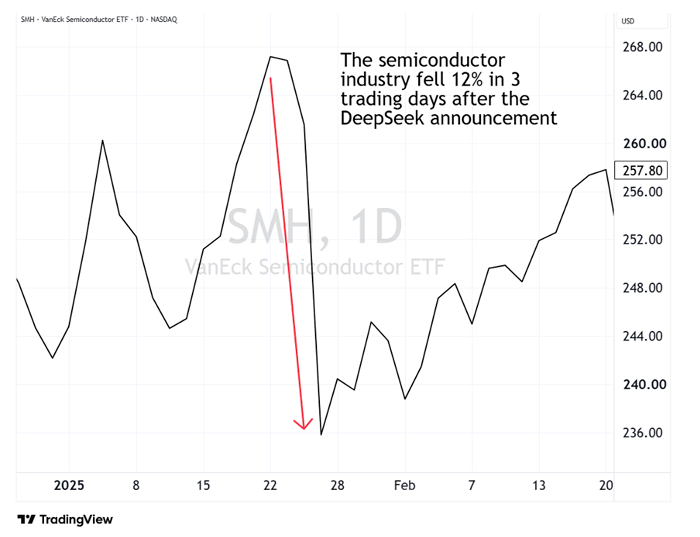
We were skeptical that DeepSeek represented a true cost breakthrough in AI model inference. But the market sold off. In three trading days, the VanEck Semiconductor ETF (SMH) fell over 12%.
Of course, lower cost of inference isn’t bad. Even if DeepSeek’s efficiency claims were accurate, the sell-off made no sense. Cheaper AI doesn’t shrink the market; it expands it.
The Jevons Paradox states that as something becomes cheaper, usage goes up even more than the cost decline. So revenues increase.
For example, the steam engine made coal use more efficient, but demand for coal actually increased. As the cost of rail transport declined, more passengers began to travel, and more businesses used rail for shipping.
We have seen the same pattern repeat with data storage, internet bandwidth, and major technology platforms. As the cost falls, developers find more uses. Adoption rises faster than the price declines. AI will be no different.
Lower inference costs make more applications profitable. Companies automate more processes. Developers build more capable products. AI agents run longer, handle more tasks, and interact with other agents. Every one of those activities requires compute.
And in the year and a half since the DeepSeek panic, semiconductor stocks have more than doubled.
But now we’re witnessing a new round of fearmongering. Last week, Kimi.ai released its new Kimi K3 model. The benchmark results are impressive. Across several coding tests, Kimi K3 is ranked alongside top models from OpenAI (GPT 5.6 Sol) and Anthropic (Fable 5).
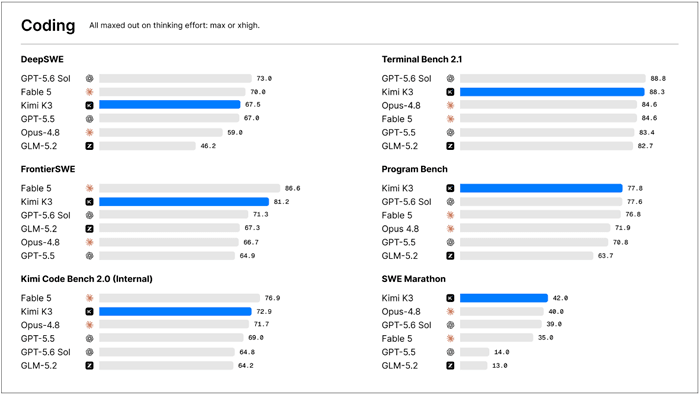
The market’s concern is familiar. Kimi comes from China, where hyperscalers’ spending is a fraction of their U.S. counterparts.
If China can produce a frontier-level model for less money, perhaps the massive U.S. data center buildout is unnecessary.
Once again, that conclusion is wrong.
The first issue is distillation. Distillation is the process of querying a stronger “teacher” model millions of times, then using those responses to train a smaller “student” model. It can reproduce valuable reasoning patterns, coding approaches, and terminal logic at a fraction of the original development cost.
Evidence suggests Kimi’s training pipeline benefited from large volumes of data generated by U.S. models such as GPT and Claude. Distillation can make a model cheaper to train. But it is not the same as independently pushing the frontier forward.
Second, Kimi may also benefit in coding benchmarks from having fewer protective guardrails than U.S. models.
The bigger point is that even if models are becoming cheaper to train, that is bullish for infrastructure demand. Lower costs mean more companies can train models. More training produces more capable systems. Better systems create more profitable applications. And more applications generate more demand.
That means more GPUs, networking equipment, memory, power, cooling, and data centers.
The capital spending confirms it. Meta and Google have raised their spending plans. Taiwan Semiconductor is increasing investment in new fabrication capacity. And ASML is expanding production capacity for the EUV machines needed to manufacture leading-edge chips.
Still, the market sold semiconductor stocks again. SMH fell 6.4% in the three days following the Kimi K3 release.
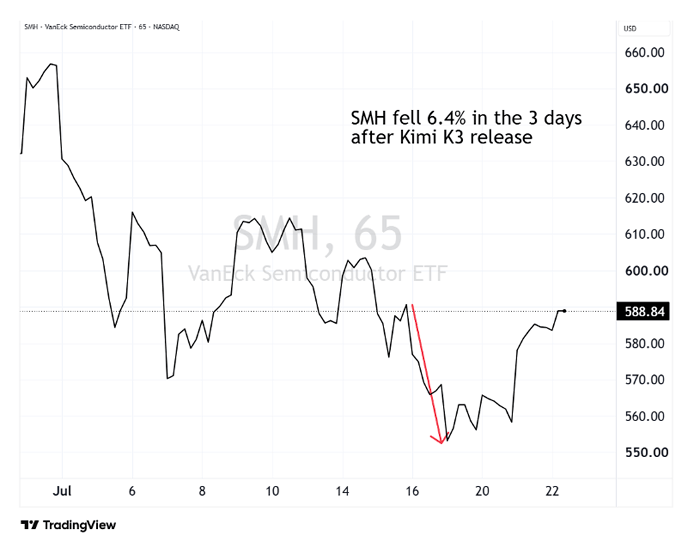
But the market remembered the lesson from DeepSeek. Within days, SMH recovered from the Kimi drop.
I’ll go out on a limb here and say semiconductor stocks have bottomed.
By Joe Withrow, Senior Analyst, Brownstone Research
The Sprott Uranium Miners ETF (URNM) tracks an index of companies engaged in the exploration, mining, and production of uranium. It has fallen roughly 16% this year as the stocks of uranium mining companies have sold off across the board.
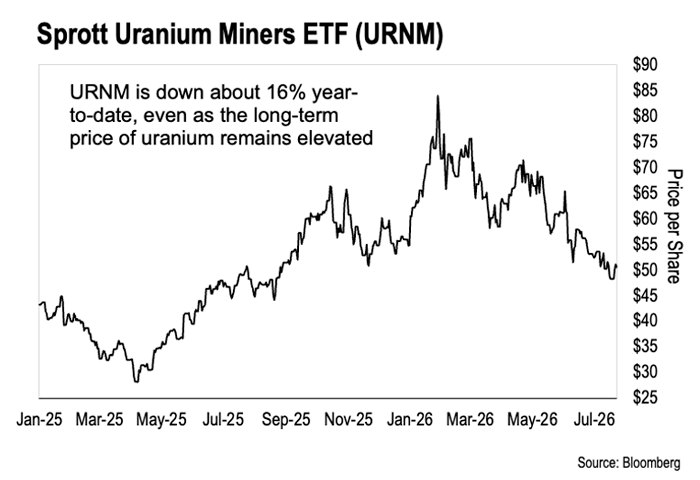
As we know, uranium is the fuel that powers nuclear fission reactors. So on the surface, the pullback in uranium stocks would suggest that the uranium market is weakening and that the prospects of a nuclear energy revival are in question.
But if we look a little deeper, we’ll see that the market is ignoring a major signal.
The long-term uranium contract price closed June at $94 per pound – its highest level in 18 years. That means utility companies are now willing to pay higher prices to lock in uranium supply years in advance.
This is the clearest sign yet that buyers expect the physical market to stay tight (or get tighter), since the long-term price is set by actual utility contracting decisions, not day-to-day trading sentiment.
So the price of physical uranium is going up, but the stocks of uranium mining companies are going down. What gives? The mining companies make more money when they can sell their uranium at higher prices, so we would expect them to trade in line with the spot price.
This is a textbook case of the physical commodity market telling us one thing and the equity market telling us the opposite. But the two can’t both be right at the same time. As such, we can expect one or the other to reverse course. The question is – which?
The long-term price of physical uranium is the number that actually matters here, because it represents the price utility companies are actually paying for uranium.
Given that the physical price just hit an 18-year high, this signals that utility companies are accepting higher prices to lock in future supply, which they would only do if they expected the physical market to tighten and uranium prices to move even higher.
And here’s the kicker – annual demand for physical uranium is around 180 pounds and expected to increase to over 300 pounds by 2040. Yet current annual production is only about 160 million pounds globally.
Given current stockpiles, the industry would need to roughly double annual production just to keep pace with rising demand. But given how difficult and time-consuming it is to bring new mines into production, such a production increase seems very unlikely.
Thus, it’s a good bet that the physical market is right and the equity market is wrong about where uranium prices are headed. If that’s the case, the current pullback represents a buying opportunity.
By Jason Bodner, Founder, Outlier Intel
Taiwan Semiconductor (TSM) reported earnings last week. It beat expectations. Revenue was strong. Guidance was solid. Yet the stock fell anyway, dragging chip names down with it and sending the Nasdaq lower by nearly 1.5%.
That’s not a fundamentals story. It’s a sentiment story.
When good news stops being enough to push prices higher, the market is telling you something about its current mood. Right now, that mood is cautious. Frankly, there are good reasons for that caution.
The United States and Iran have been exchanging strikes once again, bringing renewed concerns about the Strait of Hormuz and the impact on global energy markets.
At the same time, investors continue hanging on every word from the Federal Reserve, wondering whether interest rates may need to stay higher for longer. Senator Lindsey Graham’s sudden passing also introduces another layer of political uncertainty as attention begins turning toward the fall midterm elections.
Markets don’t like unanswered questions. Right now, there are plenty of them.
Adding to the uncertainty, SpaceX has fallen below its IPO price. Just a few weeks ago, it represented the peak of investor enthusiasm. Today it represents something very different. It’s another reminder that sentiment can change much faster than fundamentals.
Yet the core facts haven’t changed.
Artificial intelligence isn’t going away because investors became more cautious for a few weeks. Hyperscalers aren’t canceling data center projects because the Middle East is less stable. Companies aren’t slowing the biggest infrastructure buildout in decades because one stock sold off after reporting a great quarter.
The headlines changed. The businesses didn’t.
In fact, periods like this are often when the best long-term opportunities are created. When strong companies get marked down for reasons that have little to do with their own execution, patient investors are often rewarded.
Here’s what the money flows are telling us beneath the surface.
Institutional investors have become more defensive than they were two months ago. They’re rotating toward financials, established companies, and areas perceived as safer while trimming exposure to some of the year’s biggest winners.
That’s exactly what you’d expect after a powerful rally collides with an uncertain news cycle. Reducing risk doesn’t mean institutions have abandoned AI. It means they’re managing portfolios.
That’s why I think it’s important to separate price action from the underlying investment thesis. Prices can move quickly as investors react to headlines. Business fundamentals usually change much more slowly.
History also gives us some perspective.
Midterm election years have historically been the weakest and most volatile years of the four-year presidential cycle.
But the fourth quarter of midterm years has often been one of the strongest periods of the entire presidential cycle. Some of the market’s best one-year returns have started from those midterm lows. History never repeats perfectly, but it often rhymes.
I understand why some investors feel tempted to reduce exposure during periods like this.
That’s a natural reaction.
But selling great companies because of temporary uncertainty rather than permanent deterioration is a decision that investors often regret.
The geopolitical headlines will fade. The market will gain clarity on interest rates. Election uncertainty will eventually pass. Through all of it, the companies building the next generation of AI infrastructure will continue doing exactly what they’ve been doing all along.
Add Brownstone Research as your preferred source on Google to see our latest stories in your feed.
 Add as a preferred source
Read the latest insights from the world of high technology.
Fortunately for Bessent, there’s one group of buyers with a voracious appetite for short-term U.S. debt.

Stocks were climbing out of bear territory, but then the bond market spoke up.

These factories will cost billions before even a single working chip is produced…