



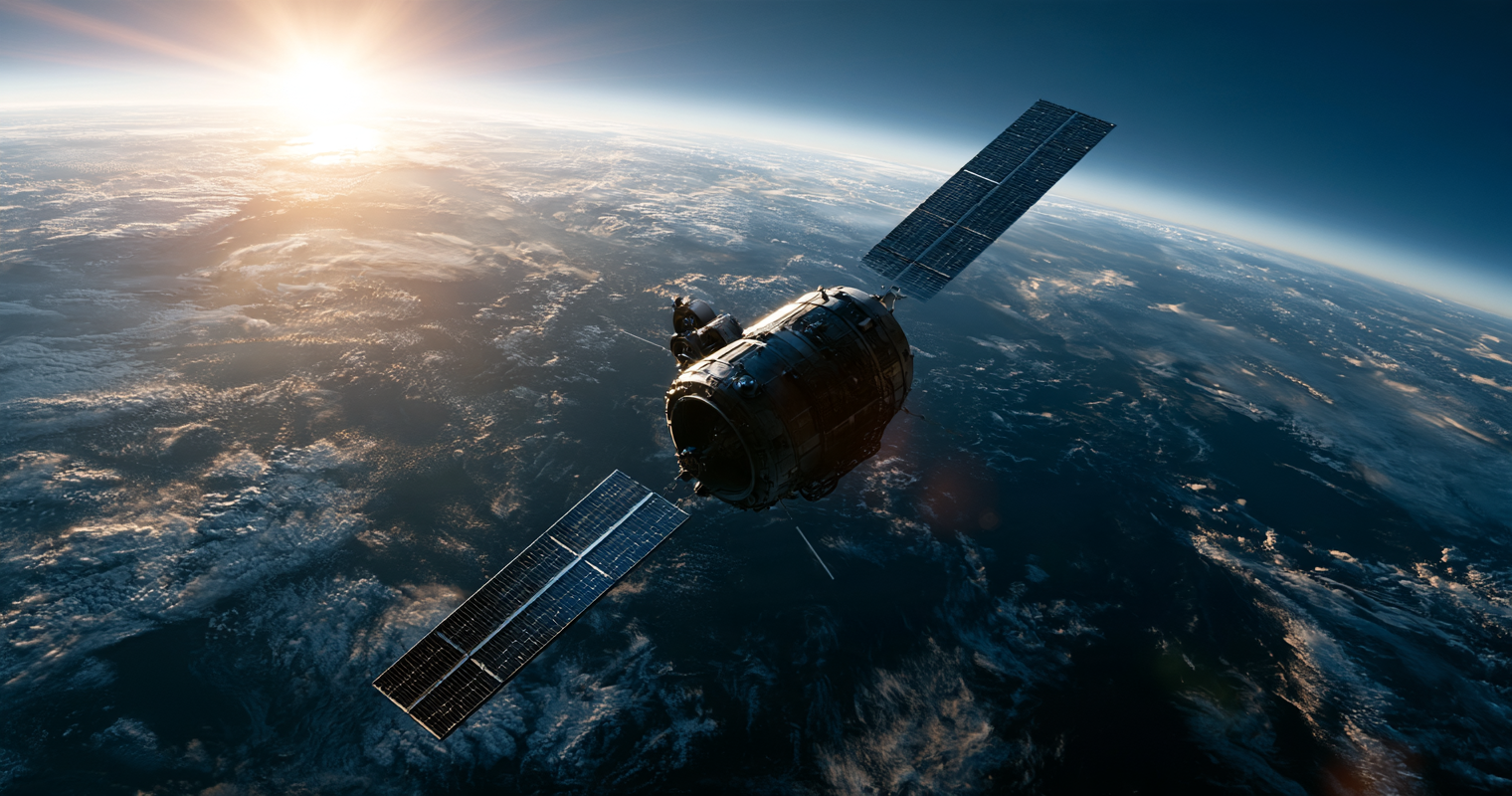
Project Suncatcher Lifts Off
An incredible development in both artificial intelligence and the space economy launched from the other side of the country...



Advanced Micro Devices (AMD) just announced a stunning deal to acquire privately held World Labs for $8.2 billion.
As we explored this week in The Bleeding Edge, the events this week in the aerospace industry were extraordinary…
SpaceX conducted its first commercial and orbital flight for its Starship. It also deployed the first 26 Starlink version 3 satellites into orbit, a major milestone. NASA/SpaceX launched four astronauts to the International Space Station, and Google deployed its first Project Suncatcher prototype AI satellite atop a SpaceX Falcon 9 rideshare mission.
Pretty much all of the major leaders in artificial intelligence technology gathered at the White House and signed an agreement to both develop superintelligence responsibly, as well as ensure that the U.S. remains the world leader in AI.
And perhaps not coincidentally, OpenAI CEO Sam Altman announced that they would be delaying the release of its next frontier AI model, GPT-6.1 Astra, due to it failing internal alignment and safety tests.
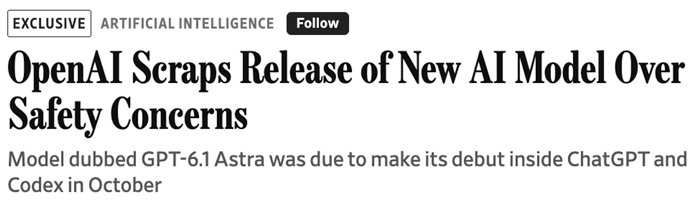
Source: The Wall Street Journal
This was clearly a show to demonstrate support for the “develop responsibly” initiative just agreed upon by the industry, and it was also a necessary thing to do given the recent problems that OpenAI has been having with its frontier models.
This is the correct way for the industry to manage product releases and limit future product liabilities. Just like any other industry, don’t release products until they have successfully passed quality and safety controls.
Advanced Micro Devices (AMD) also announced a stunning deal to acquire privately held World Labs for $8.2 billion. World Labs was founded by Stanford professor Fei-Fei Li – a prominent figure in AI most well-known for computer vision technology. Not surprisingly, World Labs’ mission is to develop frontier AI models that advance spatial and physical intelligence.
This is an interesting acquisition as it brings AMD valuable software assets that can be used widely in industry. World Labs has already commercialized Marble, which is a generative AI model that creates 3D worlds that can be used for things like gaming and simulation.
Not yet commercialized by World Labs is software known as its R2S2R, which is used to simulate environments for the purpose of training various forms of robotics that are used in the real world – physical AI.
From my perspective, AMD’s acquisition is primarily designed to position AMD well for managing inference payloads on intelligent robots. And that is exciting.
Have a great weekend,
Jeff
What is the reason that these [diesel] prices are rising? It has to be more than the wars, right? I was thinking when Musk gets his battery-operated semis delivering that this will come down. But that may be a while. Are we going to build more refineries to process diesel, and is this an investing opportunity?
– John G.
Hi John,
This is actually an interesting topic given the current industry and geopolitical events. The answer isn’t just a simple one, as you suspected.
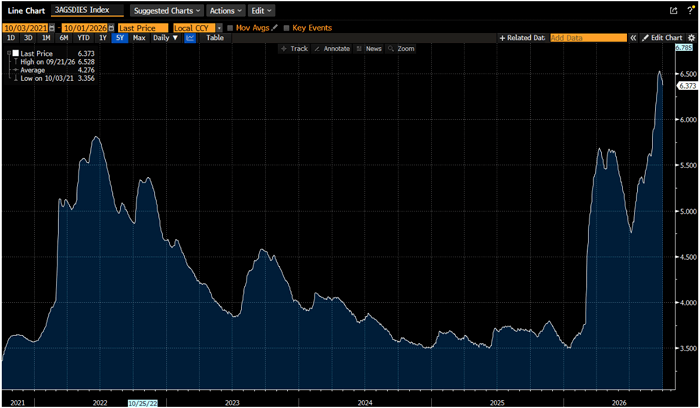
So that we’re all on the same page, the national average price of diesel per gallon is hovering around $6.37 and was recently above $6.50. It is near all-time highs.
5-Year Chart of National Average Cost of Diesel per Gallon
Source: Bloomberg
And as we can see in the five-year chart above, this is a dramatic spike in price from the beginning of the year when it was hovering about just $3.50.
So, to your point, what is driving this spike in diesel prices?
There are three main contributors to the price of diesel: the price of crude, the refining capacity to produce diesel from crude, and the demand from the freight industry.
So yes, there is an impact on the price of diesel due to the increase in crude oil as a result of the conflict with Iran. But that is not the main driver.
The major catalyst is actually the Ukrainian/Russian conflict. Specifically, Ukraine has been striking Russian refineries. About half of Russia’s largest diesel-producing refineries have been hit by Ukraine, causing the refineries to cut production or shut down entirely.
This resulted in the Russian government halting exports of diesel this July. Unfortunately, Russia is one of the largest exporters of diesel, so the absence of its exports has directly impacted the price.
The second-order effect of what Ukraine has done to the Russian refineries is that China has also cut back diesel exports, further putting pressure on the price.
The U.S. currently produces more diesel than it consumes and is a net exporter of diesel. However, due to the shortages, foreign bidders on U.S. diesel exports are currently keeping diesel prices high.
Where the money is being made right now is in the crack spread, which is the margin that is made by refiners between the cost of crude and the price they get for selling the refined product. Recently it exceeded $100 – an all-time record.
That means players like Phillips 66 (PSX), Valero (VLO), Marathon (MPC), HF Sinclair (DINO), etc. are raking in the cash on these crack spreads. One thing to keep in mind though…
This is just temporary. It’s not going to endure for years to come. It’s more of a short-term trading opportunity.
As for your point about electric semis, this issue with diesel prices has been an incredible development for Tesla.
The Tesla Semi has a 500-mile range, and more importantly, the cost per mile with a Tesla using electricity is around $0.20-0.30 depending on where you are in the U.S. That compares to a cost per mile using diesel around $0.80.
It is significantly cheaper using a Tesla Semi right now. And don’t forget, they drive themselves, making for a far more pleasant ride for the drivers.
With that aside, the problem is that Tesla’s Semi production is limited. Once it ramps up its Nevada plant, it will be able to produce 50,000 Semis a year. Even at full production, it won’t put a dent in the problem that affects millions of diesel-fueled semis.
Tesla (TSLA) will be able to sell as many as they can produce, though.
The most expensive part of Nvidia’s chips isn’t made by Nvidia. It’s a tiny device that’s sold out through 2027. And is expected to command $2 trillion a year from the AI giants. Nvidia’s CEO calls it “a technology miracle.” Without it, Nvidia’s chips wouldn’t work. In this video, Jeff Brown gives away the name of a key stock in this space, for free.

Trump's new national security mandate could be about to send $5.9 trillion into one tiny corner of tech. It's got nothing to do with AI. But in his last term, his moves in this sector handed folks 28x returns in two days. Click to see all the details.
A few months ago, I acquired $50 in USD crypto (actually the value was a little less after the “cost” of acquisition) and created and put it into my MetaMask wallet.
Scenario A: I owe you $20, and I give you a $20 bill – case closed. Simple and straightforward. No jumping backwards through flaming hoops to transact.
Scenario B: I want to transfer this $50 USD crypto to my Robinhood account and convert it into cash that I can use to purchase stock. There is a TON of things I need to do to make this transaction (that is, if it is successful at all).
Frankly, there is just TOO MUCH FRICTION for the average person to even want to use Crypto. And that does not even address seniors who would be totally LOST trying to use Crypto.
Until the crypto industry makes it as simple as Scenario A, this just isn’t going to be adopted nor embraced by the average (much less senior) crowd.
I hopefully will be able to successfully transfer my crypto to my Robinhood account.
When (and hopefully IF) that happens, I am Totally Done with Crypto. There is just TOO MUCH TIME drain on me trying to figure out how things work (together) to justify its use – and what should have been a simple transaction. Cash, checks, CC works well for me – simple and straightforward. This crypto insanity is just not ready for prime time. Until they get things together so it’s as simple as Scenario A, it’s not going anywhere. I wasted over $100 of my valuable time trying to figure out all this madness. And I’m still stumped. Certainly not a ‘glowing’ endorsement of using this fake currency.
That’s just my $.02 USD worth.
– Thomas W.
Hi Thomas,
You raise an important point about what I have long referred to as friction in using blockchain technology.
And if I think back to what it was like 10 years ago, I agree with you fully. It was a lot more work compared to what it is like working with a normal equities broker.
Fortunately, it is a lot easier today.
It is very simple now if you work with major digital asset exchanges like Kraken and Coinbase. These platforms have become very simple to use, and the cost of moving from a fiat currency to crypto has declined significantly.
In my buy-and-hold investment research product for digital assets, Permissionless Investor, and my digital assets trading research service, Neural Net Profits, we focus only on cryptocurrencies that can be purchased on these platforms. That helps keep things simple, and these are the two best digital asset exchanges in the U.S. to work with.
We also provide our subscribers with some educational material to help those less familiar with working with cryptocurrencies get comfortable quickly when they start using these research services.
With today’s platforms, the learning curve is quick, and the fees have become much more reasonable.
Now, with that said, and to your point, I don’t recommend going from fiat into crypto back into fiat, back into crypto, etc. Going back and forth like that does create a lot of friction, specifically fees for converting one to another. That can get expensive.
A better approach is to convert a desired amount of U.S. dollars into a U.S. dollar stablecoin like USDC, and then use that capital to trade/invest in cryptocurrencies over a period. Exchanging back into fiat currency should only be done when you want to take profits off the table or need some liquidity.
We’ve been taking some large profits off the table recently in Permissionless Investor now that high-quality digital assets have moved higher this year. It has been exciting. It is a high-growth asset class with a lot of asymmetrical upside, with strong advantages given to those that understand the technology, the tokenomics, and how to best trade/invest in cryptocurrencies.
That’s why I produce investment research for digital assets, and also why I think it is definitely worth taking a little bit of time to get familiar with working with Coinbase and Kraken so that anyone can participate in this next generation of blockchain technology.
Thinking of cryptocurrencies as “fake money” is the wrong characterization for digital assets. To be fair, there are meme coins and tokens with no utility whatsoever. Those I agree are of extremely low value (or no value).
But high-quality cryptocurrencies represent the value of the underlying blockchain protocol, the blockchain application/service, or the utility/adoption of that technology. These are the kinds of assets worth investing in.
Thanks for sharing your $0.02. I hope you found mine useful.
Hi Jeff,
Your response to the question on an eventual bear market was very important to me and one I am very thankful that you addressed. I know that you don’t have a crystal ball. No one is perfect. I also know that you would be prepared for that eventuality. On the other hand, it is reassuring to see that understanding in writing. We all have to be ready for that time. I think it is going to be brutal, and we will need your take on events to get to the other side. You have an overwhelming responsibility to help us non-financial people survive. Thanks for taking it on.
– Tom K.
Hi Tom,
I sincerely appreciate you writing in with your thoughts and appreciation.
I want you and everyone who uses my research to know that I don’t take it lightly. I do treat it like a responsibility, which I believe it is. It is also a burden that I carry with me every day. My days tend to be long, typically 12-14 hours during all trading days, and I’m always putting in additional time on the weekends.
I’m a firm believer in having not just depth, but breadth in my own research. Probably only 20% of what I research ever gets published. I research anything and everything that can impact the markets, economies, asset prices, and world events. Doing so is critical to figuring out how to connect the dots and see things that others don’t see.
It’s also critical to have that perspective to have a better feel for timing when any individual sector – or, more broadly, the markets – will decline or enter a bear market.
I’d rather be early to a bull market than late, and I’d rather get out of a bubble a little early than wait too long to close out positions and suffer a terrible decline.
My team and I will keep working diligently to stack the deck in the favor of our subscribers and not be taken advantage of by Wall Street. My goal is to give my subscribers the information that will be useful for them to make the decisions that are best for them.
And when a downturn comes – and eventually it will – I’ll be sure to advise quickly on recommended actions to take and also share my thoughts on how to profit from the downturn.
Your mindset is correct. We do all have to be mentally prepared to take action when the time comes.
As for now, there is a lot to look forward to,
Jeff
Add Brownstone Research as your preferred source on Google to see our latest stories in your feed.
 Add as a preferred source
Read the latest insights from the world of high technology.
An incredible development in both artificial intelligence and the space economy launched from the other side of the country...

Imagine millions, and eventually perhaps billions, of AI agents working continuously. Every one of them needs computing power. They...

Anthropic’s gig could be up, and its value as a private company could collapse.