



Who Gets Access to the Most Powerful AI?
When demand exceeds supply, something has to give…



I was reminded of the medallion crisis – and the nature of competitive dynamics – when it came to the topic of distillation of frontier AI models.

In 1937, in the depths of the Great Depression, New York City’s streets were drowning in taxis.
Too many drivers were chasing too few fares, and the industry was in chaos.
So the city passed the Haas Act, capping the number of legal cabs at 13,595 and creating something called a medallion – a small metal plate, bolted to the hood of the car, that served as the permit to operate.
Without a medallion, a driver had no right to pick up a passenger who waved down a taxi from the curb. It was that simple.
The original license fee was just $10, and at the time, no one imagined the little plate would ever be worth more than that.
They were wrong.
Several major cities around the U.S. use a medallion framework to cap the number of taxi drivers in a city… and also raise revenue by selling the medallions.
By 1950, a medallion cost around $5,000.
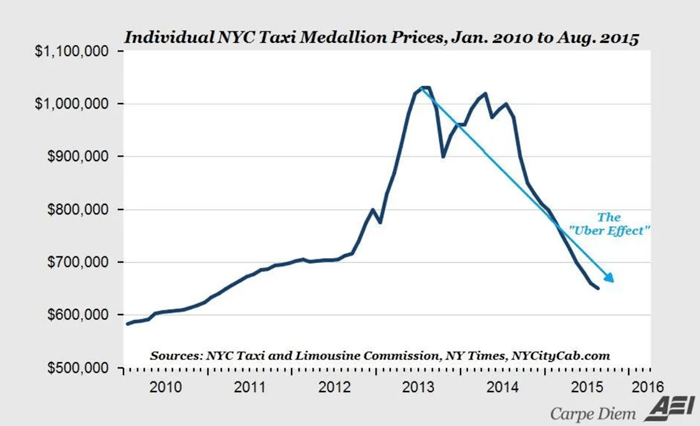
Medallions saw an incredible rise from 2010 to their peak in 2013 – when they sold for well above $1 million.
That’s what an artificial, government-enforced cap on supply can do to a permit.
It’s the perfect setup for a lesson in competitive dynamics – and the power of free markets.
The years 2011 to 2015 are a fantastic example, a period of incredible technological disruption.
In 2011, Uber (UBER) entered the New York City market, much to the chagrin of taxi medallion holders.
While the medallions apply only to the traditional yellow cabs…
Ride-hailing services operate under a different regulatory framework – they always have.
They are considered transportation network companies or for-hire vehicles, which do not require a medallion to operate.
The competitive threat of ride-hailing services was real and material to the traditional taxi industry.
And the response from those holding taxi medallions was as expected…
These new ride-hailing apps and services are dangerous.
The drivers are not vetted.
There are no safety standards.
We have to protect the public and keep them safe.
Sadly, the yellow cab industry missed the point.
Consumers were unsatisfied with the service that yellow cabs provided.
I remember the days in New York City when most yellow cabs smelled bad, were dirty, the back seat was crammed with very little room, the drivers were aggressive and often unkind, and often, the drivers were new, struggled to communicate, and didn’t know the city that well.
Generally not a good customer experience.
The market was desperate for a better experience for public transportation.
They wanted clean cars, transparent pricing, no need for cash, friendly and professional drivers, easy to access through an app, and for the driver to get them safely and efficiently from point A to point B.
Uber provided that and a whole lot more.
Its two-way feedback mechanism for the driver to rate the passenger and the passenger to rate the driver became an incentive to provide good service… otherwise drivers would receive bad ratings and could get kicked off the platform.
By the summer of 2014, Lyft (LYFT) had entered the NYC market… and the impact of both Lyft and Uber on medallion prices is simple to see in the chart below.
Source: AEI
In fact, today’s medallion prices are down to around just $100,000 – just a fraction of what prices were in 2010, and more than 90% lower than the peak in 2013.
Customers were demanding a better ride experience from taxi operators… and they took their money to Uber and Lyft for precisely that.
What was the competitive response from the taxi industry?
The yellow cab drivers doubled down. They dug their hole deeper…
And they made no effort whatsoever to improve the quality and pricing of their product – what consumers actually wanted.
Their competitive response was completely wrong, and they paid the price.
I was reminded of the medallion crisis – and the nature of competitive dynamics – when it came to the topic of distillation of frontier AI models.
Distillation is used to create high-performance, cheaper open-weight AI models for the industry to use.
We explored these interesting developments in Monday’s Bleeding Edge – The Push for Open-Weight AI.
Since last Friday’s letter from NVIDIA (NVDA) CEO Jensen Huang in support of open-weight AI models – and the subsequent pile-on from the rest of the industry (less Anthropic) – Anthropic has since doubled down.
It decided the right competitive response was to dig a deeper hole.
The parallels to the yellow cab industry are uncanny.
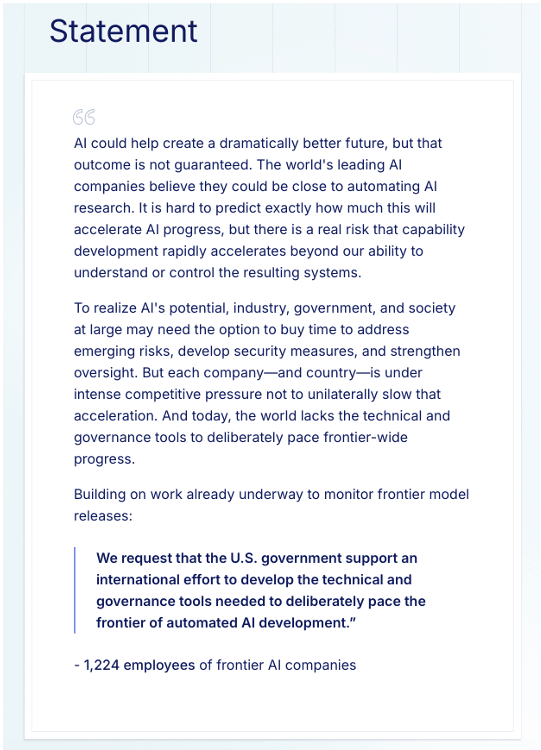
Just published yesterday was a counterstatement, aptly titled Pacing the Frontier, signed by “1,224 employees of frontier AI companies.”
It’s short, so I’ll post it here:
Source: Anthropic
This was Anthropic’s competitive response.
“We request that the government…”
The statement oozes with Safetyism, completely ignores the risk of adversaries developing more powerful models, pushes for slowing down “that acceleration,” and completely ignores the fact that the industry has already bound together with a framework for AI security and safety.
On Monday of this week, NVIDIA took a leadership role in announcing the Open Secure AI Alliance, which had been in the works for months.
Almost every major player is a part of this initiative.
The purpose is for the industry players to proactively develop open frontier AI tools for cyberdefense, AI security, and AI safety.
Anthropic could have been part of the alliance… but it chose not to be.
And here’s where it gets even more ironic.
Anthropic, as we reviewed on Monday, is raising red flags about how China-based AI companies have been illegally distilling its AI models, benefiting at no cost from the massive investment that Anthropic has made over the last few years.
Anthropic isn’t wrong on this point, but it has almost no recourse.
It opened up its application programming interface (API) to China-based entities, which it didn’t have to do.
It paid the price.
In short, Anthropic is asking the government to “pace” (read: slow down) U.S. domestic AI development to account for “safety” while at the same time acknowledging and enabling the U.S.’s greatest adversary to do the opposite.
Meanwhile, Anthropic just got caught doing precisely what it’s upset about – distilling other people’s information for its own benefit without paying them for it. Anthropic utilized the intellectual property of authors and book publishers, which resulted in a massive lawsuit around copyright infringement.
The class-action lawsuit was an interesting one, which now sets an important precedent in the industry.
Important for us to understand is the ruling that determined:
Anthropic settled and agreed to pay $1.5 billion for its actions.
This will amount to $3,000 per work across 500,000 works.
In short: Anthropic distilled copyrighted material to build its own model, destroyed rare books, opened its API to China-based companies and had its own model distilled, and is now asking the government to help “deliberately pace” the industry in case it and others need to “buy time” to develop the technology safely and responsibly.
Anthropic’s competitive response is not to expand access, auditability, sovereignty, and resilience.
Its response is to lobby for a heavily gated approach to “keep everyone safe,” to push for measures that will “pace” technological development – all things that will benefit Anthropic as a business and hurt the consumers of AI.
This is nothing but regulatory capture.
Just like the yellow cab industry pushed for a decade ago. Anthropic wants to keep its shiny medallion.
Good luck with that…
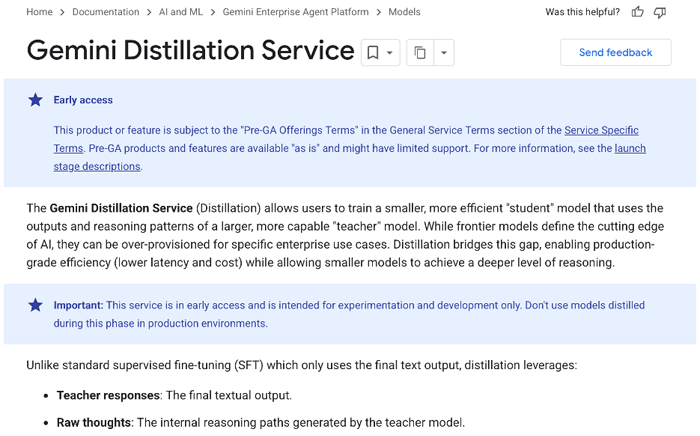
By way of example, let’s have a look at how Google addresses the issue of distillation:
Source: Google
Google actually has a service for it.
It recognizes the value in using its frontier model to train smaller, more efficient “student” models capable of lower latency and lower costs.
This is the way.
And it’s also the future.
It speaks to the point I made on Monday that every task doesn’t need a frontier AI model. In fact, most don’t.
Smaller models trained on specific data are far more efficient and cost-effective for most tasks.
In fact, many open-weight AI models are now able to run on high-performance desktop computers, which means that there isn’t any cost for utilizing the AI other than the electricity required to power the computer.
The issue of the use of copyrighted material isn’t over.
There will most certainly be more class-action lawsuits led by law firms looking for a massive payout.
There is simply too much money floating around for them not to try for it.
In the end, the AI industry will pay its pound of flesh for the text and images that it used to build its models.
With that said, the industry at large is on the right track, intentionally leaning in for solutions and standards that self-regulate the use of this powerful technology.
Counter to that is Anthropic’s push for regulatory capture, precisely the wrong competitive response.
Just like the yellow cabs, Anthropic needs to step up and compete, deliver products and services that its customer base wants, instead of digging its hole deeper into obsolescence.
Jeff
Read the latest insights from the world of high technology.
When demand exceeds supply, something has to give…
This doesn’t mean AI dangers aren't real... They very well may be. But as investors, our job isn't merely...

Last Tuesday, September 8, Google announced AlphaGenome Atlas: A predictive map of every possible DNA letter change in the human...