


Google’s Nuclear Deal Reveals the Scale of AI’s Power Problem
Google’s recent agreement reveals the scale of the AI power shortage and why supplying power is such an important...



Amidst all the excitement of the Artemis II mission, most people completely missed the new directive that was announced, which has given NASA the green light to finish development of and launch a spacecraft with a novel nuclear electric propulsion technology.
Amidst all the excitement of the Artemis II mission, something far grander in scale went completely overlooked.
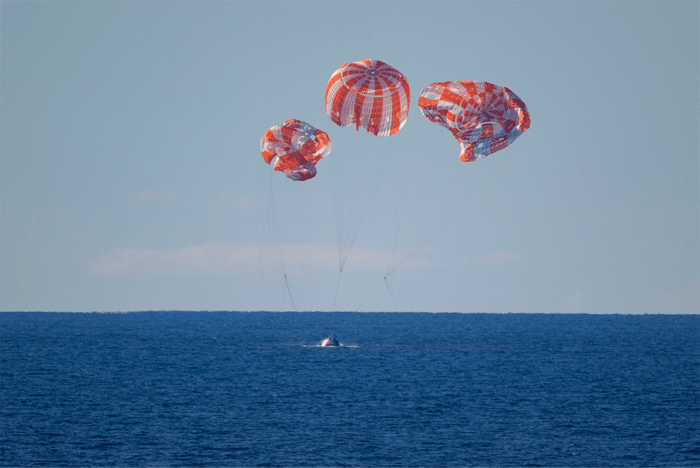
Artemis II Splashdown, April 10, 2026 | Source: NASA
Just days after the four NASA astronauts splashed down in the Pacific Ocean – having circumnavigated the moon and traveled farther than any human had ever ventured into space – the White House Office of Science and Technology Policy (OSTP) issued a new directive…
The National Initiative for American Space Nuclear Power directive gives NASA the green light to finish development of and launch a spacecraft with a novel nuclear electric propulsion technology.
This has far-reaching implications.
The directive, which is an offshoot of President Trump’s Executive Order 14369 – Ensuring American Space Superiority – is designed to accelerate the use of nuclear power in space.
It’s also intended to meet the deadline of developing and sending a lunar surface reactor to the moon by 2030 for energy production to support a lunar outpost.
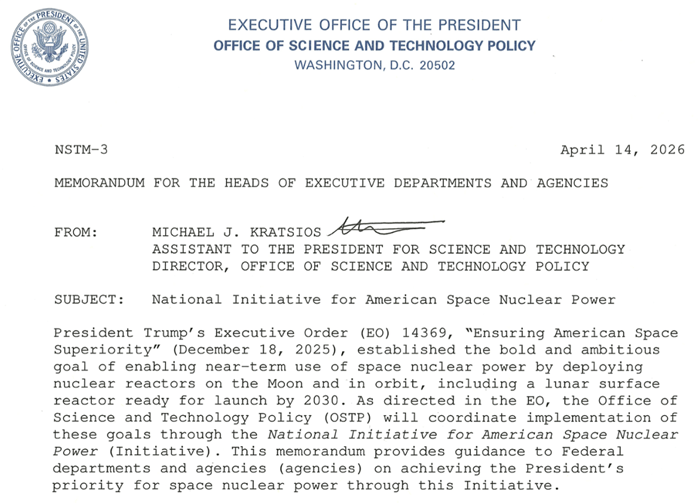
Source: White House Office of Science and Technology
These developments are part of NASA administrator Jared Isaacman’s plans to revamp NASA, refocus its efforts, do more with less, and proactively engage the private sector to accelerate the development of aerospace technology.
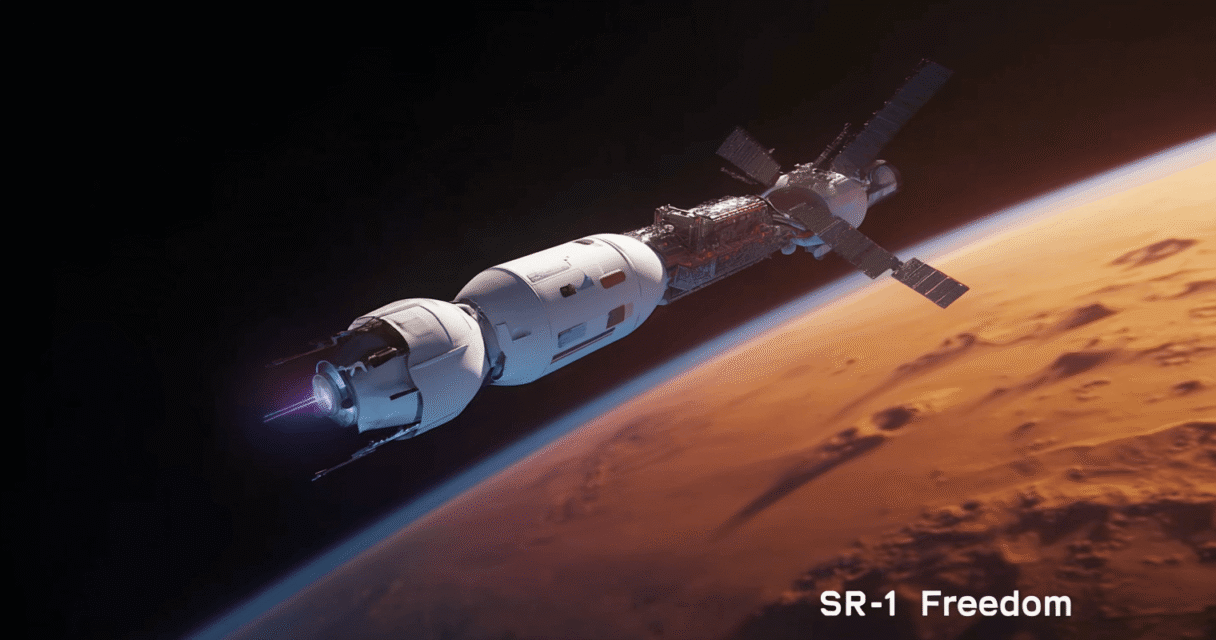
To that end, NASA announced its Space Reactor-1 (SR-1) Freedom mission to Mars, which will use nuclear electric propulsion (NEP) for its journey to the red planet.
Below is a rendering provided by NASA of the SR-1 Freedom arriving at Mars…
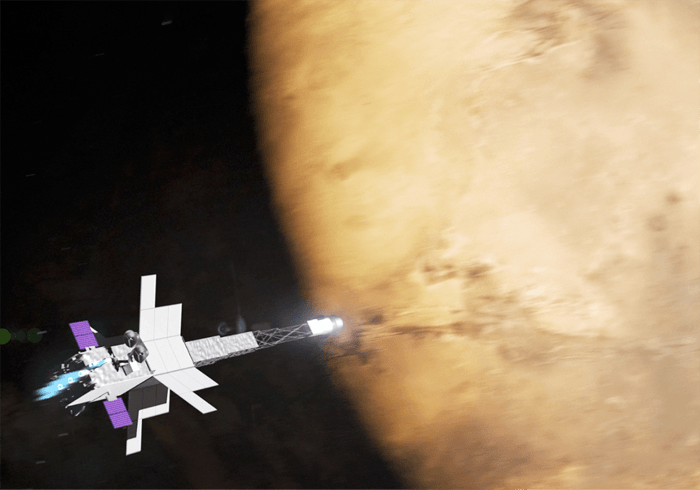
SR-1 Freedom Arriving at Mars (rendering) | Source: NASA
While this will become the very first spacecraft to use nuclear electric propulsion in deep space…
Many might be surprised to learn that the use of nuclear power in space is not new at all.
Decades ago, the Soviet Union sent dozens of nuclear reactors into orbit to power satellites.
The U.S. also launched one in 1965 as a proof of concept, called SNAP-10A.
More recently, a joint program in 2025 between NASA and the Department of Defense – DRACO – was investigating the use of nuclear power for propulsion, but it was shut down due to the high costs of experimentation.
But Issacman’s approach is far more similar to Silicon Valley than it is to legacy aerospace incumbents or large, bloated projects managed by NASA like the current Space Launch System (SLS).
Low cost, fast iteration, quick improvements, and short timescales to success.
As a result, the team at NASA refocused on nuclear electric propulsion (NEP), which has lower technical risks of implementation, lower thrust, and a highly efficient power source that can be used for an extended period of time – i.e., long enough to get a spacecraft to Mars.
NEP uses a small fission reactor to generate heat, thus power, which is used to electrify a gas, which is ejected out of the spacecraft.
This is the thrust – the propulsion to propel the spacecraft.
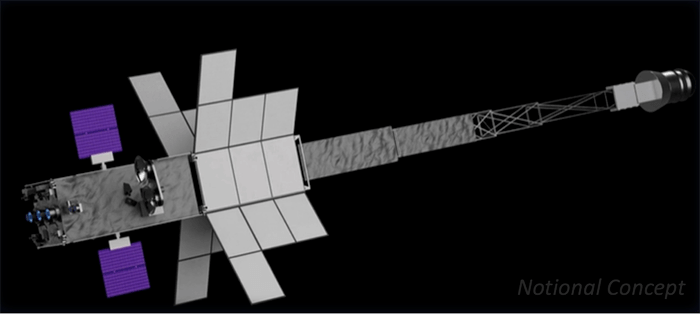
SR-1 Freedom (rendering) | Source: NASA
The SR-1 Freedom looks kind of like a giant arrow.
At the far right is an approximately 20 kWe (kilowatt-electric) fission reactor. At the far left is the 48 KW electric propulsion system.
The large “feathers” (gray tiles) on the SR-1 are actually a lightweight titanium and composite heat dissipation system.
The reality is that the fission reactor will produce far more heat than the spacecraft’s electric propulsion system will need… so it has to radiate the excess heat into space.
The build of SR-1 is planned to begin this June and be ready for testing by January 2028.
In other words, ready in time for a late 2028 launch to Mars, catching the orbital alignment window between Earth and Mars at the end of that year.
This type of timescale wouldn’t be possible if NASA were trying to do this entirely in-house.
Isaacman and the team at NASA are relying on key aerospace technology companies from the private sector to make this happen.
Lanteris Space Systems, which is a Silicon Valley-based company owned by Intuitive Machines (LUNR), will provide the power and propulsion element (PPE).
Busek and Aerojet Rocketdyne – a subsidiary of L3Harris (LHX) – will be providing the Hall-effect thrusters (electric propulsion) for the mission.
Redwire (RDW) will be providing solar arrays for the power and propulsion systems.
And a wildcard from my own research is Antares, a leading fission microreactor company that is already developing microreactors for spacecraft, which has been developing its technology with support from the U.S. Department of Energy.
While the SR-1 Freedom mission might appear on the surface to be a science experiment, it’s not.
There is a lot more going on.
NASA will be deploying three next-generation Mars “helicopters,” explicitly to scout for future crewed mission landing sights, as well as to map out subsurface water ice for the purposes of life support.
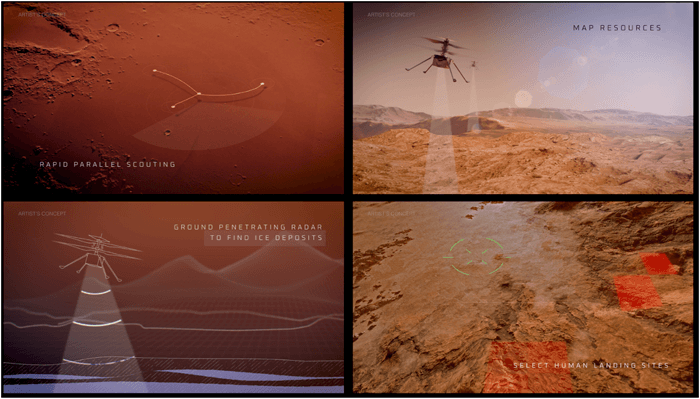
Mars Helicopters on the SR-1 Freedom Mission (rendering) | Source: NASA
Even more important, the SR-1 is a precursor for something far more critical to NASA’s lunar objectives.
The SR-1 is the engineering stepping stone towards the Lunar Reactor-1 (LR-1), which will be a reactor design to generate power for the future lunar outpost.
Yes, solar energy and power storage will be used on the lunar surface. But for critical systems and high-energy requirements, lunar reactors will be needed to fuel the lunar outpost.
NASA’s current schedule is to have the first LR-1 ready by 2030, with plans to evolve that technology to megawatt-scale energy production for both the lunar surface and the Martian surface.
Under Isaacman’s leadership, NASA is classifying this “not as a traditional government R&D project. It is an American industrial campaign.”
That’s precisely why these aggressive timescales are possible.
Nothing is more motivating than a hard deadline.
The Mars/Earth orbital alignment window comes along only every couple of years.
And the best part about this kind of private/public cooperation is that it not only accelerates technological development, but it also creates incredible investment opportunities in both public and private companies in the aerospace sector.
Ad astra,
Add Brownstone Research as your preferred source on Google to see our latest stories in your feed.
 Add as a preferred source
Read the latest insights from the world of high technology.
Google’s recent agreement reveals the scale of the AI power shortage and why supplying power is such an important...

There is something very special happening right now. A bloom of autonomous driving, and Austin is the epicenter.
The idea of a matter compiler has been a science fiction dream for decades. Not any longer.