



AMD’s $8.2 Billion Acquisition
Advanced Micro Devices (AMD) just announced a stunning deal to acquire privately held World Labs for $8.2 billion.



We’re watching the evolution of global finance and the next chapter in a 235-year-old American playbook of turning the nation’s debt into money.
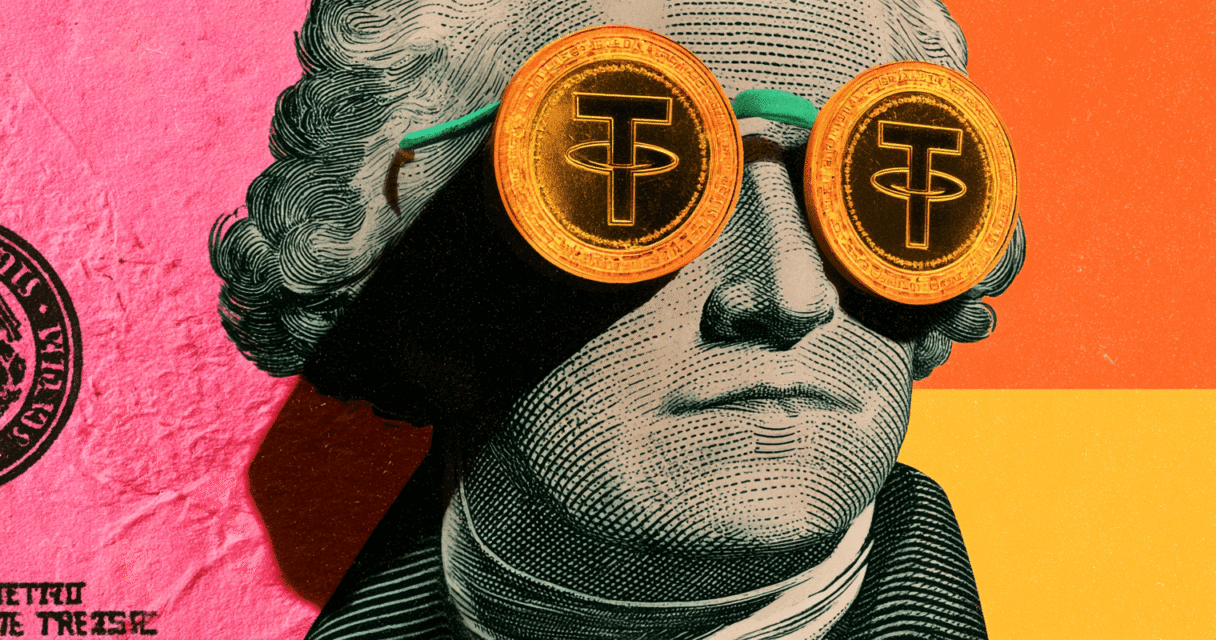
$141 billion.
That’s the amount of U.S. Treasury securities that Tether, the issuer of the USDT stablecoin, now owns.
For context, this makes Tether the 17th-largest holder of U.S. debt on the planet – ahead of Germany, South Korea, the United Arab Emirates, and many other countries… and closing in on overtaking Saudi Arabia next.
This is astounding on so many levels.
To start with, Tether isn’t a central bank. It’s not even a regular bank. It’s just an upstart stablecoin company. And here’s the kicker – Tether is only 12 years old. It’s not even a teenager.
So this upstart stablecoin company’s balance sheet now compares directly to that of G20 nations. And I don’t think anyone in the mainstream financial world is talking about what that actually means.
Stablecoins are commonly viewed as just “crypto plumbing” – a boring utility for moving money between exchanges. But that framing misses the real story entirely.
What’s happening here is one of the most consequential monetary developments of our lifetime, and it’s the newest chapter in a story that runs all the way back to Alexander Hamilton.
To see it, you have to understand a system few have heard of, and even fewer understand, even though it has quietly governed the global dollar for 60 years.
During the Cold War period from 1947 to 1991, something strange happened to the U.S. dollar. Banks outside the United States began creating and lending dollars that had never touched an American bank and never came under the Federal Reserve’s authority.
This started in London. A London bank could take a dollar deposit and lend dollars against it, creating dollar-denominated credit entirely offshore. No physical money crossed any border. It was all ledger entries.
It didn’t take long for banks in Zurich to get in on the act. And as the years passed, banks all over the world followed suit.
Economists call this the “Eurodollar system but the name is misleading. The system has nothing to do with the European Union or the Euro currency. It simply refers to dollars living outside U.S. jurisdiction.
Over the past several decades, this offshore dollar market grew into the de facto plumbing of global finance. Trillions upon trillions of dollars of international trade, lending, and settlement have come to run through it. So when a company in Singapore borrows dollars to buy oil from Saudi Arabia, it’s very likely tapping the Eurodollar system, not the American banking system.
Ironically, this system perpetuated the U.S. dollar’s global dominance… but Washington couldn’t see most of it, let alone control it.
Talk about a paradox. The dollar’s status as the world’s reserve currency rested on a vast web of offshore credit creation that the Federal Reserve did not oversee and could not directly manage.
When that offshore machine seized up – as it did in 2008 and again in March 2020 – the Fed was forced to improvise, standing up emergency “swap lines” to funnel dollars to foreign central banks just to keep a market it didn’t govern from taking down the global economy.
So America got all the benefits of dollar hegemony, but with a critical piece of the machinery operating in the dark.
And this is where Alexander Hamilton enters the story…
In 1790, the young United States was a financial basket case.
The Revolutionary War had been financed with a chaotic pile of state and Continental IOUs, and many were trading for pennies on the dollar because no one believed they’d ever be repaid.
There was no national currency at the time – just a patchwork of state banknotes and foreign coins. The term “dollar” simply referred to a weight of silver, not a national currency.
Alexander Hamilton, the first Treasury Secretary, saw this as a problem that needed fixing. It took a lot of political wrangling, but Hamilton secured enough support to have the federal government assume all that scattered, distrusted debt – roughly $25 million in state obligations – and consolidate it into a single, credible federal bond of the United States. The Revolutionary War debt became the first-ever Treasury securities.
But Hamilton didn’t stop there.
In 1791, he chartered the First Bank of the United States. Per the founding structure, the U.S. government owned 20% of the bank, and the other 80% was sold to investors in the form of stock shares.
However, investors had to adhere to a specific purchase requirement if they wanted to buy shares in the bank. The terms required that they pay one-fourth in specie (gold or silver coin) and three-fourths by exchanging newly issued federal bonds.
In effect, this transferred a portion of the U.S. government’s debt to the First Bank of the United States.
This created an income stream for the bank as it collected interest on the bonds. Then the bank issued banknotes backed by those interest payments, and those banknotes were accepted as the national currency of the United States.
So in a few strokes, Hamilton created outsized demand for the first Treasury securities, and he turned that debt into money that circulated in the economy.
And while this certainly looks to be a form of 18th-century monetary alchemy, the currency issued by the First Bank of the United States was more trusted than the patchwork banknotes that had circulated previously.
To be sure, the financial system of Hamilton’s time was quite unsophisticated by modern standards. But if we look closely, we can see direct parallels with the stablecoin system that’s being built today.
Tether’s USDT was the world’s first U.S. dollar stablecoin. It launched in 2014.
Several other U.S. dollar stablecoins have been created since then. But for most of their existence, stablecoins were the Wild West.
Of course, the issuers claimed that their tokens were backed by dollars. But the reserves were murky, and the whole thing operated in a regulatory gray zone that looked a lot like the offshore Eurodollar system – dollars circulating globally, outside of U.S. oversight.
Then, in July 2025, President Trump signed the GENIUS Act into law, and the picture changed completely.
The law is short, and its core requirement is brutally simple – every dollar worth of stablecoins issued in the United States must be backed one-to-one by cash or short-term U.S. Treasuries, with public disclosure of those reserves every month.
No fractional games. No lending the reserves out. Any company that issues stablecoins must hold the equivalent amount of dollars in Treasury securities or cash against it.
This looks a lot like the old Hamiltonian national banking system. And it’s a direct attack on the offshore Eurodollar system.
It’s important to understand that the Eurodollar system created dollars out of nothing because of the nature of the fractional reserve system. Offshore banks could leverage dollar deposits to create dollar-denominated loans worth several multiples of the underlying reserves.
The stablecoin system does the exact opposite. Under the GENIUS Act, issuers must back their stablecoins one-to-one with dollars and Treasury securities. So every stablecoin issued is, by law, a purchase order for U.S. Treasuries.
That is the Hamilton mechanism, reborn on cryptocurrency rails. Sovereign debt is once again being converted into the backing of a circulating currency. And once again, the act of issuing the money creates automatic, structural demand for the debt.
So Tether’s $141 billion Treasury stack isn’t an accident or a side effect. It is the mechanism working exactly as designed.
For 60 years, the U.S. enjoyed dollar dominance through an offshore system it couldn’t control. Washington could never realistically regulate the Eurodollar market – it was too big, too distributed, too foreign.
Rather than doubling down on regulatory efforts, the Trump administration is taking a market-driven approach with its support of stablecoins.
Instead of trying to regulate the Eurodollar system, the U.S. stablecoin industry is building a faster, cheaper, dollar-denominated alternative to outcompete it.
That’s what the stablecoin push is really about – bringing the offshore Eurodollar market back home while creating demand for U.S. debt that never existed before.
Consider a small-business owner in Buenos Aires, Lagos, or Istanbul – someone living under a currency that loses value by the week and a banking system they don’t trust.
For decades, their only real hedge was to hold physical dollars under a mattress or, if they were lucky, set up a hard-to-open offshore account. But now they can set up a stablecoin wallet on their phone and hold their savings in dollars there – where they can also transact within the global financial system.
Every one of those people overseas who choose to save their money in a stablecoin like USDT or USDC instead of their local currency is doing two things at once.
They are extending dollar usage into corners of the world that the banking system never touched – deepening dollar dominance one wallet at a time.
They are also financing the U.S. government, because the stablecoin companies buy government debt whenever they issue a new stablecoin.
What we are witnessing here is dollarization as a consumer product, and deficit financing as an automatic byproduct.
At the exact moment the United States is visibly stepping back from the expensive machinery of global hegemony – pulling away from foreign security guarantees, shedding “world police” commitments, and letting European nations carry their own weight – it is simultaneously engineering a tool that extends American monetary reach further than the State Department or the International Monetary Fund (IMF) ever could.
And it’s doing so with no soldiers, no embassies, and no bailout packages. Just a dollar-denominated token that anyone, anywhere, can choose to hold – and that quietly finances the Treasury every time they do.
That’s why the rise of stablecoins is one of the most consequential monetary shifts of our lifetime.
If the stablecoin push is successful, it will keep the U.S. dollar enthroned as the world’s reserve currency while also creating additional demand for U.S. Treasury debt and taking market share from the Eurodollar system – thus bringing control over global finance back to the United States.
And it’s all being done with a market-driven approach. The stablecoin solution must genuinely be superior to the legacy Eurodollar system for it to succeed.
Put it all together, and we’re watching the evolution of global finance and the next chapter in a 235-year-old American playbook of turning the nation’s debt into money.
Alexander Hamilton did it to build an industrial superpower from a rag-tag group of bankrupt colonies. This time, it’s being done to keep the United States as the world’s economic superpower.
Of course, there’s no guarantee that everything will play out as expected. But this is certainly a story worth watching.
Regards,
Joe Withrow
Senior Analyst, Brownstone Research
Add Brownstone Research as your preferred source on Google to see our latest stories in your feed.
 Add as a preferred source
Read the latest insights from the world of high technology.
Advanced Micro Devices (AMD) just announced a stunning deal to acquire privately held World Labs for $8.2 billion.

An incredible development in both artificial intelligence and the space economy launched from the other side of the country...

Imagine millions, and eventually perhaps billions, of AI agents working continuously. Every one of them needs computing power. They...