




Beware of Biased Billionaires
Over the last week, we have discovered that this is a massive, well-coordinated psyop carried out by some powerful...



This is an absolute breakthrough in single-cell biology that will have significant ramifications for the biotech industry.
Managing Editor’s Note: We’re just a couple of days away now from Jeff’s 24-Hour AI Fortunes event.
On Wednesday, January 28, Jeff is diving into the details behind a strange phenomenon that’s causing explosive 24-hour surges in a small group of stocks…
And the artificial intelligence he’s leveraging to help spot these opportunities well before they happen.
Just go here to automatically sign up to join us at 8 p.m. on Wednesday.
One of the most interesting applications of artificial intelligence (AI) to life sciences was just announced earlier this month.
It is a level of precision – in terms of biological understanding and predictive capability – that is almost hard to believe.
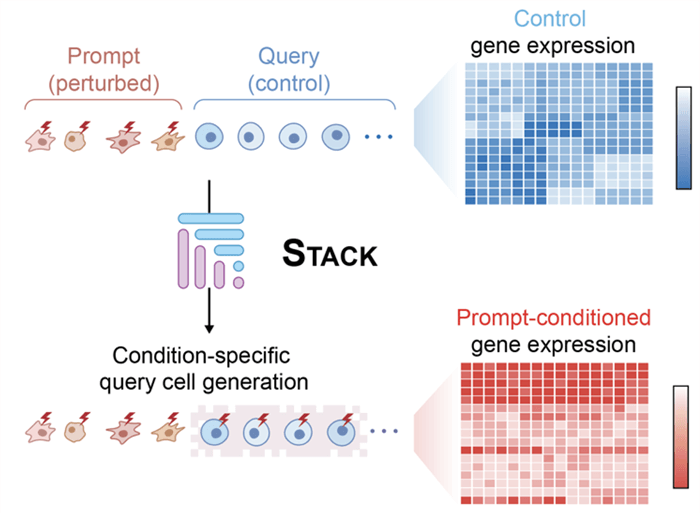
Developed by the non-profit Arc Institute in Palo Alto, California, Stack is a frontier biological AI model designed to accurately simulate and predict cellular conditions using the kinds of prompting of AI models that we have grown so used to.
This is an absolute breakthrough in single-cell biology that will have significant – and positive – ramifications for the biotech industry.
Stack’s development was a result of the large-scale single-cell RNA sequencing that had taken place over the prior years.
Data on hundreds of millions of cells has been collected across a wide range of tissues and conditions.
Source: Arc Institute
From this massive repository of single-cell information, the team at Arc Institute trained its foundation model on data collected on 149 million uniformly preprocessed human single cells.
The data on these 149 million human single cells was intentionally diverse.
It spanned hundreds of tissues, diseases, donors, and states to understand how individual cells work, as well as how cells interact with one another.
This robust data set allowed the frontier model to understand cellular context, which is an understanding of not just the individual cell, but its relationship to other cells in a variety of conditions.
The result proved to be pretty incredible.
For example, the model can be given data on drug-treated immune cells and then predict how epithelial cells (skin cells) will react to that same drug.
What’s so exciting is that the model can accurately perform this task, even though it wasn’t explicitly trained to do so. It can just successfully infer an accurate outcome.
It’s easy to imagine the implications for the biotech industry.
Researchers and companies can simply feed Stack real-world clinical data… and learn how a drug would work on different kinds of cells.
Doing so can help a company avoid bad decisions, as well as accelerate positive applications of a drug that perhaps they had not originally expected.
These newfound abilities will not only accelerate drug development but also dramatically reduce the cost of doing so.
And it gets better…
The team at Arc took its research one step further…
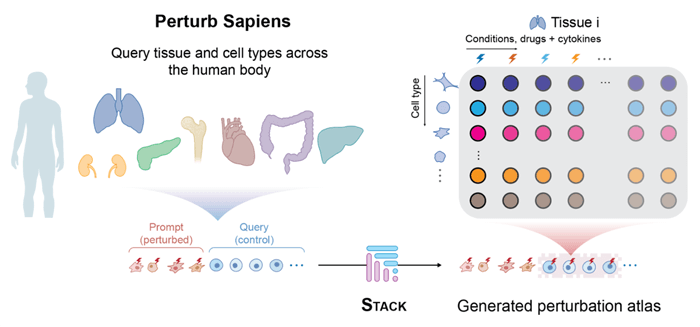
They built on Stack and created Perturb Sapiens, which is an atlas of predicted cellular responses to perturbations.
Source: Arc Institute
A perturbation simply means some kind of disruption to a cell’s normal state.
This might be through the introduction of a drug therapy, a genetic modification through something like CRISPR genetic editing technology, or even subjecting the cells to environmental stress.
Understanding how different kinds of cells react to perturbations is a gold mine for accelerating the development of highly efficacious drugs and reducing the time and money spent on those that are ineffective and have high levels of toxicity.
The model isn’t perfect yet, but it is a tremendous resource for the industry now, with approximately 20,000 predicted cell type-tissue-perturbation combinations.
A researcher can use a tool like this in a matter of minutes to discover predicted perturbations… and then confirm results with targeted experimentation.
The Perturb Sapiens model is openly available here on Hugging Face.
This is so powerful.
A biotech company can show model data on cells treated with its drug, and then the model will output how completely different cells would react to that same drug.
And the results do not require that perturbation to have been done before.
It simply infers the likely effect of the drug on the new cells.
Arc’s Stack AI model works much the same way as large language models (LLMs).
You can ask a question, like, “What would be the impact on liver cells if exposed to this cardiovascular drug?”
We can take the model one step further and ask questions like, “What kinds of cells will experience off-target effects?”
And if we have an individual patient’s cellular data, we can ask the model individualized questions, like, “How will this patient’s cells respond to this drug therapy?”
Stack and Perturb Sapiens are two more incredible computational resources for the biotech industry, in addition to Google DeepMind’s AlphaFold3 and other frontier biological models that I reviewed in The Bleeding Edge – How DeepMind Made History and The Bleeding Edge – Proton Concentration.
It’s impossible not to be excited about life sciences and the biotech industry today.
Research and analysis that used to take years and hundreds of millions of dollars can now be performed with predictive accuracy using these frontier AI models and a bunch of GPUs.
The costs of running these models have become insignificant. And the outputs can be generated in a day, if not in minutes. Not years.
2026 is the year the biotech golden age takes off.
It’s the beginning of an acceleration in the improvement of the human condition and human longevity itself.
There is so much to look forward to.
Jeff
Add Brownstone Research as your preferred source on Google to see our latest stories in your feed.
 Add as a preferred source
Read the latest insights from the world of high technology.
Over the last week, we have discovered that this is a massive, well-coordinated psyop carried out by some powerful...

Last month I was excited to see an announcement made by a leading humanoid robotics firm, Figure AI, for...

When demand exceeds supply, something has to give…