



Will Crypto Bend the Knee of Trump?
There’s something that feels unequal about this. Something ethical… A subject that’s about to become the main talking point...



The proverbial gate has been pushed open, and we’re about to see a major wave of activity follow.


The latest move in tokenization has crossed a line.
And the result… We’re witnessing a psychological activity known as “flocking instinct.”
Flocking instinct – also called herd behavior – is where a group looks to leading individuals to gauge what is socially acceptable. Think “safety in numbers.”
It’s basically when you see a few other people doing something, and you start to tell yourself this is acceptable… Say, for example, parking your car on the grass area within a parking lot during a busy July 4 fireworks event.
That grassy spot is a place you wouldn’t normally consider parking. But once you see a few others doing it… Yeah, sure, why not? It is acceptable because others have first established that it is.
Individuals pave the way for the collective, signaling it’s time to move in the same direction. Leading the flock.
This flock instinct is worth noting because it’s happening right before the final text for the CLARITY Act drops this week.
The proverbial gate has been pushed open, and we’re about to see a major wave of activity follow. It’s also showing us just how intense the competition is getting in this new frontier of finance.
Let’s look at what this activity was last week, starting with a company that readers of Chain of Thought are familiar with…
Securitize (SECZ) went public last week on July 2. They are a firm specializing in tokenizing assets. We can think of them as a bridge that moves assets to public blockchains.
They’ve garnered the trust by tokenizing $4.4 billion in assets from names such as BlackRock, Hamilton Lane, VanEck, Apollo Global Management, and BNY Mellon, among others to move their assets.
At first blush, this might seem like a normal initial public offering… The company started to trade on the New York Stock Exchange under the ticker SECZ.
This all came after its SPAC merger with Cantor Equity Partners II, a Cantor Fitzgerald affiliate. Securitize raised around $400 million, giving it a value of $1.25 billion.
And at the end of the first few days of trading, the stock is trading with a $1.82 billion valuation.
What is less known is the fact that Securitize’s shares began trading elsewhere on the same day.
As the company put it, “We’re gonna eat our own dog food.” They did this by issuing nearly $300 million worth of SECZ tokens on two public blockchains, Solana and Avalanche.
This might seem more like a novelty move to help advertise their services. But when we unpack their solution, we see it points to a future where initiatives such as Project Crypto become a reality.
Project Crypto is an effort by the White House, SEC, and CFTC to bring finance onchain. The administration and regulators have been pushing hard on this agenda for the last year.
And Securitize is making this a reality as their tokens that are trading are quite literally shares of the company.
This might seem obvious, but Securitize does something called Issuer-Sponsored Tokens (IST). It’s a model where the token on the public blockchain is the share and the blockchain acts as the record of ownership.
I’ll explain why this is so crucial in just a moment…
But first, we need to realize that when it comes to the shares we buy in our brokerage account, those are not shares. They are known as “security entitlements.” They are legal claims on stock that is held by a 50-year-old custodian known as the Depository Trust & Clearing Corporation (DTCC).
This is worth knowing because the solution that Securitize is putting forward removes multiple layers of middlemen and instead issues the raw share itself that can be held directly by the trader or investor.
It’s full self-custody, representing a shift in finance that is showcasing how public blockchains can produce greater efficiency for our markets.
But CEO Carlos Domingo isn’t stopping there.
Self-custody of an asset enables more use cases for the holder.
When it comes to the shares in our brokerage account, those shares are held by the DTCC in the brokerage’s name. Not our name.
This means if we look to borrow against those assets or perhaps lend them out, we need to go through our brokerage. We are playing in their playground. There’s no lower-cost or better alternative for borrowing that might exist somewhere else in the market. We’ve been held captive as we don’t even own the shares we think we do.
This model will be a thing of the past.
We mentioned this before, but it bears repeating. In the words of Domingo…
Natively tokenized securities can be used to facilitate DeFi use cases, such as on-chain trading, lend/borrow pools, and other collateral use cases within whitelisted ecosystems.
This comes from a letter that he wrote to the SEC. And if we look at the Securitize website, we see Domingo is not just talking the talk. He’s actively laying the groundwork to follow through…
On the page that discloses details on the SECZ token, we can see this section.
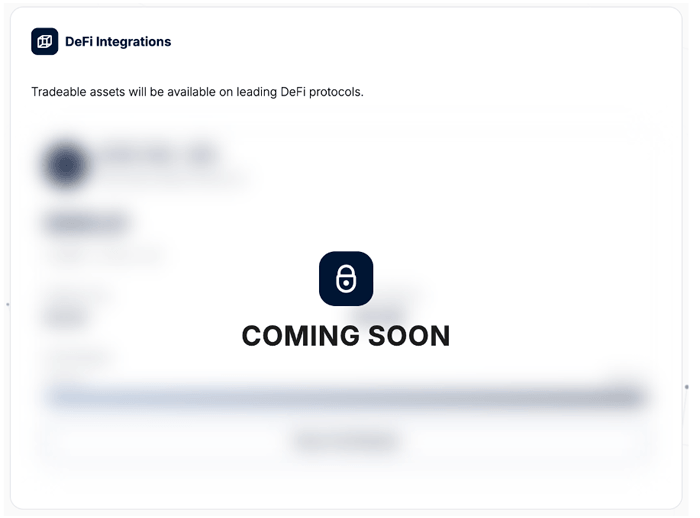
Source: stocks.securitize.io/assets/SECZ
It’s hinting at features to come. Specifically, the ability to lend the asset out into various decentralized finance (DeFi) protocols or borrow against the asset.
The protocols are not listed…
But subscribers of Permissionless Investor know the names that will appear here as we’ve been covering them for months.
The tokenization of stocks like Securitize represents $100 trillion of assets getting ready to flow through certain protocols that already have relationships with major entities such as Securitize.
But here’s the thing…
The push for tokenizing stocks is starting to see everybody make their move despite the SEC or the passage of the CLARITY Act giving the explicit green light for their issuance.
On the same day that Securitize released its tokens onchain, retail-oriented trading platform Robinhood announced that its layer-two (L2) Robinhood Chain was officially live.
We originally detailed CEO Vlad Tenev’s plan a year ago at The Bleeding Edge in our Tokenizing Stocks issue, as we knew the entire industry would be racing to tokenize stocks this year.

Source: Tenev presenting at his To Catch a Token event | Source: Robinhood
He has now made good on his plan that supports 24/7 tokenized stock tokens.
What’s important to note here is that these tokens are essentially debt instruments, not the actual share itself. For this reason, it’s not available to U.S. retail yet, unlike Securitize’s model.
Nonetheless, what’s important to realize is that Robinhood’s L2 has multiple DeFi protocols that are already being integrated into its chain.
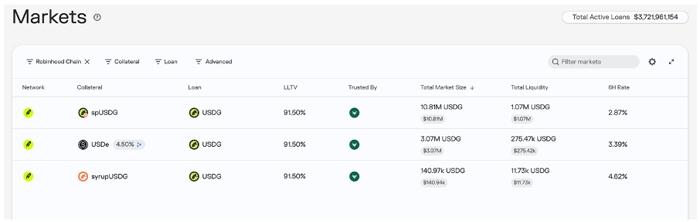
Source: app.Morpho.org
Now most of the DeFi solutions are stablecoin-oriented. But make no mistake. We will see stocks move into these protocols around the same time Securitize does their move.
It’s part of the herd mentality, as we can see that several companies keep pushing the limit nearly in step.
For example, on the same day that Securitize listed and Robinhood announced their L2… Ondo Finance, another tokenization company similar to Securitize, launched the first custodial tokenized U.S. securities operating within the country’s existing regulatory framework.
This is a model that differs from Securitize, as the tokens are not the equity itself. The equity is held by a custodian. This makes it similar to shares in your brokerage account, but with one less layer in the stack.
And historically, the push for custodial solutions for shares has not been offered in the U.S., which is why this is such a big deal.
It’s part of this flock instinct where the herd is moving in unison, almost telling one another that each step they take is acceptable.
Yet the CLARITY Act is not yet law, and the SEC’s rules that pertain to items like this are not final. What we see here is that the tokenization trend is now moving beyond what existing rules and regulations have laid out.
This might also be a hint to the market that we should be more optimistic about the CLARITY Act.
Firms like Securitize, Robinhood, and Ondo Finance are making bold moves simultaneously, their timing in unison.
Either some sort of breakthrough took place last week as it pertains to legislation, or the industry is no longer waiting.
The stakes are too high to wait around for Congress to get its act together.
And the current regulatory regime doesn’t seem like one to slap the hands of offenders right now. Meaning the flock will be pushing us towards tokenization even faster in the coming weeks.
The race is getting more intense, and before the end of the summer, we should expect to see more than $100 million in stocks flowing through DeFi.
Your Pulse on Crypto,
Ben Lilly
Editor, Chain of Thought
Read the latest insights from the world of high technology.
There’s something that feels unequal about this. Something ethical… A subject that’s about to become the main talking point...
Digital asset investors know this fight. They’ve been fighting it for years now.

A bank doesn’t hang around for nearly two centuries without being adaptable….