




The AI Doomer Counterattack
Companies such as Anthropic and OpenAI are screaming at the top of their lungs, “Regulate us!”



The technology is revolutionary for our society. We cannot forget.

Editor’s Note: According to Jeff Brown, a rare window of opportunity just opened in a completely overlooked sector. At the center of the story is Elon Musk, SpaceX, and the essential “ingredient” to make Musk’s ambitions a reality. This has nothing to do with the typical AI stocks. It’s something else entirely. Get all the details right here.
It’s rough sailing out there…
A few headlines from the past few days:
We won’t get into each of those stories. But suffice it to say that they’re hardly bullish for blockchain or digital assets.
We had planned to write an essay on yield markets and some novel solutions coming to foreign stablecoin currencies. But that doesn’t seem to be the most pressing topic right now.
Instead, let’s refresh our perspective and try to take stock of what we know. Let’s go back to the beginning of blockchain and digital assets—the promise, the philosophy, and the brave new world that might still come into being.
So, maximize your screens and dim the lights.
The story begins…
The world almost imploded in 2008.
A combination of leverage, centralization and good old-fashioned human stupidity brought the entire financial system to the brink of collapse. The government and the Fed would throw hundreds of billions of dollars at the problem, and the entire system limped on.
Sure, people were tossed out of their homes and retirements were ruined, but that probably seemed like small potatoes compared to the existential threat that was the Global Financial Crisis.
While all of this was happening, a seemingly unrelated event was unfolding…
A “white paper” posted anonymously online was starting to get the attention of computer nerds, hard money libertarians, and anarcho-capitalists all over the world.
Posted by an author known only as “Satoshi Nakamoto,” Bitcoin: A Peer-to-Peer Electronic Cash System reads:
A purely peer-to-peer version of electronic cash would allow online payments to be sent directly from one party to another without going through a financial institution. Digital signatures provide part of the solution, but the main benefits are lost if a trusted third party is still required to prevent double-spending. We propose a solution to the double-spending problem using a peer-to-peer network.
The white paper would go on to outline the details of a monetary system diametrically opposed to the monetary regime that led to the Global Financial Crisis. It proposed a network of peer-to-peer payments that was permissionless, decentralized, immutable and transparent.
Put another way, it proposed a new type of money that anybody could use…that nobody could control…that nobody could tamper with…and that everybody could see.
It went on to outline the details of such a money.
It was a money with a capped supply, hardcoded into the software. It was a money maintained on a cryptographically secure, decentralized network of willing participants incentivized via a monetary policy that was similarly hardcoded into the system. We would later come to refer to this type of network as a “blockchain.”
The paper proposed a money that was everything our current money was not. It was the beginning of Bitcoin.
At the heart of Bitcoin was a philosophy, call it a promise if you want: You can truly own your own money. You can transact with whomever you like. You can exist in a monetary framework not beholden to the banks, and the Treasury, and the Fed, and whatever other Powers That Be.
The promise was straightforward…
You. Do. Not. Need. Them.
This idea took hold and spread like wildfire. All manner of misfits, rascals and cypherpunks picked it up and dove into the ecosystem.
Bright and inquisitive minds got to thinking. If Bitcoin could make money decentralized and permissionless, why can’t everything else be as well?
Enter Ethereum and the enigmatic creator Vitalik Buterin. Ethereum was, and is, the world’s first smart contract blockchain. Like Bitcoin, it was permissionless, decentralized, immutable, open source and transparent. It also had a monetary incentive to incentivize individuals and entities alike to secure the network. But Ethereum went one step further.
It made a blockchain that could be built upon. Developers saw the potential and got running.
They built innumerable decentralized solutions on top of the Ethereum blockchain using smart contracts, which could execute actions on the precondition that certain criteria were met without ever needing a trusted intermediary.
Some of the projects built on the Ethereum blockchain were useful. Some were silly. Some were downright hilarious. But they were all worthy experiments.
Until DeFi Summer.
DeFi stands for decentralized finance, and “summer”… Well, it was the summer of 2020.
A Cambrian explosion of new protocols emerged. Lending and borrowing, exchanges, portfolio management tools, yield optimizers, stablecoins and more.
An entire financial ecosystem was born in a span of months. Middlemen were nowhere to be found. Automation was the common denominator.
Innovation was thriving. Wall Street was being upgraded before our very eyes.
Then, before we knew it, the Securities and Exchange Commission came down on the industry like a ton of bricks. The industry was scared into submission, throttled by enforcement, choked off by legal fees.
The banks even managed to wall off crypto-related businesses from opening a bank account.
We’ve come a long way since DeFi Summer. We’re now on the cusp of legislation being passed to embrace innovation once again. The possibilities of what permissionless and decentralized technology can do will bring forward multiple waves of innovation.
It’s just about embracing it.
The crypto ecosystem born from the innocuous Bitcoin white paper has now proposed a decentralized solution to virtually every modern technology industry imaginable.
It’s a fact that takes us beyond DeFi and the financial system.
We’re witnessing permissionless and decentralized AI come to life before our very eyes.
Open-weight models can tap into distributed GPUs across the globe for compute at a fraction of the cost of the big boys.
New models are running a pretraining run on a network of household chips… Households that don’t know one another.
It’s comparable to what we witnessed with DeFi Summer in 2020.
Public, decentralized and permissionless blockchains are helping us remember just how powerful this technology can become when given the ability to thrive.
I bring this up because what we’re covering at Chain of Thought isn’t about the next token that will soar. Yes, we look for that, but there’s more.
We’re tracking good and evil.
Will our society allow individuals to innovate with liberty and sovereignty? Or will we continue to see government used as a tool to preserve corporate needs over societal reform?
Only time will tell.
And given the fact that much of this rests on our policymakers in Washington, D.C., over the coming week, I’m quickly reminded of a quote by Thomas Jefferson that gave me goosebumps the first time I visited his monument in D.C.
I am not an advocate for frequent changes in laws and Constitutions. But laws and institutions must go hand in hand with the progress of the human mind. As that becomes more developed, more enlightened, as new discoveries are made, new truths discovered and manners and opinions change, with the change of circumstances, institutions must advance also to keep pace with the times. We might as well require a man to wear still the coat which fitted him when a boy as civilized society to remain ever under the regimen of their barbarous ancestors.
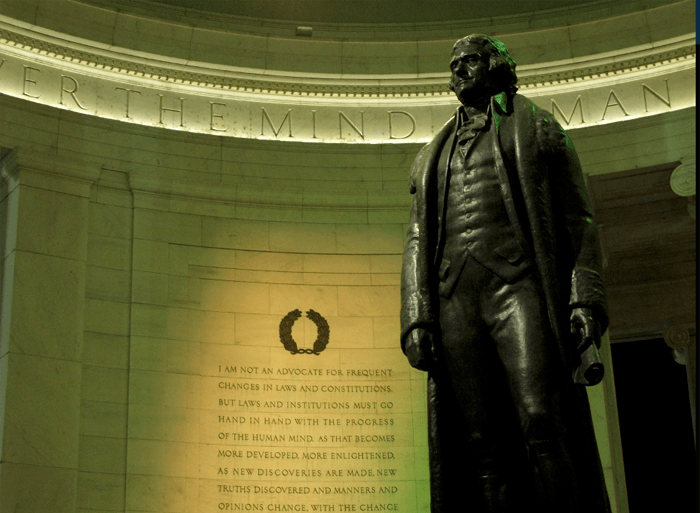
Source: flickr.com
The wake of 2008 produced a new discovery. We’ve since become more enlightened than ever before.
We can’t let the headlines of today cause us to lose sight of what’s happening. It might seem difficult to stay optimistic when we’re witnessing a barrage of negative news, unfavorable price action and what feels like an exhausting legislative battle.
But the technology is revolutionary for our society. We cannot forget.
To borrow from Jefferson, it’s just a matter of whether we shed the coat of our ancestors.
Your Pulse on Crypto,
Ben Lilly
Editor, Chain of Thought
Add Brownstone Research as your preferred source on Google to see our latest stories in your feed.
 Add as a preferred source
Read the latest insights from the world of high technology.
Companies such as Anthropic and OpenAI are screaming at the top of their lungs, “Regulate us!”

Get these assets so entrenched, so dug in, that no future administration can rip them out without creating systemic...
There’s plenty of blame to go around, and I’m more than happy to name names.