




AI Is Hungry
The GPUs are being deployed in a timely manner. What isn’t arriving fast enough is the electricity to power...



The big banks are kicking off earnings season, Warsh is making good on his promise for "regime change," and three things to watch for before making an investment, all in today’s First Signal…


Earnings season is underway. And the honor of kicking things off goes to the big banks…
These financial institutions sit at the center of nearly every major financial transaction. They make loans, issue credit cards, process payments, and see when consumers begin missing payments.
They often spot changes in the economy before the rest of the business world does. That is why investors say financials lead the market.
And right now, that’s a bullish signal.
The six largest banks – JPMorgan Chase, Bank of America, Citigroup, Wells Fargo, Goldman Sachs, and Morgan Stanley – all beat Wall Street’s revenue and earnings estimates.
Financial stocks responded positively. The Financial Select Sector SPDR ETF (XLF) just broke out to new highs.
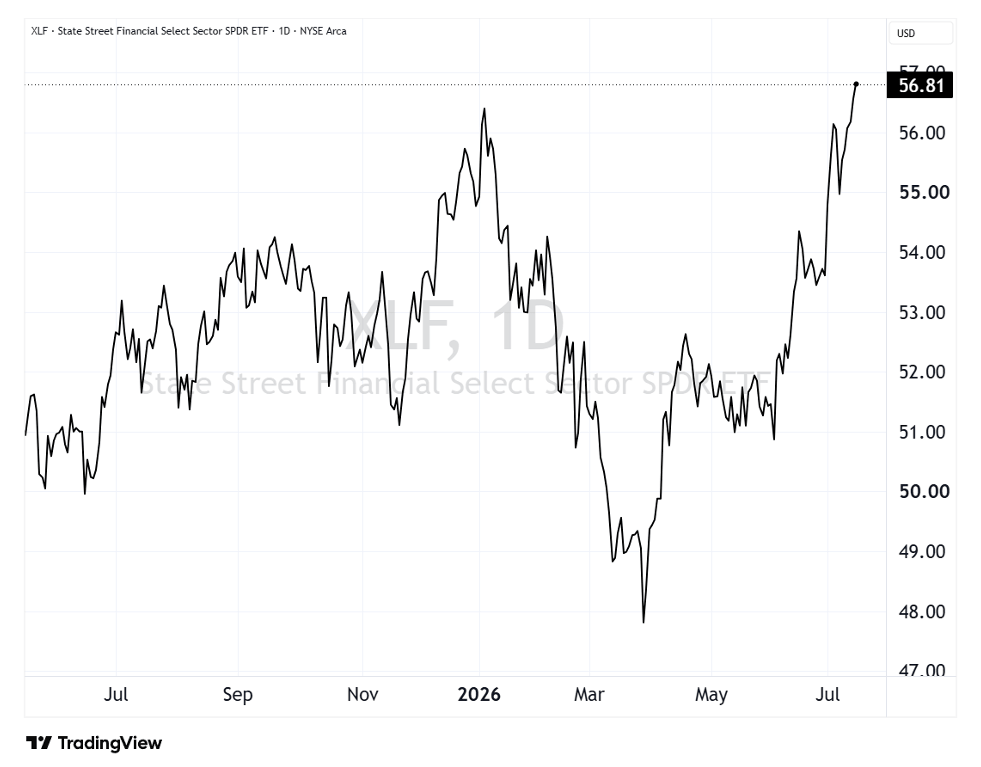
This is great news for investors. Major market declines rarely begin while financials are making new highs. Banks are the plumbing of the economy. When profits are rising, credit remains healthy, and loan losses stay contained, it usually points to continued expansion.
So even as technology stocks pull back, the banks are giving us a reason to remain bullish.
The most important message from this week’s reports is that the U.S. consumer remains in good shape.
JPMorgan CEO Jamie Dimon said the consumer was “fine.” He continued to say that spending remained robust across every income group, while delinquencies came in lower than expected across the credit spectrum.
Bank of America said the U.S. economy has proved “more durable than expected,” supported by resilient consumers, AI-driven investment, and easing energy costs.
Wells Fargo reported lower charge-offs and improving savings trends. Management acknowledged continued concerns about affordability and inflation. But it also pointed to a strong labor market and healthy wage growth.
Citigroup added another data point. Consumer spending through its credit-card business rose more than 6% year over year.
Even large regional banks, including PNC Financial and U.S. Bancorp, reported healthy credit conditions and reduced the reserves they set aside for potential losses.
This is not what an economy on the edge of recession looks like.
But whenever we turn on the news, we hear plenty about a struggling consumer being crushed by inflation. And a “K-shaped” economy, which means that the upper class is spending more and thriving while the lower class is struggling.
But the banks have a much broader view than a single survey or news segment that is filtered to meet the news network’s agenda. That’s why we go straight to the source. And that’s why I love quarterly conference calls. It gives us a direct line into how businesses and the economy are faring.
And banks are telling a consistent story. Consumers are still spending. Credit quality remains healthy. And businesses and households can still pay their bills.
The U.S economy remains resilient. With financials at new highs and credit conditions strong, the bull market likely has more room to run.

New Federal Reserve Chairman Kevin Warsh promised “regime change” at the Fed… and it seems he was serious.
As one of his first acts, Warsh just named five external task forces charged with reviewing how the central bank makes policy.
One task force will assess the Fed’s communications. One will assess the Fed’s balance sheet. One will assess the data the Fed relies on. One will assess productivity, jobs, and the impact of artificial intelligence. And the final task force will assess the Fed’s inflation framework — what Warsh called “examining the drivers of inflation, first principles, and the full range of ideas for delivering price stability.”
No doubt this is the most direct structural assessment any Fed chair has made of the institution’s internal machinery in decades. And the task force assignments mostly read like an attempt to deliberately import outside intellectual capital rather than rely on internal orthodoxy.
Interestingly, the Productivity and Jobs task force pairs venture capitalist and techno-optimist Marc Andreessen with Stanford economist Charles I. Jones and Microsoft Xbox CEO Asha Sharma.
The Balance Sheet Policy task force brings in former Reserve Bank of India governor Raghuram Rajan and former Fed governor Jeremy Stein, both now at elite academic posts.
The Inflation Frameworks task force pairs Harvard’s Greg Mankiw, a mainstream Keynesian economist and former chair of the Council of Economic Advisers, with NYU’s Thomas Sargent, a Nobel laureate in rational-expectations economics.
The Communications task force is led by former New York Fed executive Peter Fisher, former Bank of England Governor Mervyn King, and Arminio Fraga – former president of Brazil’s central bank.
The Data task force includes former Walmart CEO Doug McMillon, Harvard economist Raj Chetty, and University of Chicago economist Kevin Murphy.
So Warsh isn’t stacking the deck with a bunch of ideological allies to rubber-stamp a predetermined agenda here. It appears that he is bringing in a wide range of outsiders to assess the Fed’s inner workings and offer insight and suggestions from different perspectives.
Of course, it’s one thing to form a task force, and it’s something completely different to institute real change. But Warsh has already signaled that he’s serious about challenging deep-seated orthodoxy.
At his June press conference, Warsh explicitly rejected the Phillips Curve orthodoxy that has anchored Fed policy reasoning for 50 years. That is, Warsh rejected the assumption that unemployment and inflation trade off in a stable, predictable relationship.
As Warsh put it in his announcement: “The U.S. economy has changed significantly over the last generation, and never more so than right now.”
So this is something to watch.
Of particular note, Andreessen’s Productivity and Jobs task force is explicitly designed to formalize how the Fed thinks about AI-driven productivity gains as a source of non-inflationary growth.
The idea is that AI capex can expand the economy’s productive capacity fast enough to absorb demand without triggering the inflation that the old models would predict.
If that framework gets validated and adopted, it reshapes all the assumptions currently built into expectations around the Fed’s monetary policy. And it would suggest that Warsh may be inclined to cut the Federal Funds Rate sooner rather than later.
Given that the market now assumes rate hikes rather than rate cuts, that would be quite the surprise.

Financial films and TV shows would have you think investing is easy.
Someone always knows what the Fed will do next. Somebody else has the next hot stock. Every worst-case scenario is navigated with ease. Market entries and exits are often timed to perfection.
Even commercials make it seem so simple. Remember the old E-Trade ads with babies trading stocks from highchairs? The message was obvious. Making money in stocks is so easy, a baby could do it.
I learned a long time ago that it isn’t.
Markets are emotional. Fear and greed make people buy at the wrong time and sell at the wrong time. Headlines make us chase what’s already gone up and abandon good companies after they pull back.
I’ve done both, as have most folks who have been in the business of investing for long enough.
Those lessons were expensive.
Over time, I realized something important: the biggest winners rarely look obvious in the beginning. Nobody rings a bell at the bottom. CNBC doesn’t tell you to buy them. Most analysts don’t recognize them until much later. The clues show up quietly.
So, how do you consistently find great stocks before everyone else does?
For me, every investment I make starts with looking for three things…
First, I want to see strong fundamentals…
Are sales growing? Are earnings growing? Is the company profitable? Does it have too much debt? Is it part of a long-term trend that can keep growing? These are the questions I dig into to gauge the fundamental strength of a company.
Second, I’m looking at the stock performance…
I want companies in healthy uptrends. Stocks that are making higher highs with institutions supporting the move.
Third, and most important… I want to know who’s buying.
Big institutions control most of the money in the market. There are also mutual funds, pension funds, insurance companies, and hedge funds.
They don’t buy billions of dollars of stock in one afternoon. They build positions over time. And when they do, they leave footprints. Those footprints are big inflows of capital.
And tracking those flows has become my life’s work.
When strong fundamentals, healthy technicals, and institutional buying align, your odds improve dramatically.
You stop chasing thousands of stocks. You start focusing on a handful of steady companies with a real chance to become tomorrow’s leaders.
Add Brownstone Research as your preferred source on Google to see our latest stories in your feed.
 Add as a preferred source
Read the latest insights from the world of high technology.
The GPUs are being deployed in a timely manner. What isn’t arriving fast enough is the electricity to power...


There’s one metal named in the procurement rules that hasn’t seen a major deal…yet.