




AI Is Hungry
The GPUs are being deployed in a timely manner. What isn’t arriving fast enough is the electricity to power...



In today’s First Signal, the FDA is restructuring its “radical transparency” initiative, some of the world’s most powerful financial institutions are making waves onchain, and there’s more than one way to play an IPO…

By Feruz Kurbanov, Senior Analyst, Brownstone Research
In July 2025, the U.S. Food and Drug Administration (FDA) introduced a “radical transparency” initiative…
The initiative established a policy around Complete Response Letters, or CRLs. These are simply official rejection letters that the agency sends to drug companies when it cannot approve a new medicine in its current form.
With the introduction of the policy, the FDA released more than 200 CRLs for applications submitted between 2020 and 2024.
The goal was to offer insight into why the agency rejects certain drugs. Patients, doctors, researchers, and investors would be able to better understand why certain drugs are rejected and refine their own clinical strategies before seeking regulatory approval.
However, concerns were raised by the pharmaceutical industry about protecting confidential business information.
And as such, the FDA recently decided to temporarily stop releasing these letters while it develops a more formal and structured policy.
While this may appear at first glance to be a step backward for transparency, the bigger picture suggests otherwise…
The FDA is not wholly abandoning the policy to make these letters public. Instead, it is working to refine and formalize the policy to address the pharmaceutical industry’s concerns while honoring the policy’s push for greater transparency.
On the one hand, greater transparency can help improve public trust and allow other drug developers to learn from previous regulatory decisions.
On the other hand, Complete Response Letters often contain sensitive information about clinical trial design, manufacturing processes, and future development plans that companies consider highly confidential.
The FDA is now trying to create a system that provides greater openness while still protecting legitimate trade secrets and confidential commercial information.
For biotechnology companies, this change has both advantages and disadvantages.
Publicly available rejection letters could help companies avoid repeating mistakes made by others, making future drug development more efficient. They could also provide investors with a clearer understanding of why a drug was delayed, reducing speculation and rumors after an FDA decision.
At the same time, smaller biotechnology companies may worry that releasing these letters too quickly could expose valuable business information or cause investors to overreact before the company has an opportunity to explain how it plans to address the FDA’s concerns.
Finding the right balance between honoring transparency and protecting innovation will be essential.
Patients also stand to benefit from a more transparent regulatory process.
People living with serious diseases often wait years for promising new treatments to become available. When a drug is delayed or rejected, patients and their families naturally want to understand why.
Public access to the FDA’s reasoning will improve confidence in the review process and should help explain whether additional studies, manufacturing improvements, or safety data are needed before a treatment can move forward.
At the same time, the FDA must ensure that greater transparency does not unintentionally discourage companies from pursuing innovative therapies or slow the development of new medicines.
Viewed alongside the many leadership changes that have taken place at the FDA over the past several months, this decision appears to be part of a much broader transformation.
The agency is modernizing the way it regulates increasingly complex technologies such as gene therapies, cell therapies, gene editing, and RNA medicines.
Rather than simply becoming more or less strict, the FDA seems to be building a regulatory system that is both scientifically rigorous and more open and predictable.
The temporary pause on releasing Complete Response Letters reflects this careful balancing act.
Ultimately, the agency appears committed to improving transparency, but it wants to establish clear rules that protect innovation while providing patients, companies, and investors with more consistent and reliable information.
That balanced approach could strengthen confidence in the regulatory system and support the continued growth of the biotechnology industry for years to come.
By Ben Lilly, Senior Crypto Analyst, Brownstone Research
JPMorgan CEO Jamie Dimon is one of the most powerful bankers in the world.
When he speaks, markets listen. And for years, he has used his influence to bash crypto.
You have probably seen the clips… For years, he railed against Bitcoin. More recently, it was the bill that gives digital asset regulatory certainty in the CLARITY Act and also Coinbase CEO Brian Armstrong, both of which he was blasting on live TV.
Dimon seemingly never misses a chance to take shots at the industry.
But in markets, money speaks truth.
While Jamie remains an outspoken crypto critic publicly, his bank – JPMorgan, the world’s largest in terms of market cap – has quietly spent the last few months building an onchain money market fund that lives on the Ethereum network.
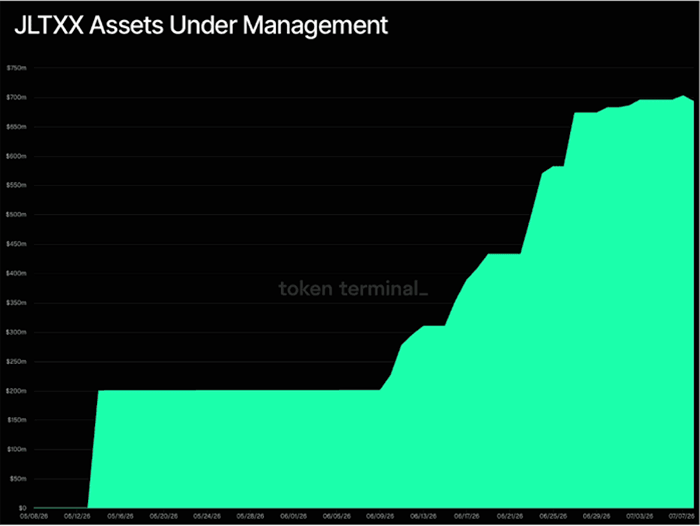
It invests in traditional assets such as Treasury bills, bonds, and overnight repos. And as the chart below shows, the growth is no joke.
Since going live in early May, it has gone from zero to over $685 million in net asset value – 250% growth in a month.
Source: Token Terminal
In decentralized finance (DeFi), the JPMorgan fund is what is known as a vault.
A vault is a smart contract that securely holds assets onchain. The curator – in this case, JPMorgan – decides what assets the fund holds and who can gain access to the fund. Then investors can deposit funds into the vault to gain exposure to the vault’s strategy automatically.
It’s a setup that cuts out a major chunk of middlemen and costs from the operation.
Think of it like a traditional ETF with the twist that the blockchain network handles custody, settlement, and record-keeping by default.
This means total transparency, faster settlement, lower costs, and markets that operate 24/7/365. These vaults fit squarely into Project Crypto, the SEC’s push to upgrade the U.S. financial system onchain. It’s a historic shift we’ve been covering for the past two years for our Permissionless Investor subscribers.
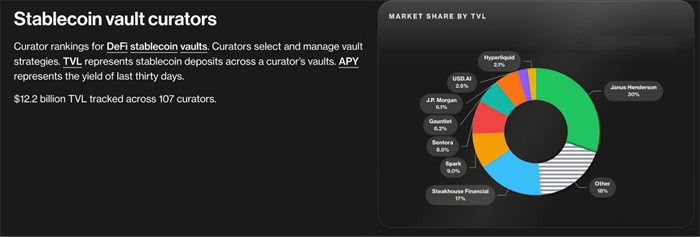
And that shift onchain looks to have gone into high gear with JPMorgan’s recent growth. Their $685 million vault already makes them one of the largest vault curators in all of DeFi.
Source: TradingStrategy.ai
The bank whose CEO hates crypto is now a top player in it. Ironic, isn’t it?
And they’re not the only traditional finance outfit seeing a future on onchain vaults…
Last week, Gauntlet – arguably the crypto-centric leading vault curator – raised a $125 million Series C. SBI Holdings USA – the American arm of Japanese banking giant SBI Holdings – wrote the entire check.
SBI chairman Yoshitaka Kitao called the move to onchain finance an “irreversible transition.” He pointed to the GENIUS Act and the CLARITY Act as the green light and said SBI plans to build next-generation financial rails that span Japan, Asia, and the world.
This is our permissionless thesis being validated in real time by the biggest names in finance.
These institutions are not waiting around for market prices to recover or for the CLARITY Act to finally become law. They are wiring themselves into onchain economies today and actively building the financial rails that will dominate tomorrow.
We shouldn’t wait around either if the world’s biggest banks are positioning themselves in crypto before the crowd shows up. So should we.
By Larry Benedict, Editor, Opportunistic Trader
The market for initial public offerings (IPOs) could be heading toward the biggest boom we’ve ever seen.
A growing number of companies are waiting their turn to go public amid market conditions that are the best they’ve seen in years.
An IPO is when a private company offers shares to the general public for the first time and lists on a stock exchange. Key ingredients are necessary for an IPO boom to take off.
Risk appetite needs to be strong among investors. That’s because many IPOs are very speculative. Most companies going public are in a high-growth phase but are still operating with negative earnings on the income statement.
The regulatory landscape can play a big role as well in supporting or deterring private companies from going public.
And right now, a perfect mix of catalysts is unleashing a record-setting number of IPOs.
Investor enthusiasm for IPOs is running high. That was on full display with the SpaceX IPO last month. SpaceX (SPCX) debuted at a $1.7 trillion valuation and raised over $85 billion – both numbers all-time records.
And just last week, a little-known company leveraged to the AI trade tapped into the easy money environment. SK Hynix is a memory chip maker that competes with Samsung and Micron Technology (MU). The South Korean company has traded on its home exchange for some time. But with conditions ripe, SK Hynix decided to launch a listing on Nasdaq.
In doing so, SK Hynix raised over $26 billion – the second-largest IPO in U.S. history, behind SpaceX last month. That amount grabs the top spot for a foreign company listing on a U.S. exchange.
Investor demand for shares was so strong that the SK Hynix offering was oversubscribed by seven times. That shows investor appetite for IPOs is running at a fever pitch.
At the same time, the Securities and Exchange Commission (SEC) recently launched a campaign it calls “Make IPOs Great Again.” The slogan points to the SEC’s desire to see more companies go public. It is removing red tape and shrinking costs to do so.
A combination of strong investor demand and a favorable regulatory backdrop seems primed to open the IPO floodgates… and lure investors at the exact wrong time.
There’s a massive backlog of “unicorns” waiting to go public. A unicorn is a private company with a $1 billion valuation or more. By one estimate, there are over 800 unicorns that could launch their own IPOs. We could see a flood of private companies rushing to the public markets.
While investors dream of striking it rich with IPOs, the reality is that buying post-IPO shares can be a difficult way to profit. By the time a company goes public, the easy money has been made.
In fact, buying IPO shares immediately following a listing could saddle you with losses. One study looked at 30 recent major IPOs. The performance of those IPOs a year later showed that only 43% delivered a positive return.
But the maximum drawdown during the first year of being public really stands out. Each IPO saw an average maximum drawdown of 55% during the first year of trading.
That’s why I trade IPOs differently. I’ve discovered an opportunity on IPO days that’s allowed my subscribers to collect a payout 82% of the time historically.
I call them IPO profit windows, and the number of opportunities is set to explode with the coming IPO boom. And here’s the best thing: I don’t even touch the stock.
Join me tonight at 8 p.m. ET to see my five-minute strategy and hear why it may be one of the only ways everyday investors can profit on IPO day… including the ticker behind my strategy.
Add Brownstone Research as your preferred source on Google to see our latest stories in your feed.
 Add as a preferred source
Read the latest insights from the world of high technology.
The GPUs are being deployed in a timely manner. What isn’t arriving fast enough is the electricity to power...


There’s one metal named in the procurement rules that hasn’t seen a major deal…yet.