





Growth Is Now Value
Prices and earnings can’t move in opposite directions forever.

From The Editor
Editor’s note: Jeff Brown has issued what he calls a “red alert.” The reason is a document Elon Musk quietly filed with the Texas Department of Licensing and Regulation, which Jeff says is setting a major tech trend in motion. He will explain it live on Tuesday, November 24, at 8 p.m. ET, in his “M.A.G.I. Phase II” strategy session. Get more details and reserve your seat with one click right here.
In this issue
01
Growth Is Now Value
Jason Bodner
02
The Price of Fragility
Ben Lilly
03
Google’s Big Bet on AI Drug Discovery
Feruz Kurbanov
Growth Is Now Value

Jason Bodner
Founder, Outlier Intel
Here’s a number that stopped me in my tracks.
Nvidia, the company at the center of the biggest technology buildout of our lifetimes, trades at 9.9 times next year’s earnings. Costco trades at 44 times. Nvidia is expected to grow earnings about 69% next year. Costco, about 10%.
Costco isn’t alone. Walmart trades at 40 times next year’s earnings for 12% growth. Coca-Cola goes for 28 times with growth under 6%. Several of these steady names sit near 52-week highs.
Meanwhile, growth stocks are under attack.
I compared two groups of large companies.
The first is what I call the Steady Eddies: Costco, Walmart, Procter & Gamble, Coca-Cola, PepsiCo, and other household names. Great businesses, but slow growers.
The second is a group of growth leaders: Microsoft, Nvidia, Broadcom, TSMC, Applied Materials, and others like them.
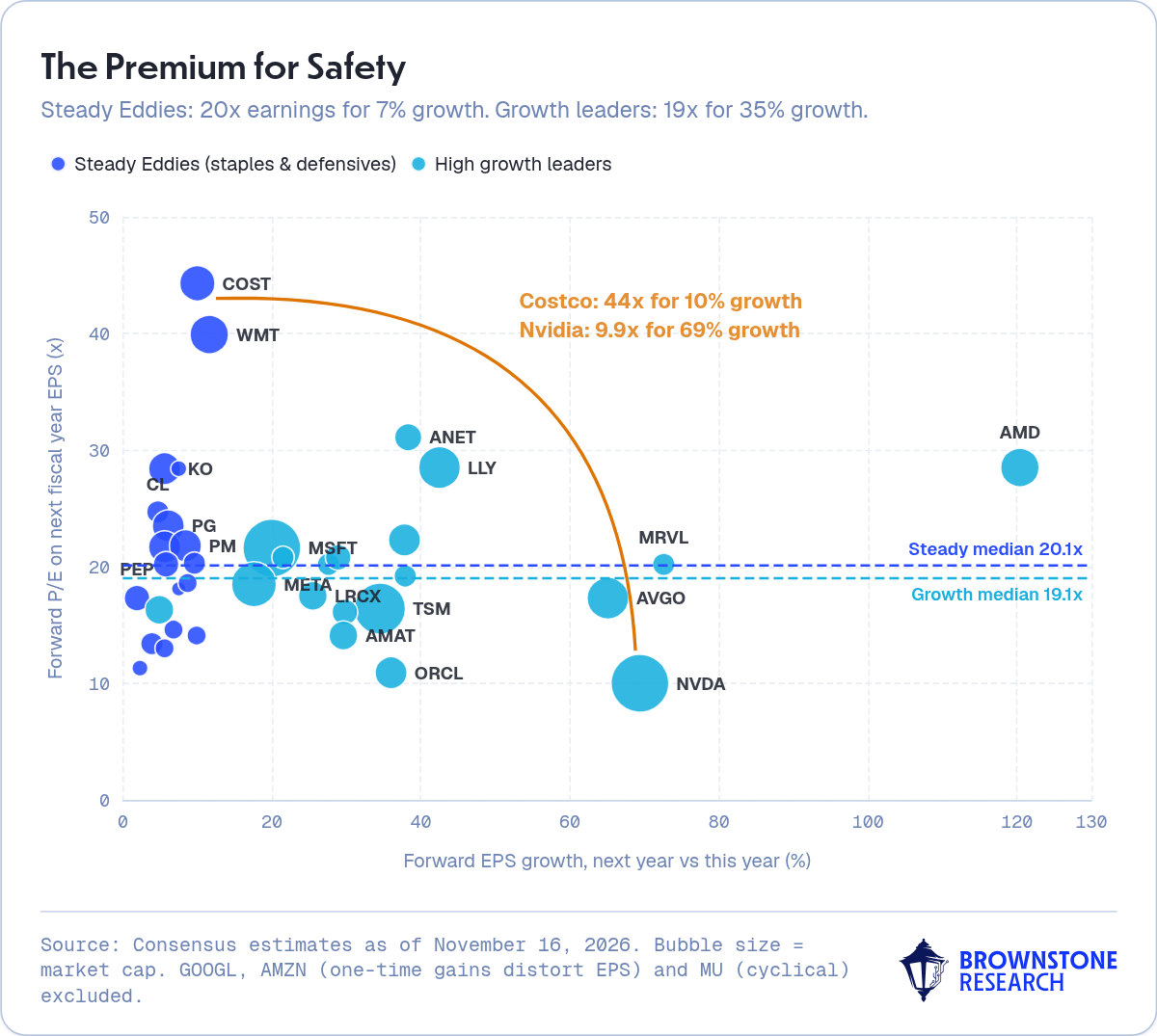
The Steady Eddies trade at a median of 20 times next year’s earnings for about 7% growth. The growth leaders trade at 19 times for about 35% growth, with profit margins three times higher.
Faster growth… wider margins… cheaper price tag. In a normal market, this would never happen, but here we are.
The squeeze goes well beyond the biggest names. Of 71 large companies growing earnings at least 20% and sales at least 15%, 64 trade at a lower multiple than Costco.
This is fear: investors paying any price for safety while dumping stocks whose earnings keep rising. Prices and earnings can’t move in opposite directions forever.
Cheap can always get cheaper. So the real question is how long growth stays out of favor and what happens when the tide turns.
To find out, I compared the Nasdaq to the Dow going back to 1990.
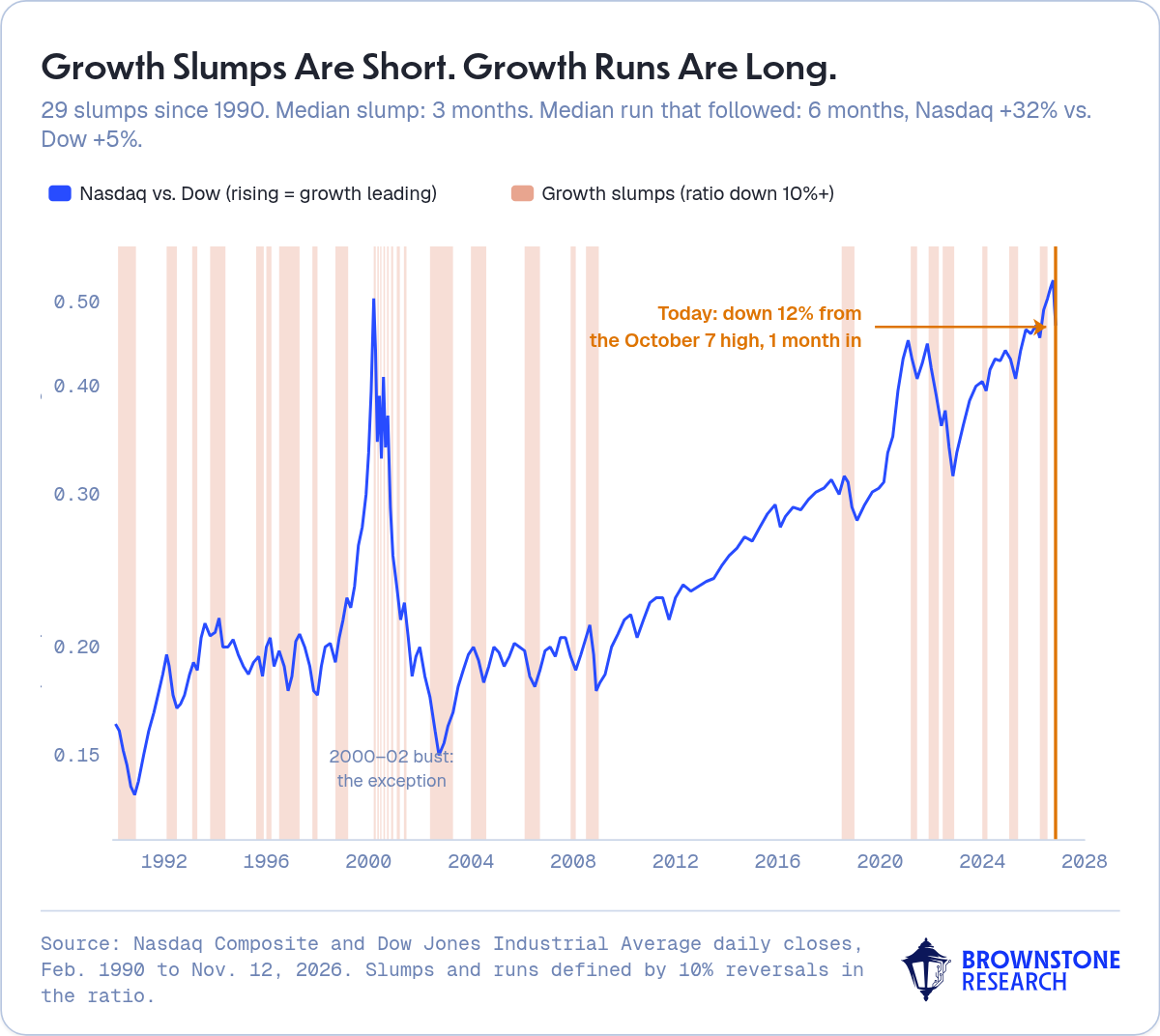
Since 1990, the Nasdaq has fallen at least 10% behind the Dow 29 times. The typical slump lasted about three months. The comeback lasted about twice as long, with the Nasdaq gaining a median 32%, versus 5% for the Dow.
Outside the 2000 dot-com bust, when growth stocks were overpriced, the Nasdaq was beating the Dow six months later in 18 of 19 cases. A year later, it was higher in 17 of 19, with a median gain of 21%.
Today, growth isn’t the overpriced side of the market.
Safety is.
Recommended Links
Musk Is About to Need 200 Billion of These Strange Devices
Goldman Sachs calls the company that makes them a "generational buying opportunity." On Tuesday, November 24, at 8 p.m. ET, Jeff Brown reveals its name and ticker free during his M.A.G.I. Phase II strategy session. Click to register for free.

Free Stock: The Company Elon Can’t Build a Single Car Without
Jeff Brown is giving away the name and ticker of one stock – free. Elon Musk can’t build a single car, robot, or rocket without it. And it’s at the heart of his masterplan… the one Elon says could return “more than 1,000x.” Click here to get the free ticker symbol.
The Price of Fragility

Ben Lilly
Senior Crypto Analyst
On Monday, customers at JPMorgan Chase, Bank of America, U.S. Bank, Truist, Wells Fargo, Capital One, and even payment services such as Zelle reported widespread outages, according to Downdetector.
Even Apple Pay, Cash App, and others drew reports.
A JPMorgan Chase spokesperson called it a technical issue. Some transactions were taking longer than usual, the spokesperson said, but customers still had access to their accounts and funds.
But that wasn’t the whole truth.
Many Chase customers reported seeing this message: “Some services aren’t available. We’re working on them. Please try back later.”
To me, that doesn’t sound like customers had access.
Worse, several banks denied the issue. Bank of America said its systems operated normally throughout the day…
There’s no telling how much this will affect customers…
But throughout the ordeal, one system ran flawlessly. It’s a payment system that anybody can access around the clock (even weekends), that can send dollars anywhere in the world, and that doesn’t rely on some bank to operate.
It’s this one:
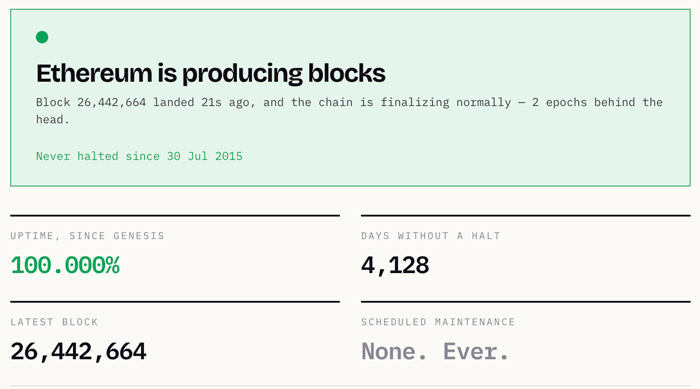
Source: ethereumuptime.com
Yes, Ethereum. And it’s not alone.
Bitcoin and many other networks ran as expected. And that’s the point.
Their nodes and validation services are spread across the globe. A few can go down without issues. There is no single point of failure.
Ethereum has nearly one million active validators. Taking down such a network requires a simultaneous global attack – and that assumes mesh networks and GPS solutions fail too.
If that ever happened, we would have much bigger problems than ensuring a global payment goes through.
Many of us don’t realize how dependent we are on big, centralized systems. We don’t think about it because, when everything works, we don’t need to. Then, one day, we’re forced to.
Public, decentralized, and permissionless technology isn’t just a feel-good saying. It’s the future. One that is more resilient, free, and ours.
Google’s Big Bet on AI Drug Discovery

Feruz Kurbanov
Senior Analyst
Isomorphic Labs, a biotechnology company backed by Google parent Alphabet, just raised $5 billion in a Series C round.
Its goal is to accelerate the development of medicines using artificial intelligence (AI).
Traditionally, developing a new medicine can take more than a decade and cost billions of dollars, with most experimental drugs failing before reaching patients.
Isomorphic hopes to improve this process by using AI to study how proteins and other molecules interact, identify promising drug targets, and design new compounds before expensive laboratory testing begins.
Its proprietary technology, called IsoDDE, combines advanced AI models with biological and chemical information to help researchers find potential medicines that might otherwise take years to identify.
The latest financing attracted some of the world’s top tech investors, including Sequoia Capital, Greenoaks, Andreessen Horowitz, and Alphabet. That interest is remarkable because Isomorphic has yet to demonstrate that its technology can produce an approved medicine. Its most advanced drug candidates remain in preclinical development, with human testing still ahead.
Major drugmakers have also signed on. Isomorphic has drug discovery partnerships with Novartis, Eli Lilly, and Johnson & Johnson.
These collaborations let the company apply its technology to real drug development programs while benefiting from the experience and resources of established pharmaceutical companies.
Such partnerships could also generate substantial revenue through research payments, development milestones, and royalties if the resulting medicines reach the market.
The company plans to use its new funding to expand its AI technology, advance its own drug candidates, and strengthen its research operations. Unlike traditional biotechnology companies that focus on developing a handful of medicines, Isomorphic hopes to create a platform that can repeatedly discover drugs across many diseases.
If successful, this approach could transform the economics of pharmaceutical research by helping scientists identify better drug candidates earlier and reduce costly failures during development.
For the broader biotechnology industry, the financing is a vote of confidence in AI-powered drug discovery.
Investors’ willingness to commit billions of dollars before a company has entered human clinical trials shows how much value they believe advanced technology can create.
Isomorphic Labs’ success ultimately depends on turning its technological breakthroughs into medicines that improve people’s lives. But the company’s enormous financing means it won’t lack resources.
This investment highlights a potential shift in the pharmaceutical industry: AI is moving from a research tool to a central part of how tomorrow’s medicines are discovered and developed.
Continue following Brownstone Research
Add Brownstone Research as your preferred source on Google to see our latest stories in your feed.
 Add as a preferred source
More stories like this
Read the latest insights from the world of high technology.
-
-
-

Nvidia is Bigger Than Jensen Huang
Did Nvidia just lose its CEO, or did it lose the extraordinary business he built?