





Life After Jensen
The AI buildout is bigger than any one man.

From The Editor
Editor’s note: Jeff Brown has issued a “red alert,” and the window to prepare is short. On Tuesday, November 24, at 8 p.m. ET, he goes live with his “M.A.G.I. Phase II” strategy session. His case: a document Elon Musk quietly filed with the Texas Department of Licensing and Regulation sets Phase II in motion, and Jeff says it “could be 1,123x times bigger” than Phase I. During the event, he will reveal an overlooked company he calls “Elon’s Silent Partner.” Come ready to write down its name and ticker. Add your name to the guest list with one click right here.
In this issue
01
Life After Jensen
Nick Rokke
02
Unlocking “The Heavies”
Dave Forest
03
Bitcoin’s Moment of Maximum Opportunity
Ben Lilly
Life After Jensen

Nick Rokke
Senior Analyst
Nvidia (NVDA) reported earnings last night. It was the first time without Jensen Huang at the helm.
Investors had one question: Can Nvidia keep winning without him?
The answer was a resounding yes.
Revenue soared 103% from this quarter last year to $116 billion. That beat Wall Street’s $109 billion estimate. It’s Nvidia’s 17th straight quarterly sales beat.
Data center revenue – the chips and systems powering artificial intelligence – jumped 110% to $108 billion. Analysts expected $102 billion. And earnings before interest, taxes, depreciation, and amortization (EBITDA) hit $79 billion, crushing the $73.5 billion consensus.
Nvidia is swimming in cash, too. In September, the board added $150 billion to its share buyback program. That’s more than Nvidia’s entire market cap just six years ago.
These are huge numbers. But they weren’t what investors cared about most.
Jensen resigned last week after reports surfaced of extramarital affairs. Many investors could look past that. A link to an alleged Chinese spy was another matter.
U.S. intelligence reportedly believes one of the women was working for Chinese intelligence. She was an executive at Megaspeed, a Singapore-based company that bought billions of dollars of Nvidia chips. The Justice Department is reportedly investigating whether some of those chips were illegally routed into China. None of this has been proven.
Since Jensen’s departure, there have been calls to have him reinstated. The company addressed that too.
On the call, board Chair Harvey Jones said, “The NVIDIA board unanimously accepted [Jensen Huang’s] resignation and does not intend to reinstate Jensen as CEO.”
So, despite a petition claiming more than 100,000 signatures – Elon Musk’s among them – Jensen isn’t coming back soon… or ever.
That puts the spotlight on interim CEO Colette Kress. She’s been Nvidia’s chief financial officer for 13 years. Analysts know her well. And she brings what investors need most right now… continuity.
Her message was clear: “Our momentum is real […] Vera Rubin is off to an explosive start, our roadmap is on track and our ambition has never been greater.”
Nvidia expects fourth-quarter revenue of $130 billion. Wall Street was looking for $125 billion. That would be 91% growth from a year ago.
She also raised Nvidia’s fiscal 2028 forecast. Nvidia now expects revenue to grow 75%, up from 70% in August. For a company this size, that’s staggering.
And demand is still building. Nvidia estimates the cloud industry’s revenue backlog has hit $2.5 trillion. That’s up from $2 trillion just three months ago.
Best of all, none of these figures rely on orders from China. Nvidia’s outlook assumes zero data center revenue from the country. After the week Nvidia just had, that’s exactly what investors want to hear.
The market agreed. Nvidia shares rose 5% after hours last night. And the semiconductor sector, as measured by the VanEck Semiconductor ETF (SMH), climbed 3%.
I expect that strength to carry into today’s session.
Jensen built Nvidia into the company powering the AI revolution. But the AI buildout is bigger than any one man. And last night, Nvidia proved it hasn’t missed a beat.
Recommended Links

Tuesday, November 24, at 8 p.m. ET Elon Musk's "M.A.G.I. Phase II"
Jeff Brown’s calls on M.A.G.I. Phase I gave his readers a chance to turn $5,000 into $126,650, $302,349, and even $1.8 million. He believes Phase II could be 1,000x bigger. Register here with a single click.

BREAKING: Washington Triggers Accelerated Wealth-Building Window
Thanks to a major event in D.C., billions of dollars could surge into the market on days you can circle on your calendar today. Handing everyday Americans a chance to potentially pocket tens of thousands of dollars over the next 12 months. Hedge fund legend Larry Benedict says if you act now, you could potentially move your retirement forward by YEARS. And he’s giving away the ONE ticker he trades most to play it, completely free. Click here to get it before December 9.
Unlocking “The Heavies”

Dave Forest
Senior Analyst
One of the best-performing stocks in October had nothing to do with AI… at least not directly.
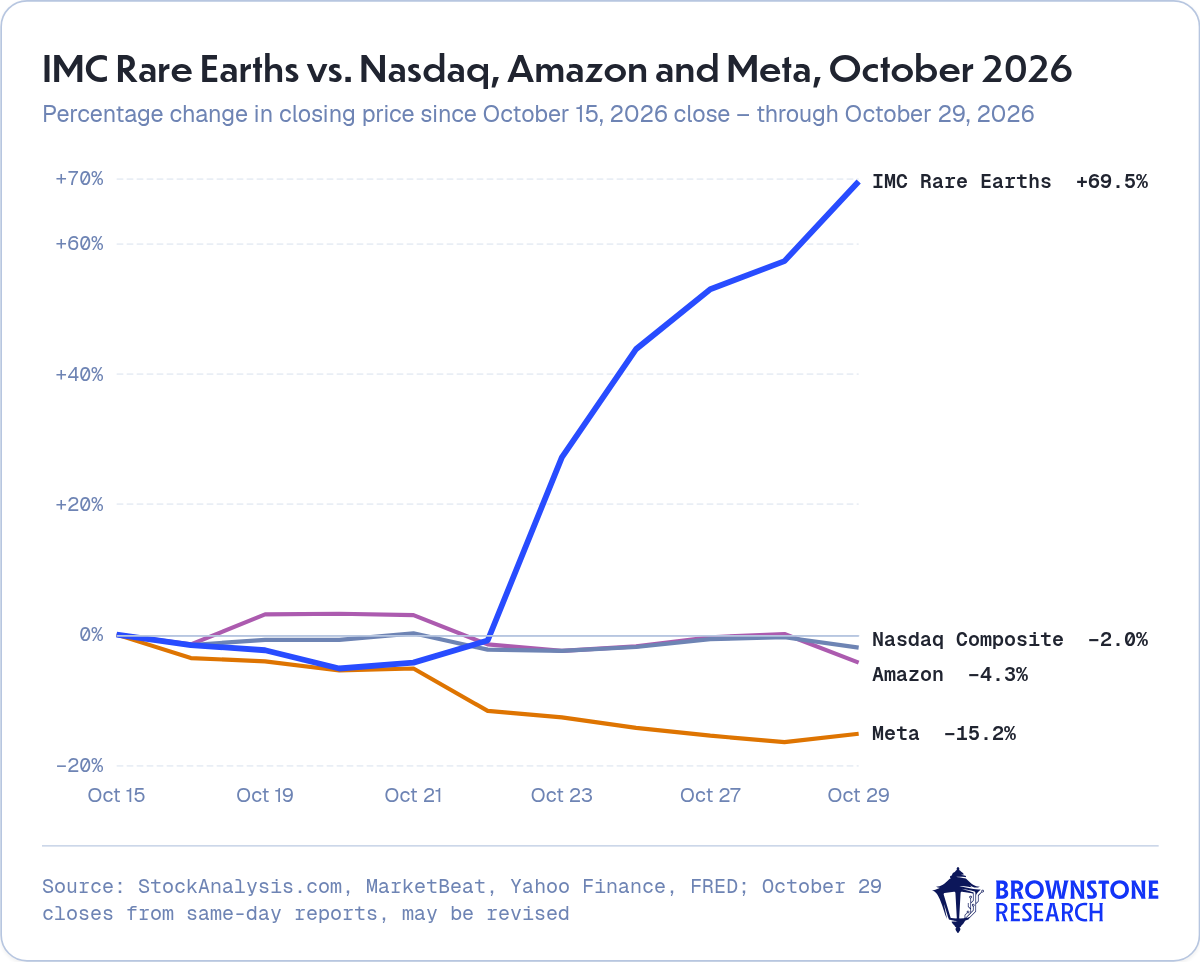
The company is IMC Rare Earths (NYSE American: IMC), which went public in July and, as shown below, trounced the Nasdaq and several large tech companies in the back half of October.
Investors’ sudden interest in IMC stems from a specific group of rare earth metals. I’m sure readers are familiar with rare earths, the critical minerals essential in everything from EV batteries, consumer electronics, and military systems. But less well known is that there are different “flavors” of rare earths.
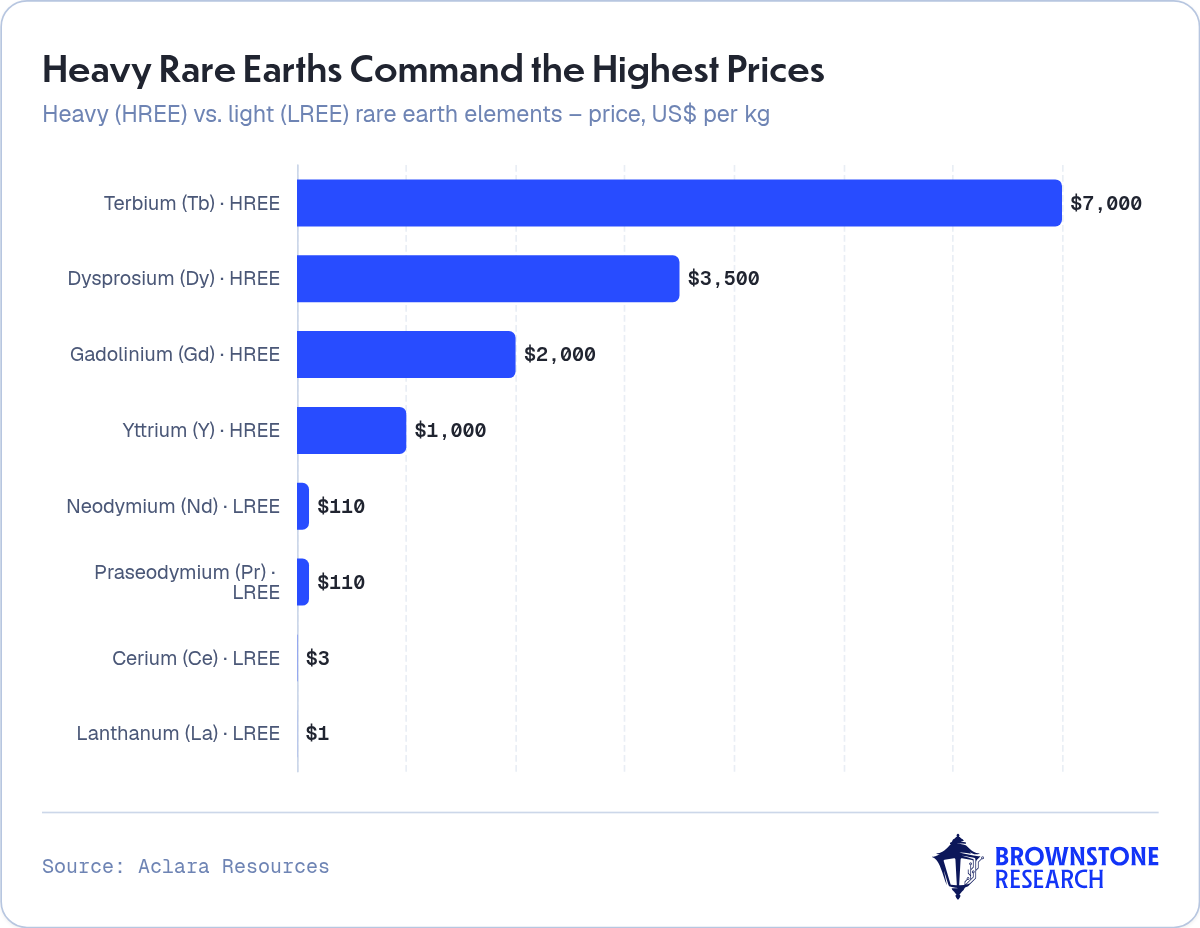
Heavy rare earth elements (HREEs) command massive premiums. In many cases, “the heavies” sell for 1,000% or more above light rare earth elements (LREEs).
To this day, China controls about 98% of the world’s heavy rare earth production. And that could be a problem starting early next year.
That’s because American tech and defense buyers face two looming game-changers for rare earths. Both will hit as early as January 2027.
The first is new Pentagon purchasing rules, slated for January 1, 2027. They restrict purchases of defense tech containing rare earths from China.
But that’s not the only problem.
China has also introduced export controls to cut off rare earth supplies to America and its allies. They were due to take effect this month, but a last-minute extension pushed the deadline to January 10, 2027.
That means rare earth supply could face two major bottlenecks in just a few weeks. Many U.S. buyers will be barred from Chinese supply, just as China chokes off exports.
That brings us back to IMC.
The company owns an ionic clay deposit in Brazil. Clay minerals adsorb all kinds of metals, grabbing them as they wash out from rock during ample rains. In the 1970s, Chinese geologists noticed that these clays were excellent at capturing the sought-after heavy rare earths. This “clay miracle” is why China has such a dominant position in HREEs. Today, these ionic clay deposits account for a third of China’s rare earth output.
And now, IMC has the same type of deposit just ahead of a major supply crunch for heavy rare earths. IMC isn’t the only rare earth miner getting attention.
In July 2025, tech entrepreneurs quietly raised funding for a new firm called Ionic Mineral Technologies. They acquired an old mining district just south of Salt Lake City where the geology suggested ionic clay deposits might be found.
Ionic Mineral remains private. But independent mine engineers have projected that the Utah clay could produce more than $92 billion in revenue from rare earths and other metals over a 44-year mine life. If Ionic Mineral Technologies ever went public, it could be valued north of $100 billion based on comparable companies.
It paints a clear picture…
Insatiable demand for heavy rare earths from tech and defense buyers, combined with an imminent supply shortfall, is creating a perfect storm for rare earth companies able to fill the gap.
In the November edition of Critical Assets, I shared my thesis on a company I believe will be among the biggest beneficiaries. If subscribers haven’t already, catch up right here.
Bitcoin’s Moment of Maximum Opportunity

Ben Lilly
Senior Crypto Analyst
Bitcoin’s down about 25% from its October highs. And dedicated readers shouldn’t be surprised.
We flagged the ominous duo of Bitcoin ETF outflows and macro credit stress in October, in Bitcoin’s Biggest Buyers Have Left the Building… for Now. At the time, BTC was still hovering in the mid-$80,000s.
ETF net flows then stood at −$617 million for October. Since then, another $2.24 billion has flowed out, bringing the net total to −$2.86 billion since October 1.
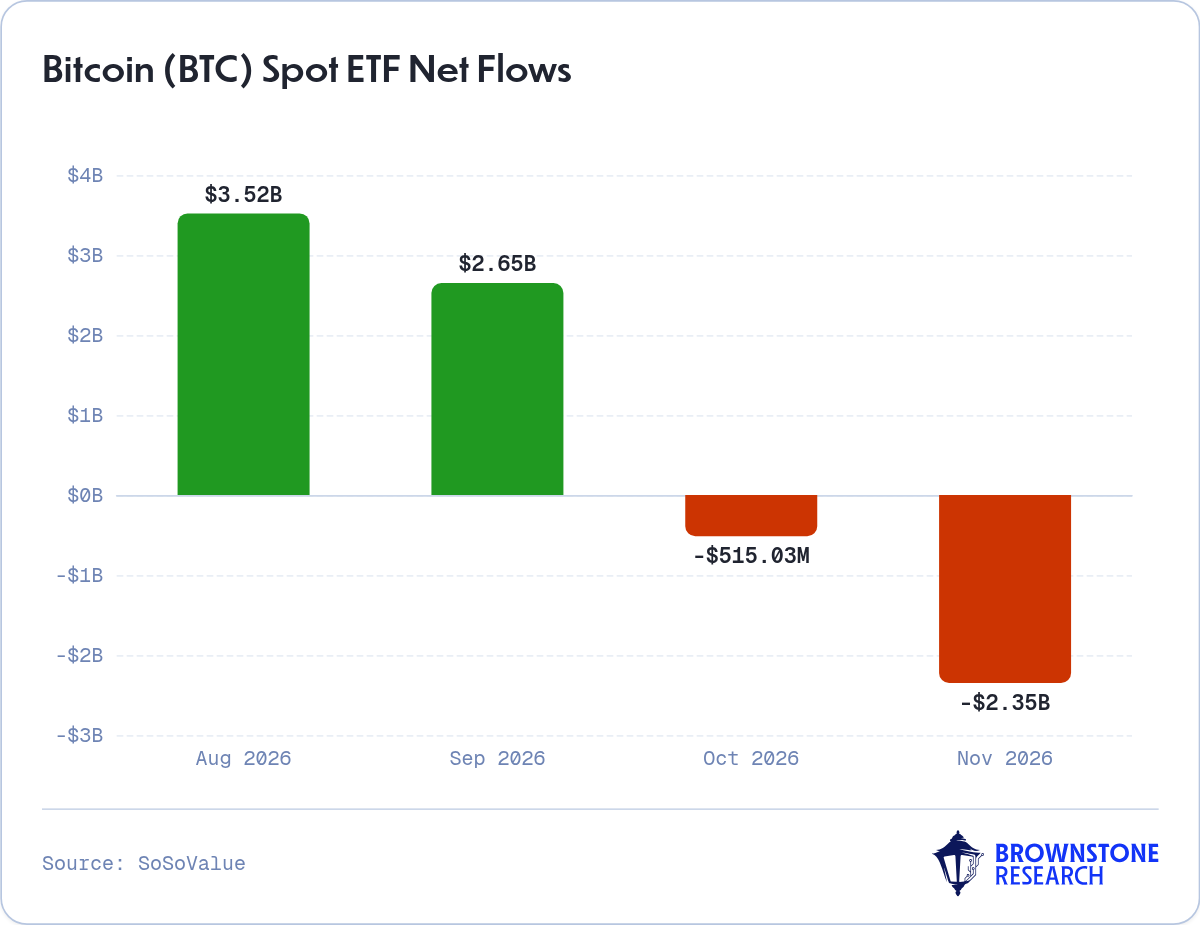
A string of bad headlines drove this selling…
Hot inflation reports raised the odds of another Fed hike in December. Then came the $6.3 billion Binance hack in late October, the midterm shift, and, as the cherry on top, Jensen Huang’s controversial resignation as Nvidia CEO last week. All of it fueled another flush lower for risk assets.
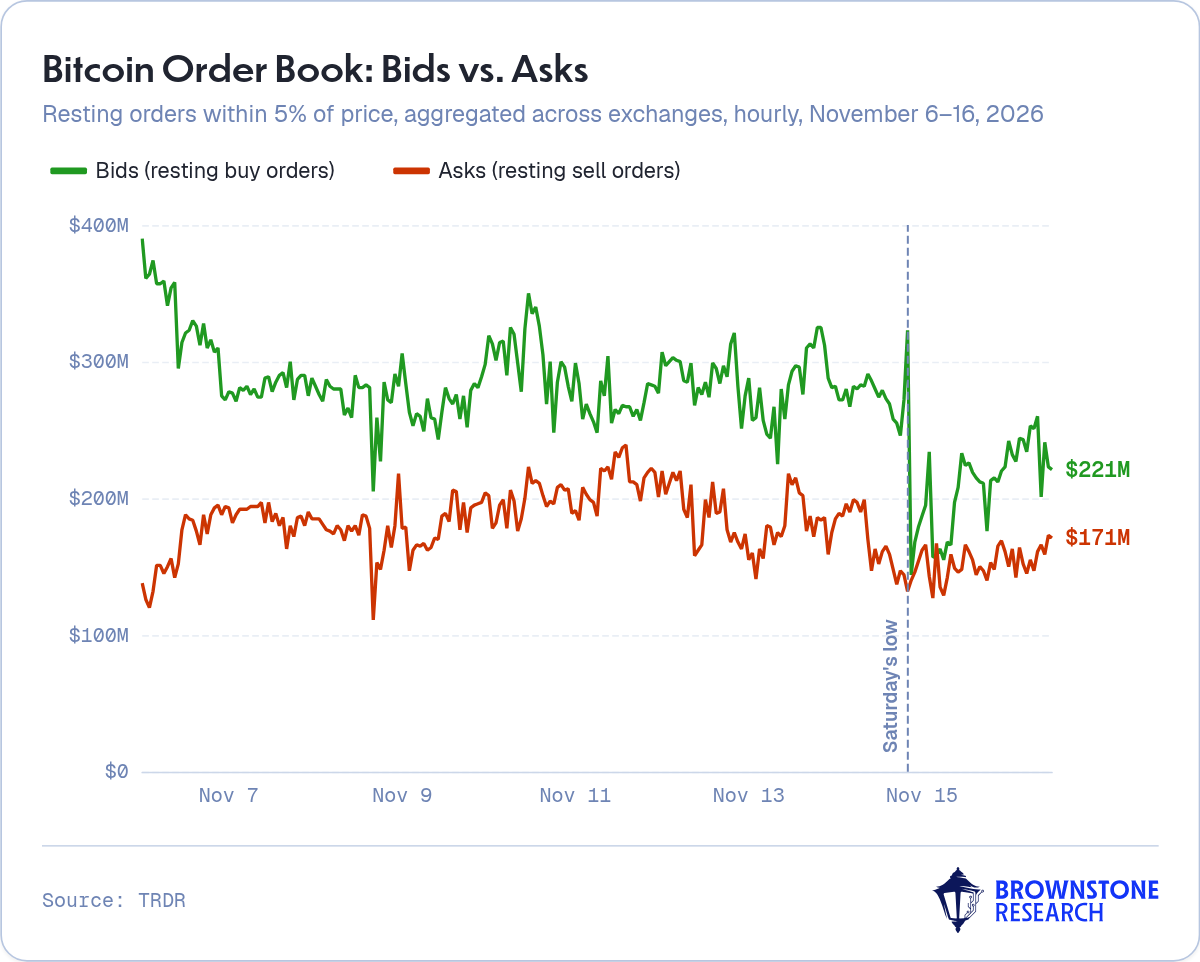
This sent Bitcoin swan-diving into the resting bid orders we flagged here last week:
“The order book is a real-time snapshot of whether the market prefers to buy or sell a specific asset. Right now, resting bids, shown as ‘bid depth,’ have trended higher since the summer. These bids reflect the market’s hidden demand. They also represent nearly $280 million of real capital from willing buyers. Any drop will run into that wall of demand.”
That drop arrived and the wall held.
The chart below shows that since Saturday’s low, almost 2,000 BTC in aggregate has been bought on Coinbase alone, nearly $130 million worth at current prices.
That means that despite the aggressive selling over the weekend, large buy orders waiting in the wings backstopped the price.
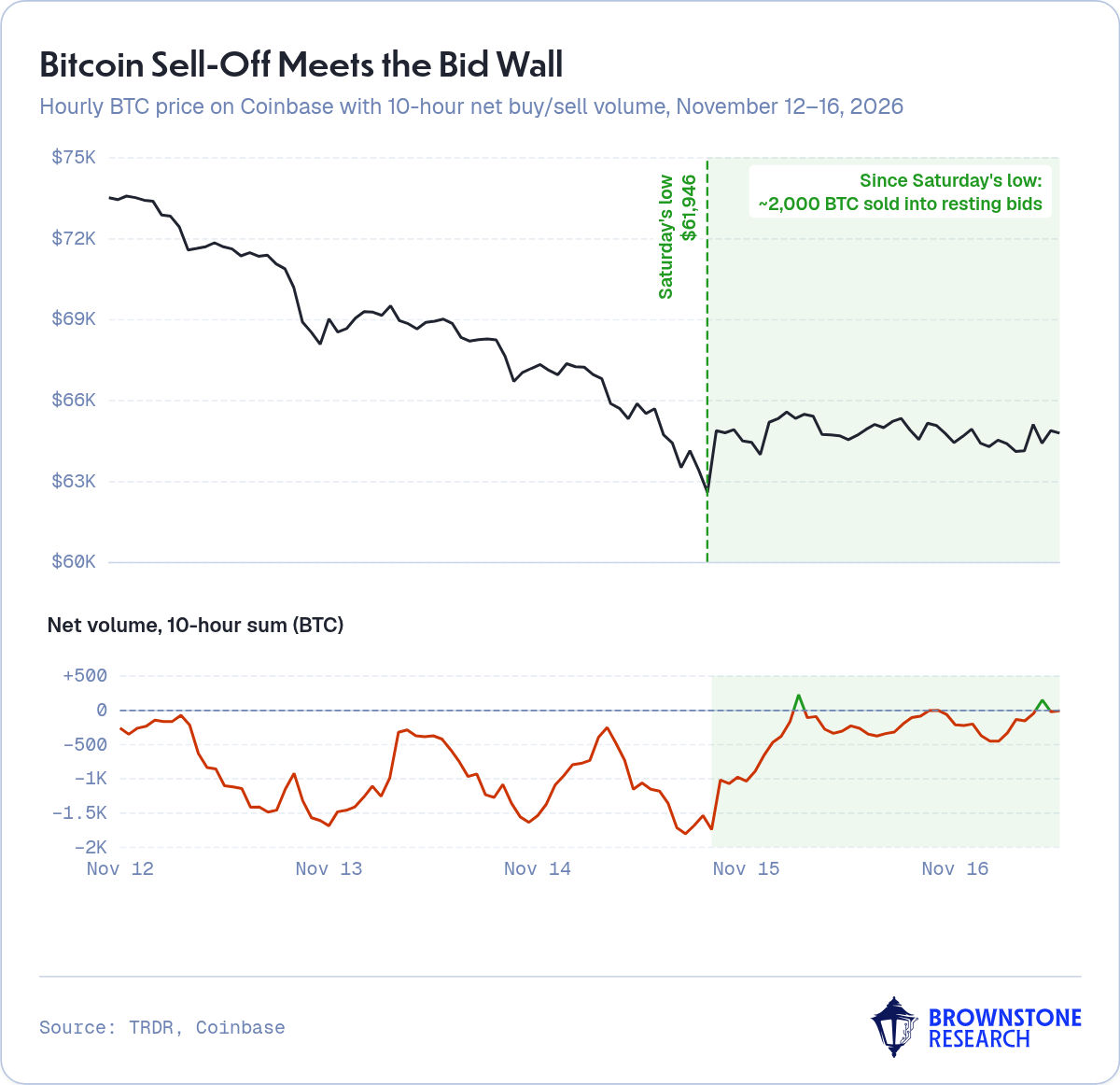
Even after that much volume was absorbed over the past couple of days, demand at these levels still outweighs supply.
Across exchanges, bids (resting buy orders) within 5% of Bitcoin’s current price total about $221 million, versus about $171 million in asks (resting sell orders). That imbalance shows there are more buyers than sellers in this range.
This much supply changing hands is reminiscent of what we saw at previous bear market lows, such as the one that followed FTX’s collapse in November 2022.
As we covered in You’ve Been Here Before earlier this week, the timing continues to sync with the four-year cycle we’ve seen play out in years past.
Bitcoin has historically bottomed about 18 months before the next halving.
The sell-off arrived right on schedule. If history is any guide, the future should look much brighter for the world’s first cryptocurrency.
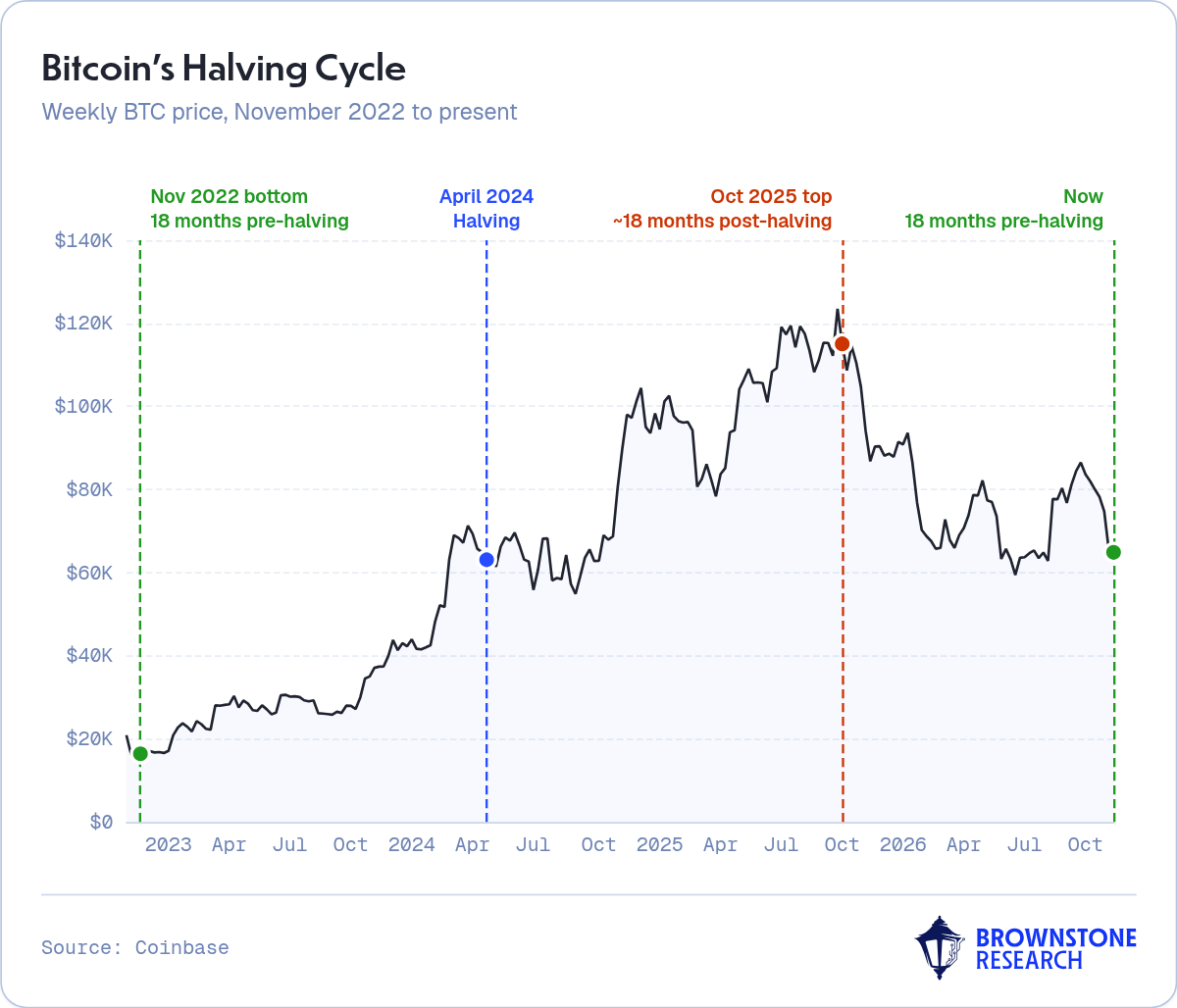
If we look at the current landscape, history may not be repeating, but it’s certainly rhyming.
In November 2022, we had a midterm shift in power, the FTX collapse, and a hawkish Fed fighting inflation.
This time around, we have the midterms, the Binance hack, and once again a hawkish Fed fighting inflation.
The conditions that marked the last bottom are back in place. Now it’s a matter of waiting for price to stabilize while we build our positions for the next cycle.
History says the end of 2026 will mark the moment of maximum opportunity.
Continue following Brownstone Research
Add Brownstone Research as your preferred source on Google to see our latest stories in your feed.
 Add as a preferred source
More stories like this
Read the latest insights from the world of high technology.
-
-

Nvidia is Bigger Than Jensen Huang
Did Nvidia just lose its CEO, or did it lose the extraordinary business he built?
-

The Fast Money Is Gone (For Now)
Once the major indexes broke key technical levels, there were forced sellers across the board.