




The Market’s Winter Solstice
The index never felt the cold. The market underneath took all of it.



Elon Musk’s grand plans all pivot on a strange new suite of metals


We’re on the verge of a new commodities supercycle…and it’s thanks in large part to Elon Musk’s unprecedented tech rollout.
Over the last 160 years, there have been four distinct periods when commodity prices boomed nearly across the board. In each supercycle, the takeoff for hard assets lasted 25 to 40 years.
One supercycle happened after the American Civil War. Another took place around the time of World War II. The most recent supercycle took off in 1999 when the rise of China supercharged demand for metals and energy.
Turning back to the present, Elon Musk’s grand plans all pivot on a strange new suite of metals, ones that many people have never even heard of unless they took advanced chemistry in university.
They’re called rare earth metals.
One of the major uses of rare earths is in making high-strength magnets. Those components are essential in guidance systems for defense technology: missiles, fighter jets, drones, and even submarines.
But the same things that make rare earths indispensable for defense also make these metals key to Elon Musk’s big plans with SpaceX, Tesla, and his other companies.
Take those Optimus robots that Musk plans to produce by the billions. They need strong magnets for the high-torque electric motors that allow Optimus to perform tasks like walking and picking up objects.
Powering those magnets is the rare earth metal neodymium. Each Optimus uses 7.5 pounds of neodymium magnets.
That’s not the only part of Musk’s strategy that pivots on rare earths. SpaceX also plans to launch a million AI satellites into orbit to create a massive network for data transmission.
Those satellites communicate with each other at incredibly high speeds and across distances of up to 3,355 miles. That’s only possible because of another rare earth metal, called erbium.
Then there’s the Terafab, which is going to produce a million wafers per month. Those chips use, you guessed it, rare earth metals like neodymium, praseodymium, terbium, and dysprosium.
At every turn, rare earths are the key to all the big things SpaceX and Musk plan to roll out in the next few years.
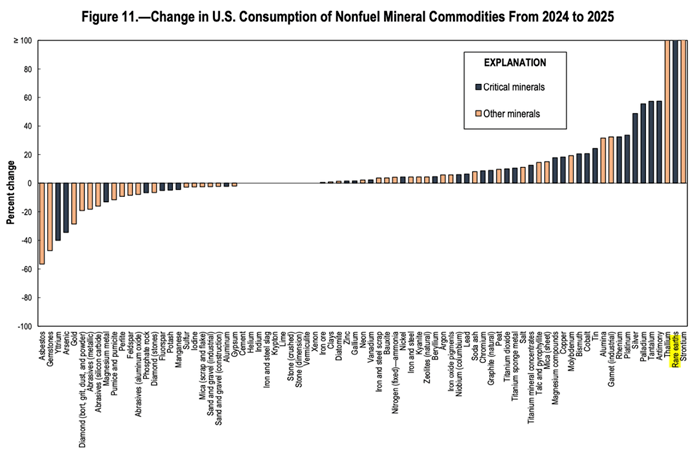
With all that in mind, have a look at this chart:
Source: U.S. Geological Survey
What you’re looking at is the latest research from the U.S. Geological Survey on metals demand from American industry. You can see rare earths at the far right of the chart, with demand in 2025 up more than 100% compared to 2024.
At the same time as U.S. demand is booming, top rare earth supplier China has throttled down exports of these tech metals. Chinese officials plan to use their rare earths stranglehold to punish nations around the world unfriendly to their political goals.
That led to huge moves from the U.S. government. In February 2026, President Donald Trump unveiled Project Vault, setting aside $12 billion to buy and stockpile rare earth metals for America’s military and business sector.
Again, all that funding is aimed at securing the rare earth metals that America currently needs. It doesn’t factor in any future demand from SpaceX and Elon Musk’s other businesses.
All of this—surging rare earths demand, constricting supply from China, and massive funding flowing into new sources of rare earths—adds up to one thing.
It’s a perfect storm for companies that can produce and supply rare earth metals on U.S. soil.
That’s why I just recommended a small, U.S.-based rare earths miner to our Critical Assets subscribers. For reasons I explained in my investment thesis, the stock is flying under the radar, but perhaps not for much longer.
If you’re curious to learn more—and to see what we’re up to at Critical Assets—you can go right here.

As of last week, the standoff over the Strait of Hormuz remained unresolved, sending oil up 5% last Monday. SpaceX reported its first post-IPO earnings, nearly doubled revenue to $7.8 billion, and still dropped 13.6% as investors winced at $16 billion in quarterly capex.
Yet by Thursday, the S&P 500 drove to a record high. The Nasdaq 100 also added 1.15% as back-to-back inflation readings made a September rate hike less likely. Money markets priced less than a 40% chance of a hike.
Most interesting of all: The Russell 2000 set a record, suggesting the rally is expanding beyond the mega-cap names that dominated earlier this year. The data bears this out.
Last week, small- and mid-cap companies worth between $500 million and $50 billion accounted for 84.6% of all inflows. Mega-cap names above $300 billion accounted for just 1.3% of the total.
When institutions get nervous, they typically hide in the biggest, safest, most liquid names.
Right now, they’re doing the opposite.
Money is flooding into smaller, higher-growth companies. That’s one of the clearest risk-on signals in months.
With that in mind, it’s worth looking at recent earnings.
With 88% of S&P 500 companies reporting earnings, 86% beat earnings estimates and 76% beat revenue estimates. The blended earnings growth rate is 50.4%, the highest since Q2 2021. Exclude large one-time gains at two major technology companies and blended growth still comes in at 32%, the second consecutive quarter above 25% and seventh straight quarter of double-digit growth. Corporate America is delivering.
August is historically the second-weakest month of the year. That weakness is more pronounced in midterm election years.
And yet the S&P 500 is pushing toward records. Small caps are breaking out. Flow data shows institutional accumulation rather than retreat.
When a market absorbs unresolved geopolitical tension, climbs to records, floods money into small caps, and produces its best earnings season since 2021, something important is happening beneath the surface.
The Greek philosopher Epictetus is supposed to have said that “it is not what happens to you but how you react to it that matters.”
So far, August has thrown plenty at this market.
And so far, its reaction has been to keep climbing.

Chip stocks have been among the biggest winners of the artificial intelligence (AI) boom… until recently.
AI hyperscalers are projected to spend over $700 billion this year alone. Money is being plowed into data centers and computing hardware—including semiconductors—to run AI applications.
Chip stocks are seeing an earnings boost as the profit outlook keeps growing brighter. Semiconductors represent up to 95% of the internal hardware value for a data center, so they’re major beneficiaries of the capital expenditures.
That fueled strong gains for chip stocks. Starting in early April, the whole semiconductor sector took off and ran through the end of June. The VanEck Semiconductor ETF (SMH) went along for the ride.
But since then, SMH and many of its biggest holdings have struggled for traction. Now a key chart level is coming into play that could tip the next move.
The sharp gains in SMH created the right conditions for a mean-reverting move lower, which was also flagged by the Relative Strength Index (RSI).
The RSI measures underlying price momentum. It started diverging negatively in June. Have a look at the chart.
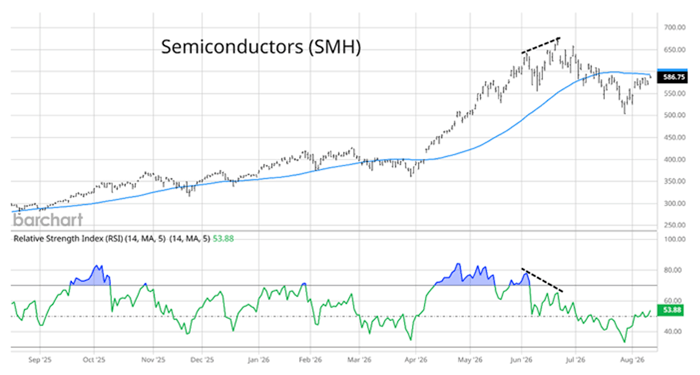
As SMH made higher highs in price into the end of June, the RSI started making lower highs (dashed lines). That showed upside momentum was starting to fade. SMH was also extended far above the 50-day moving average (MA—blue line).
A subsequent pullback in SMH took the ETF lower by 25%, which retraced about 50% of the entire rally since April.
While the RSI didn’t quite extend to oversold territory below the 30 level, it fell to the lowest level since the selloff in April 2025 following the trade war. That sparked a rebound off the $500 level. But have a look at that chart one more time.
SMH is pushing up against the 50-day MA from below, which gives us the next big test to monitor. It’s common to see key support or resistance levels tested following a break… only for the trend to resume.
But if SMH stalls out below the 50-day, then watch for the $500 support level to come into play once again.
Add Brownstone Research as your preferred source on Google to see our latest stories in your feed.
 Add as a preferred source
Read the latest insights from the world of high technology.
The index never felt the cold. The market underneath took all of it.

The bond market quickly caught on that the PCE numbers could’ve been fudged...
That deadline still looms large, and if China says yes to those export controls, metals supply in America and...