




Attack of the “Ants”
In South Korea, individual stock traders have an unusual nickname: gaemi, the Korean word for ants.



And what makes this IPO very interesting is the motivation for it. This is really about acceleration...

Editor’s Note: Welcome to First Signal, the only publication where subscribers can access the collective expertise of our entire analyst team in one place. Every Monday, Wednesday, and Friday, we’ll share three focused insights—the stories and data you need to make the most of the trading day ahead. Expect to read new insights from Jeff Brown, Larry Benedict, Jason Bodner and our handpicked pool of analysts in the weeks ahead. And if you haven’t already, be sure to catch up on your free special report, The First Signal Forecast, right here.
By Jeff Brown, Founder & CEO, Brownstone Research
It’s official. The market is getting ready for the biggest IPO in history. SpaceX has filed its S-1 form. We have also confirmed that SpaceX is gearing up for its IPO roadshow this month. The wheels are absolutely turning here.
And what makes this IPO very interesting is the motivation for it. This is really about acceleration.
Elon Musk wants to accelerate his vision and his plans. At the highest level, those plans – as crazy as it sounds – are to make the human race a multi-planetary species.
It may come as a surprise, but in 2027 and 2028, on average, SpaceX is already planning to launch around 25 Starships with materials, life support systems, food, water… everything that’ll be needed for a lunar outpost. Those missions should start before the end of 2026, which is extraordinary to think about.
The company is already building its Gigabay to manufacture hundreds of Starships per year. This will eventually lead to SpaceX being able to launch a Starship every day. This company is also building out a Gigafactory for manufacturing what will become the 1 million AI data center satellites to support the 1 million satellite constellation that SpaceX is planning to build.
On top of all that, Musk has kicked off plans for the TeraFab, which, when finished, will be the largest semiconductor manufacturing plant in history.
So, we have:
With that in mind, it’s easy to understand why Musk wants to take SpaceX public and raise $100 billion-plus. He wants to accelerate all this infrastructure, all this manufacturing capacity, to achieve the combined goals of SpaceX and xAI, which was recently acquired by SpaceX for $250 billion.
The combined entity of SpaceX and xAI is worth around $1.75 trillion. And I’m predicting we’ll see a valuation at IPO in excess of $2 trillion.
By Jason Bodner, Founder, Outlier Intel
Last month, the Trump administration unveiled a roughly $2 billion push into quantum computing…
That includes funding quantum chip foundries, photonic systems, and domestic infrastructure.
The message could not be clearer: Quantum computing is no longer being treated like a science project. It is being treated like strategic infrastructure.
But let’s back up a minute.
Every digital device you have ever used ultimately runs on binary code. Your phone, laptop, television, gaming console, cloud server, and every AI model underneath it all depend on billions of microscopic electrical switches rapidly turning on and off.
A traditional computer bit is either a 1 or a 0.
On or off.
Electricity flowing or not flowing.
That ultra-simple system transformed civilization. But the world is beginning to encounter the limits of it.
As computing demands explode from AI, robotics, scientific simulation, cryptography, and advanced modeling, some problems become exponentially more difficult as complexity rises. Traditional computers can still solve them, but eventually the required time becomes absurd.
That is where quantum computing enters the story.
Instead of traditional bits that are either 1 or 0, quantum systems use qubits, which behave according to the laws of quantum mechanics.
The simplest way to think about it is this: imagine trying to solve a maze. A traditional computer explores paths one at a time, incredibly quickly. A quantum system can explore many possible paths simultaneously before collapsing toward an answer. That is not perfectly scientifically precise, but it is directionally useful.
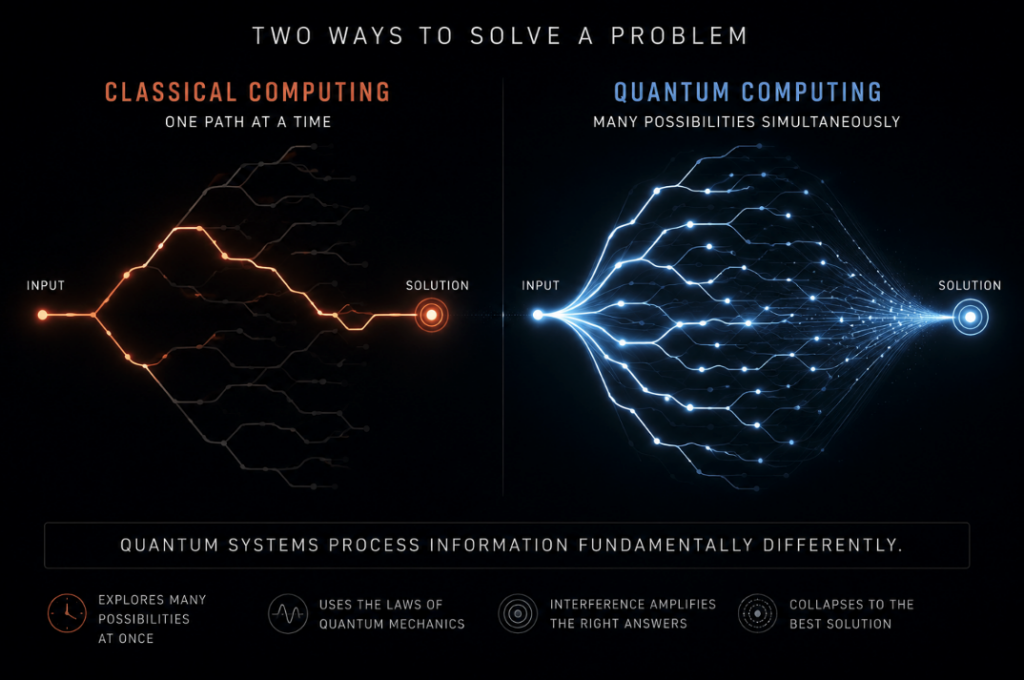
The important point is that quantum systems process information fundamentally differently from classical computers. And for certain categories of problems, that difference could become revolutionary.
Drug discovery could accelerate dramatically. New materials could emerge faster. Complex optimization problems could improve. Certain AI workloads could evolve. Modern encryption methods may eventually become vulnerable. That is why governments and technology companies are pouring billions into the field.
But for investors, this might be the really interesting part: Quantum computing is increasingly becoming a photonics story.
Photonics is the science of generating, controlling, transmitting, and measuring light. Lasers. Optical sensors. Fiber optics. Photonic chips. Wavelength control systems. In many quantum architectures, light becomes the mechanism that controls qubits, measures qubits, synchronizes systems, transfers information, and networks quantum machines together.
Quantum systems are unbelievably fragile. Tiny disturbances can disrupt calculations – heat, vibration, electromagnetic noise, timing instability, environmental interference. The systems require extraordinary precision. And increasingly, one of the best ways to achieve that precision is through light itself.
Which means the future of computing may become increasingly optical instead of purely electrical. Instead of electrons moving information through copper wiring, photons move information through optical systems.
The easiest way to understand the opportunity is to think of quantum computing less like a single invention and more like an emerging technology stack.
Governments understand this.
The United States, China, Europe, and Japan increasingly view quantum technologies as strategically important. This is not just a commercial race. It is an AI race, an encryption race, a scientific leadership race, and increasingly, a national security race.
By Joe Withrow, Senior Analyst, Brownstone Research
It’s almost a cliché at this point…
Every quarter for the past several years, someone explains why the AI infrastructure buildout is finally about to peak. And every quarter for the past several years, Nvidia’s earnings have proven them wrong.
The company’s fiscal first-quarter earnings print is the most decisive rebuttal to date.
For Q1 FY2027, Nvidia reported record revenue of $81.6 billion. That’s an increase of 85% year-over-year and 20% sequentially. Even more impressive, revenue coming from Nvidia’s data center segment hit $75.2 billion. That was a massive jump of 92% year-over-year.
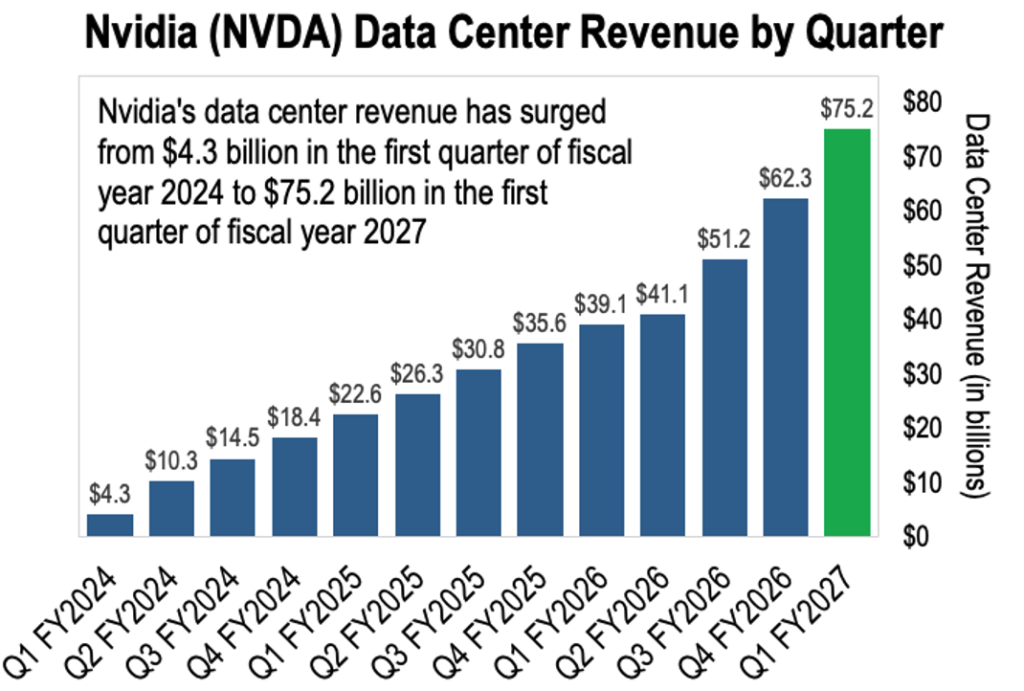
Now let’s consider this – Nvidia’s total revenue for all of fiscal year 2023 was roughly $26.9 billion. So the company now generates more than three times that amount in a single quarter – and most of that comes from its data center business line.
The reason is simple. Hyperscalers like Meta, Google, Amazon, and Microsoft are deploying AI infrastructure at a pace that is structurally different from prior technology investment cycles.
When Meta says it is spending $145 billion on capex in 2026, or when Google raises its own AI infrastructure capex guidance, a large portion of those dollars flows directly into Nvidia products. The $75.2 billion Data Center revenue quarter shows that.
Of course, we’ve seen plenty of stories suggesting that AI infrastructure spending would hit a wall — either because hyperscaler return on investment (ROI) would disappoint… enterprise AI adoption would lag… or perhaps the frontier AI model arms race would consolidate.
But the proof is in Nvidia’s quarterly earnings data. None of those friction points have materialized.
The long-term ROI is being justified. Enterprise adoption is accelerating. And model competition between Anthropic, OpenAI, Google DeepMind, and xAI is, if anything, intensifying. And that means we will see more demand for AI compute, not less.
Here’s why that’s important…
Nvidia’s earnings print has cascading implications for every layer of the AI connectivity stack. Whether it’s connectivity solutions… bandwidth optimizers… or power and cooling solutions – demand for everything continues to increase.
Bottom line: The AI boom still has legs.
The companies positioned to benefit from this aren’t just the ones building the semiconductors. They’re also the ones solving every problem that $75 billion in quarterly data center revenue creates downstream.
The question for investors isn’t whether to have exposure to the AI infrastructure buildout. Nvidia’s numbers settle that debate.
The question is where the next layer of compounding growth is building — and whether you’re in front of it before the consensus catches up…
Add Brownstone Research as your preferred source on Google to see our latest stories in your feed.
 Add as a preferred source
Read the latest insights from the world of high technology.
In South Korea, individual stock traders have an unusual nickname: gaemi, the Korean word for ants.

The GPUs are being deployed in a timely manner. What isn’t arriving fast enough is the electricity to power...