



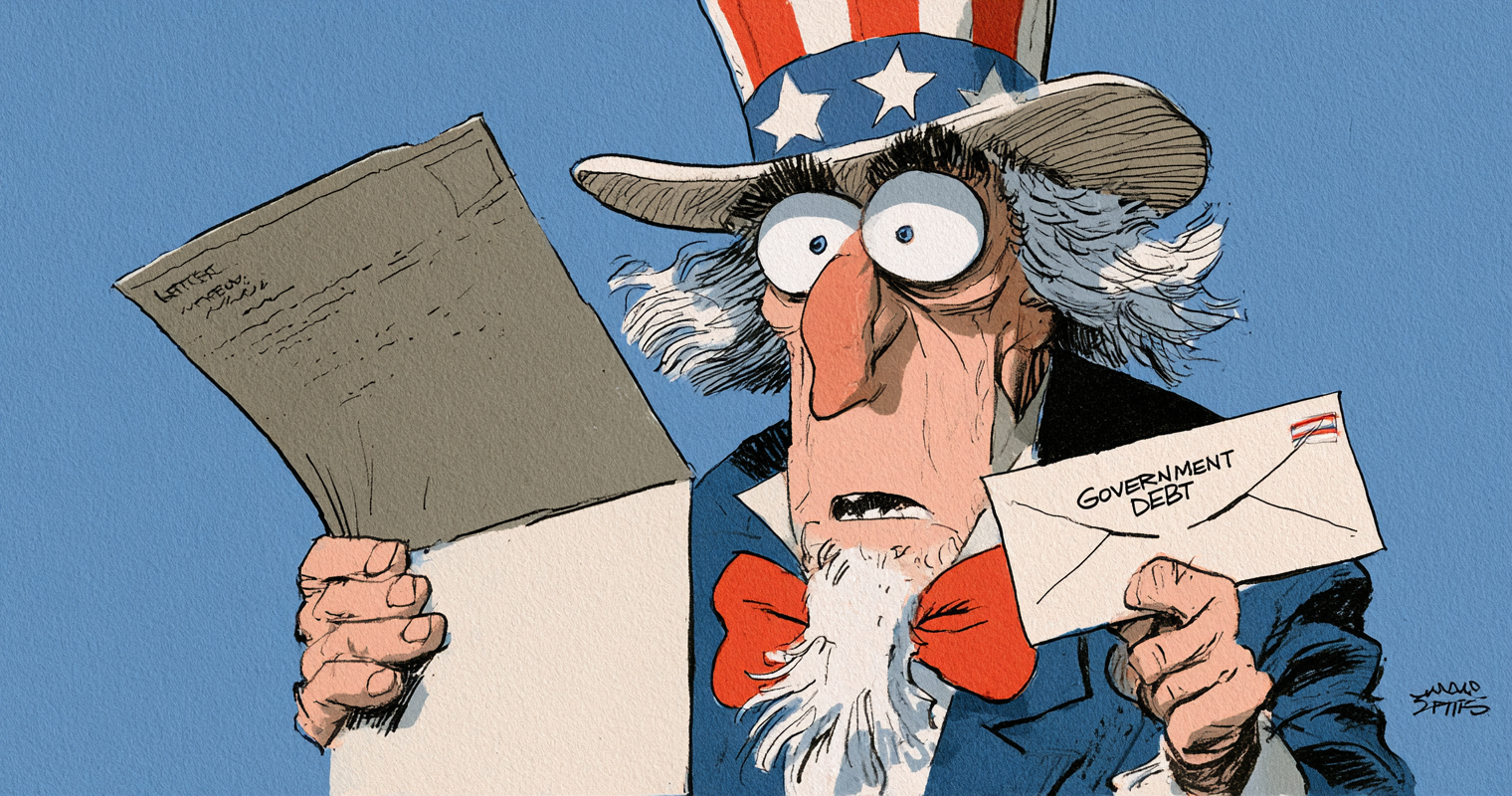
Quantitative Easing Is Back (Sorta)
Bessent appears to be picking up the quantitative easing baton from the Fed. And so far, it doesn’t seem...



This could mark an important turning point in the fight against cancer…

On Wednesday, our colleague – Market Wizard Larry Benedict – is holding an emergency briefing…
He says money has started leaving the AI giants that dominate millions of retirement accounts… and folks whose retirement remains tied to those former leaders while the new winners rise elsewhere may be in for a retirement reset.
But he also has his eye on the one ticker that could stand to benefit as more than $1 trillion starts to move… And he believes it could become the first major opportunity of what he’s calling the “AI Retirement Reset.” He’s explaining everything next Wednesday, August 26, at 8 p.m. ET.

This could mark an important turning point in the fight against cancer…
Moderna (MRNA) and Merck (MRK) announced a breakthrough this week concerning their experimental treatment, Intismeran.
Intismeran is often described as a personalized cancer vaccine. But unlike vaccines that prevent infections, this treatment is designed to treat a person who already has cancer.
The idea is simple yet remarkable. Doctors take a sample of a patient’s tumor and study its unique genetic “fingerprint.” Using that information, a personalized mRNA treatment is created specifically for that patient.
The goal is to teach the patient’s own immune system what that specific cancer looks like, so it can recognize and attack cancer cells if they remain in the body.
In a large Phase 3 study involving 1,137 patients with high-risk melanoma whose tumors had been surgically removed, participants received either Merck’s cancer immunotherapy Keytruda alone or Keytruda together with the personalized mRNA treatment.
The combination produced a statistically significant and clinically meaningful improvement in preventing the cancer from returning, as well as from spreading to other parts of the body, compared with Keytruda alone.
And the market reaction to the news was just extraordinary. Moderna closed on Wednesday, Aug. 19 (the day of the announcement) at around $174.38, up roughly 177% in a single session (see the chart below). It was the largest one-day gain in Moderna’s trading history by far.
For decades, scientists have dreamed about creating vaccines that could help the human immune system fight cancer. Many have failed.
This time is different.
This is the first positive Phase 3 trial of an individualized neoantigen therapy and the first positive Phase 3 trial of an mRNA-based cancer treatment.
As a reminder, Phase 3 is the large, late-stage clinical trial done to evaluate efficacy, monitor any side effects, and compare the treatment against the current standard of care or a placebo. After a successful Phase 3, the next step is to file for FDA approval.
Moderna’s mRNA-based treatment has demonstrated efficacy in a large, rigorous clinical trial with improved clinical results compared with the current standard of care (Keytruda).
Melanoma is only the beginning.
Merck and Moderna are already running nine Phase 2 and Phase 3 studies of Intismeran across several cancers, including melanoma, lung, bladder, and kidney cancers.
To be clear, success in melanoma does not automatically guarantee success in other types of cancer. Biology rarely gives guarantees. But these results give scientists and investors much stronger evidence that the underlying idea can actually work in humans.
Personalized cancer vaccines represent an obvious evolution of biotechnology, one that results in higher efficacy and fewer unwanted side effects.
Imagine a future in which a patient’s tumor is removed, its genetic information is sequenced and analyzed, and a medicine specifically designed to recognize that person’s cancer is manufactured and given to help prevent the disease from coming back.
We’ll be monitoring Intismeran’s progress very closely. But the announcement tells us something very important… The idea works well enough to succeed in Phase 3.
In short, what has been theorized for decades has now been proven to be possible.
And for biotechnology as a whole, it is evidence that the long-promised era of medicines designed around the biology of an individual patient is getting much closer to reality.
During the 2022 Retirement Reset, approximately $3.4 trillion was wiped from US retirements. Yet Larry Benedict put together 14 straight winning trades for his members. Inside that streak, he even created the potential to turn $10,000 into more than $156,000… In just 44 days. Now Larry believes the biggest Retirement Reset of his 40-year career has begun. He’ll reveal the ONE ticker he believes should be your first move, during a free briefing this Wednesday, August 26 at 8 p.m. ET. Click here to register.

Take a look at this… It’s a radical “light-speed” device that’s turning AI as we know it into “Accelerated AI”, making it 100 times faster and 100 times more energy efficient. In fact, Jensen Huang, Nvidia’s founder and CEO, says this device is shattering the limitations of AI and without it, AI can’t scale. If you want to discover what this technology is, why Nvidia is betting billions on it… And the one stock we believe could be the biggest winner when “Accelerated AI” goes mainstream… Click here to see all the details.

Last week, headlines looked alarming…
The 30-year Treasury yield touched 5.33%, a level not seen since 2007. Bond vigilantes (investors who sell Treasuries to punish perceived fiscal recklessness) were in open revolt.
Treasury Secretary Bessent responded by announcing doubled debt buybacks, briefly pushing yields lower before they reversed to 5.25% by week’s end. Crude climbed as tensions with Iran continued. The Nasdaq fell four of five sessions.
The political overlay added another layer of uncertainty Wall Street really dislikes.
Democratic socialist Angie Nixon scored a major upset in Florida’s Democratic Senate primary, defeating Alex Vindman. Progressive Aisha Wahab won California’s special House election to fill Eric Swalwell’s seat.
The leftward drift of the Democratic Party heading into November introduces policy uncertainty on taxes, regulation, and AI oversight that markets have not fully priced.
Midterm rhetoric is ratcheting up. Outcomes are unclear. Uncertainty is the one thing Wall Street consistently dislikes more than bad news.
And yet beneath all of it, corporate America continued crushing it. The blended net profit margin for the S&P 500 reached 16.9% for Q2 2026, the highest since FactSet began tracking in 2009.
Semiconductors reported 135% earnings growth. Analysts project full-year 2026 S&P 500 earnings growth of 30%. LSEG confirms that 85.1% of companies reporting beat EPS expectations. Underlying earnings growth excluding Alphabet and Amazon one-time gains was approximately 31% to 32%—one of the strongest profit growth periods in recent years.
The AI buildout isn’t a story anymore. It’s in the numbers.
But this is what thin August markets do to high-conviction positions. Senior traders are away. Desks are staffed with juniors. Market makers see big sellers and yank bids, knowing someone must get out, making the doorway smaller.
Liquidity dries up. Spreads widen. Great stocks get sold at bad prices.
The physical sensation of watching this is genuinely unpleasant. It feels like being wrong. It feels like the market knows something you don’t.
But as I noted above, corporate America is firing on all cylinders. And speaking of the stocks held within our model portfolios, these are not distressed companies. These are among the most fundamentally superior growth businesses available anywhere in public markets.
And here’s the important part: They are mathematically cheaper today than they were before the selling started.
Queasiness is real. Math runs opposite.

Bond yields are soaring all over the world—in some places to the highest levels seen in decades.
In Europe, longer-dated yields are rising across France, Germany, and the United Kingdom. In some instances, borrowing costs hit the highest level since 1998. Japan’s 10-year yield on government debt just hit the highest level in three decades.
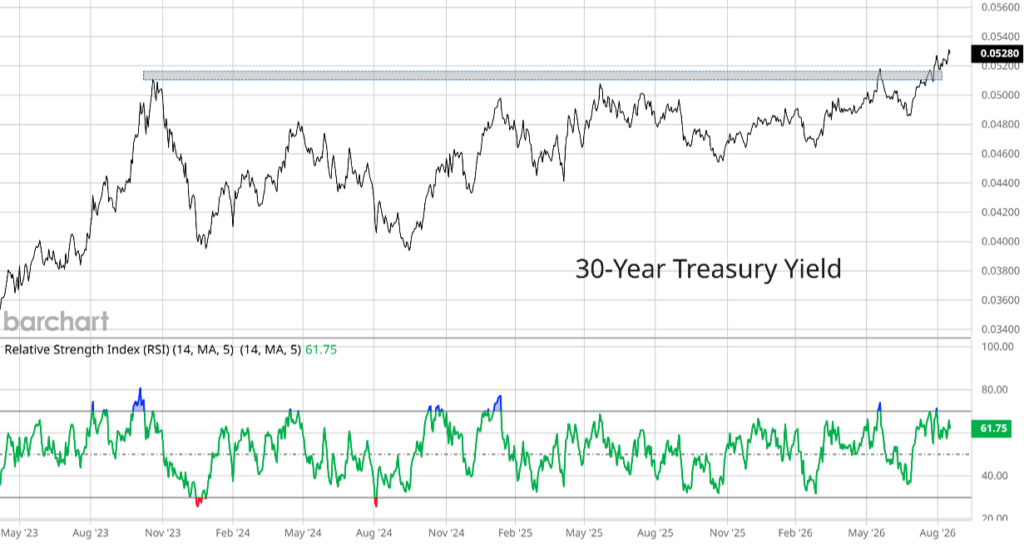
And the U.S. isn’t being spared. The interest rate on 30-year Treasury bonds hit the highest level since 2007.
This increase in rates is a continuation of an uptrend unfolding over the past couple of years… and it could be only the start.
The rise in interest rates is taking out key levels, especially on the longer end of the yield curve.
The 30-year Treasury yield broke above the 5.15% level in July, and the move is only accelerating. Here’s the chart:
The move can hurt investor portfolios in a couple of ways.
Bonds are a core holding in retirement portfolios and are supposed to provide diversification. But remember that bond prices fall when yields are rising.
Rising rates can also pressure the stock market. They diminish the value of future profits. Investors can quickly rethink how much they should be paying for a stock, especially when valuations are elevated.
Higher rates can also draw funds away from stocks. When interest rates are on the rise, that means investors can earn a higher rate of return on bonds, so bonds start competing with stocks for investors’ money.
As rates keep rising, investors are finally starting to show some concern.
Several catalysts can spark a move higher in interest rates. Inflation and problems with the state of government finances are two big ones. And right now, both are hitting at the same time.
Inflation pressures are emerging all over the place. The most obvious price impact is coming from geopolitical conflicts in key energy regions. That includes the ongoing war between Russia and Ukraine as well as hostilities in the Middle East affecting the flow of energy products.
The AI infrastructure buildout is inflationary as well. Copper prices are hovering near record highs, and companies such as Apple and Tesla are warning about rising prices for consumer products as a result of semiconductor shortages.
Then there’s spiraling fiscal spending all over the world. The U.S. is projected to run a budget deficit of $1.9 trillion this year—about 6% of GDP, a level rarely seen when economic times are good.
Putting it all together, there’s a perfect storm of catalysts to spark an increase in interest rates.
While investors are already starting to fret over the latest increases, it could just be the beginning.
Read the latest insights from the world of high technology.
Bessent appears to be picking up the quantitative easing baton from the Fed. And so far, it doesn’t seem...

The winners of the next phase of the AI infrastructure buildout have already been determined...

Elon Musk’s grand plans all pivot on a strange new suite of metals