




Bonds Call BS on Inflation
The bond market quickly caught on that the PCE numbers could’ve been fudged...



For traders, this is not the time to force anything.


The market had a big surprise last Friday…
Following June’s slightly lower-than-expected Job Openings and Labor Turnover Survey (JOLTS), Friday’s nonfarm payrolls (NFP) data surprised to the downside.
Against expectations of around 80,000 new jobs, NFP showed that the economy actually shed 23,000 jobs in July. May and June were also revised lower by a combined 103,000 jobs. And while unemployment unexpectedly dipped to 4.1%, that came as the labor force participation rate fell to 61.4%—its lowest level in more than five years.
That combined to take some heat out of rate hike expectations…
Yesterday, the CME FedWatch Tool was factoring in a roughly 52:48 split for a 0.25% rate rise at the Federal Reserve’s next meeting in September—52% expect the Fed to leave rates unchanged, while 48% expect a hike.
And then came this morning’s inflation print…
The latest reading from the Consumer Price Index (CPI) showed topline inflation at 3.4%. The much-watched core inflation—which strips out the notoriously volatile food and energy categories—printed 2.5%. Both were in-line with expectations.
Tomorrow, we’ll get the Producer Price Index (PPI) for July. After it fell (to -0.3%) in June, markets are expecting a 0.1% reading. Any surprises here could turn the dial on interest rate expectations.
For traders, this is not the time to force anything. For now, I’m advising my readers to sit back…and wait.

Beware a market that fails to make new lows on bad news.
Last week, crypto was dealt a major blow after legislators failed to bring the CLARITY Act to a vote ahead of the August recess. The bill is now delayed until September 15.
As a reminder, this is the bill that would give the digital asset industry clear rules of the road. It would also put an end to the regulatory gray area the industry has been forced to operate in, and green-light U.S.-based innovation.
But there is a silver lining…
Despite the bad news, Bitcoin and other major digital assets held firm.
Bad news like this would normally send prices down to retest their lows from earlier this summer. Bitcoin and Ethereum did the opposite. Both closed slightly up on the week.
The behavior we saw from Bitcoin spot ETFs was also counter to what you might expect.
These spot ETFs are the primary way institutions get their BTC exposure. Last week they brought in $865.3 million of net inflows to start off August.
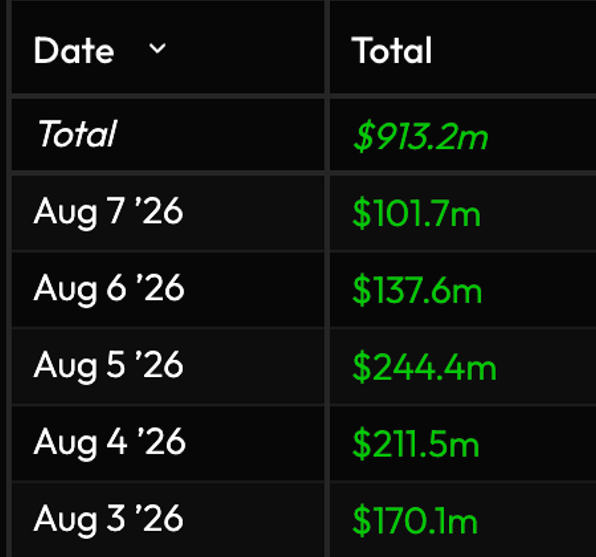
Source: Velo.xyz
This is the old trading trope “buy the rumor, sell the news” running in reverse.
The CLARITY delay had already been priced in earlier this year during the crypto sell-off. The market knew the disappointment was coming. And these new flows tell us big players are now looking ahead to what comes next.
They are treating the summer lull as a discount window for building positions.
And it’s not hard to see why…
The SEC and CFTC both calmed nerves by promising the market they will write their own rules if necessary. They will not allow our financial markets to be held hostage by the Senate’s politics.
It’s a topic we covered extensively in our recent Chain of Thought, “The CLARITY Act’s 11th-Hour Push (and the SEC’s Backup Plan).”
This means, one way or another, Project Crypto—the Trump administration’s initiative to bring finance on-chain—will be advancing this year.
And their reassurance hits at the perfect time.
That’s because the historic bottom signals we have flagged here in recent weeks have continued to fire…
Bitcoin’s power-law support is still intact, options skew is steadily trending bullish, the ETH/BTC ratio is getting closer to a breakout, and Strategy’s financial alchemy continues to strengthen.
All of these signals tell us the same thing.
The market is fundamentally underpriced and could be coiling for a big move higher on good news. That’s what the $865 million-plus flows tell us from last week.
And if the snapback rally in digital assets does come, history suggests it will be fast…
Bitcoin—a good proxy for the digital asset market—spent nearly three years trending sideways-and-down after the then-peak around $19,000 in December 2017. But then, BTC hit an inflection point in late summer 2020. From approximately $10,000 in September of that year, BTC more than doubled by year’s end.
BTC peaked again in November of 2021. And once again, it trended lower for nearly two years. But again, we hit an inflection point in late summer 2023. From around $26,000 in September of that year, BTC doubled by February 2024.
The delay on CLARITY was a setback, but digital asset investors have been here before. Quality assets don’t stay discounted for long, and the signals suggest we’re nearing the end of crypto’s fire sale.

If you’ve ever had blood drawn for a lab test, you know the basic idea. Even a small sample can tell doctors a lot about what’s going on inside your body.
Now, a new kind of blood test is starting to shape how entire cancer drug programs get developed, and a recent partnership between two companies, Exelixis (EXEL) and Natera (NTRA), shows exactly how.
Exelixis makes cancer drugs. One of its newer ones, called zanzalintinib, is being tested as a treatment for colorectal cancer (cancer of the colon or rectum).
Natera doesn’t make drugs. It makes a blood test called Signatera, which can detect tiny traces of cancer DNA still floating around in a patient’s bloodstream, even after surgery, and even when scans and X-rays look completely clean. Doctors call this molecular residual disease (MRD)—you can think of it as cancer that’s still “hiding.”
Exelixis is running a big clinical trial to see if zanzalintinib can help patients who’ve already had surgery for colorectal cancer but are at high risk of the cancer coming back. The tricky part of any trial like this is figuring out who actually belongs in it. Test too many low-risk patients, and you won’t see a clear result. Test too few, and the trial takes forever.
That’s where Natera comes in.
Instead of Exelixis guessing who’s at risk, Natera’s Signatera blood test finds patients who test positive for those hidden cancer traces. This is the exact group most likely to benefit from more treatment. Natera’s test is also being used partway through the trial to check whether the drug is clearing that cancer DNA from the bloodstream, which gives an early hint of whether treatment is working.
A cancer-immunotherapy medicine from Merck is also part of the mix, but the blood test is the piece worth paying attention to.
This deal is a small example of a bigger shift happening across the diagnostics industry.
Companies like Natera and its competitors, Guardant Health and Tempus AI, used to be seen mainly as standalone businesses, selling tests directly to patients and doctors.
Increasingly, they’re becoming something else—essential infrastructure for the drug companies themselves.
Instead of competing with pharmaceutical companies, these testing companies are getting paid to help drugmakers find the right patients before a treatment even reaches the market.
That’s a valuable, and sticky, role.
Once a diagnostic test becomes baked into how a major drug trial is run, it tends to stay baked in. Doctors keep using the same test after the drug is approved because it’s already part of the treatment routine.
For patients, this kind of teamwork could eventually mean more personalized cancer care with treatments aimed specifically at people whose cancer is genuinely at risk of returning, rather than a one-size-fits-all approach.
For the companies involved, it’s a sign that testing and treatment are becoming two halves of the same business, rather than separate industries working side by side.
Add Brownstone Research as your preferred source on Google to see our latest stories in your feed.
 Add as a preferred source
Read the latest insights from the world of high technology.
The bond market quickly caught on that the PCE numbers could’ve been fudged...
That deadline still looms large, and if China says yes to those export controls, metals supply in America and...

Indexes look great, your brokerage statement may not.