




Growth Is Now Value
Prices and earnings can’t move in opposite directions forever.



Last week was difficult. And the turbulence may not be over yet.

Editor’s note: Jeff Brown has issued what he calls a “red alert.” The reason is a document Elon Musk quietly filed with the Texas Department of Licensing and Regulation, which Jeff says is setting a major tech trend in motion. He will explain it live tomorrow, November 24, at 8 p.m. ET, in his “M.A.G.I. Phase II” strategy session. Get more details and reserve your seat with one click right here.

Anthropic held its IPO with much fanfare last week. Listed under the ticker “ANT,” shares priced at $83 Wednesday evening, above the originally marketed range of $70 to $78. When the stock began trading around midday Thursday, shares were going for about $111.50, a 34% pop.
By any measure, it was a wildly successful debut, and a testament to the hunger for new stocks on the front lines of AI.
The market sold off anyway… with the Nasdaq down about 2% by Thursday’s close.
If you’ve ever wondered what a forced liquidation feels like… now you know.
The latest data shows margin debt fell 2.1% in October to $1.45 trillion. Outflow signals on leveraged long ETFs rose from 2 on Monday to 12 on Thursday. This is not the market responding rationally to changing fundamentals. This is margin-called investors selling whatever they can… at whatever price.
The good news is that it can’t last much longer.
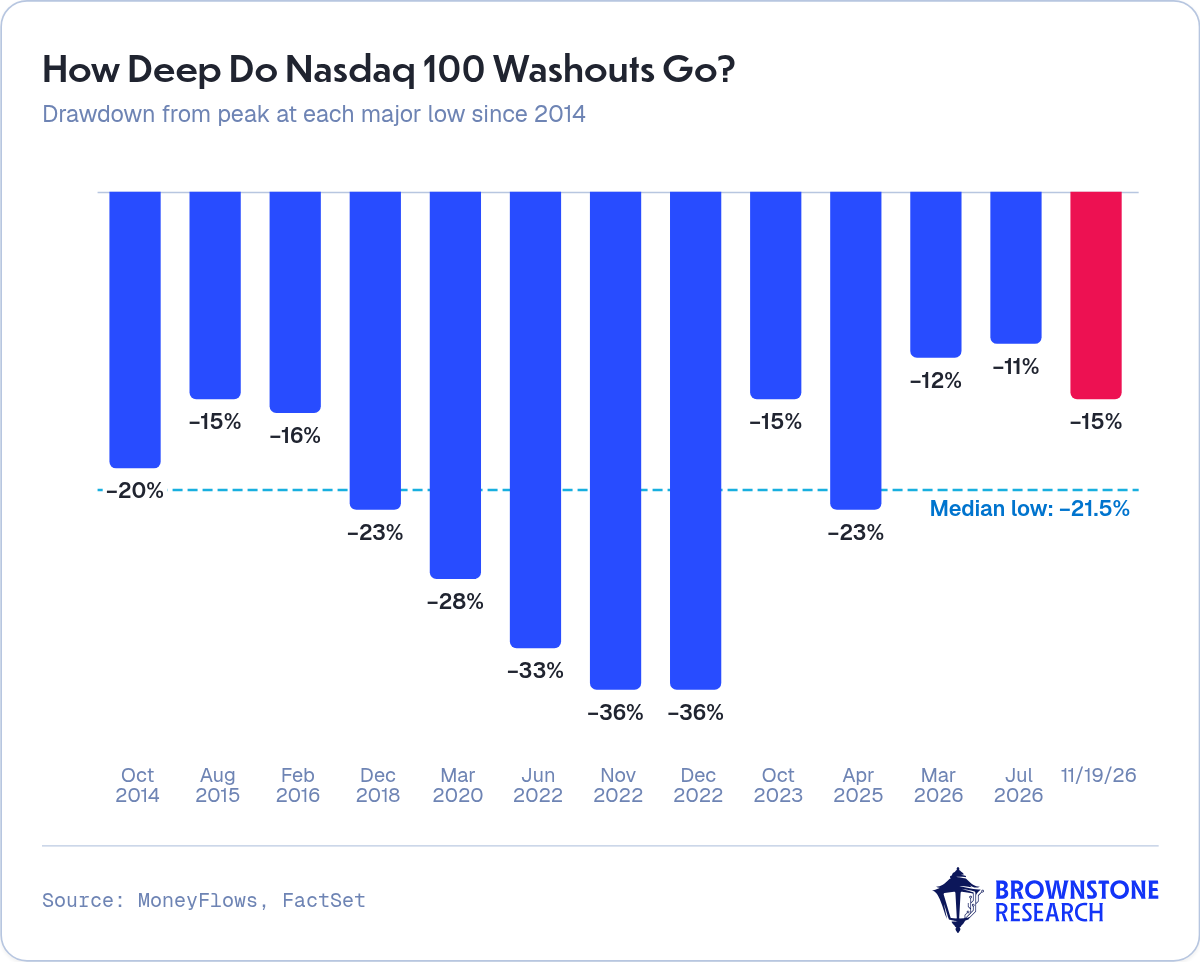
The Nasdaq 100 is down 15% from its October peak. The median drop at major lows since 2014 is 21.5%, and after every major low since 2008, the Nasdaq 100 was higher one week, one year, and two years later.
Meanwhile, the fundamentals keep improving. Of S&P 500 companies that have reported, 84% beat estimates, third-quarter earnings are growing 31.9%, and fourth-quarter estimates rose during the quarter, when analysts usually cut them.
The result: the hardest-hit stocks look downright cheap.
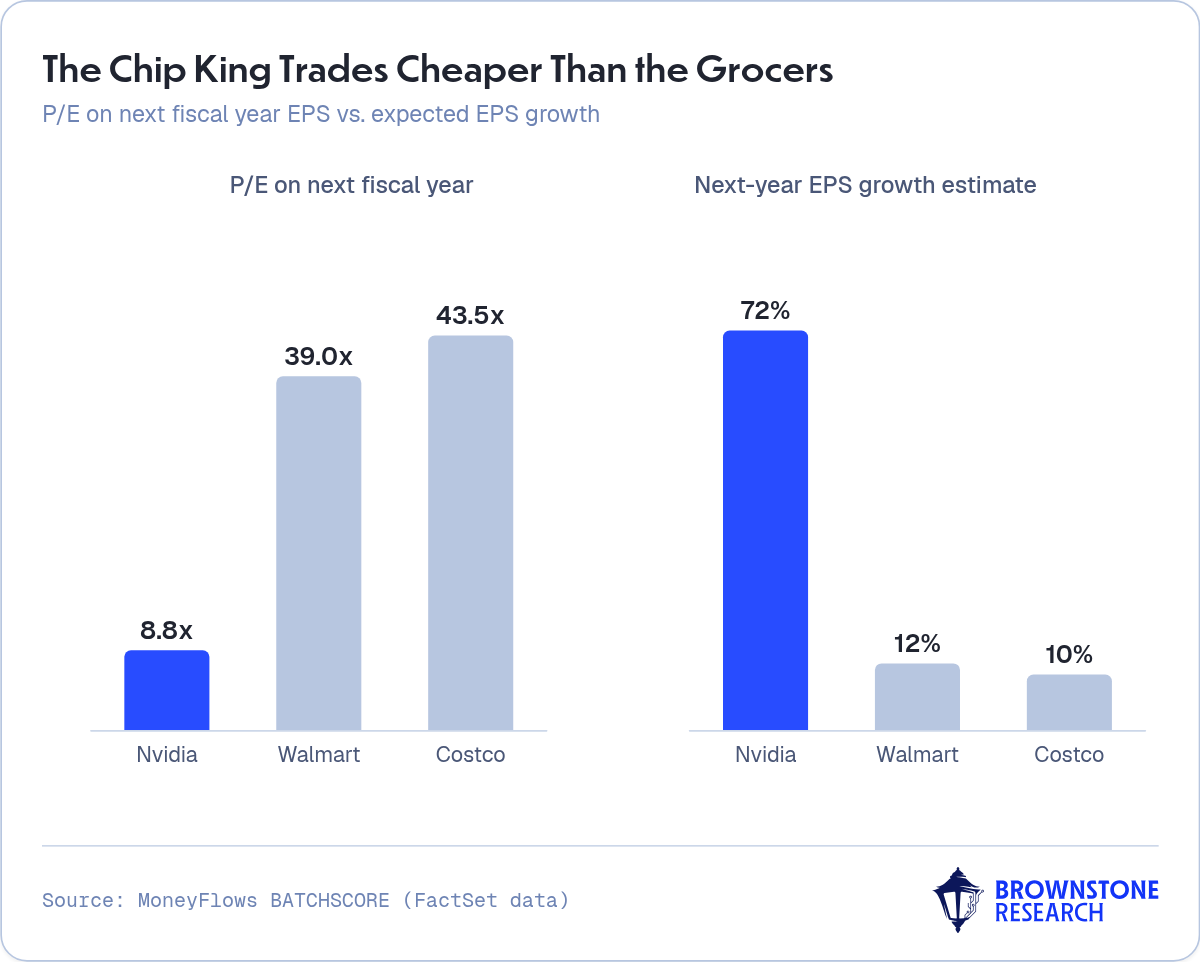
Chip stocks worth $10 billion or more are down a median 48% from their highs, yet they grew earnings 32% and trade at 16x forward earnings. Large staples trade at 21x for 8% sales growth. On next year’s earnings, Nvidia trades under 9x, versus 39x to 44x for Walmart and Costco.
Last week was difficult. And the turbulence may not be over yet. History and the data tell us that these periods of irrational selling may run longer than you think… but they can’t go on forever.
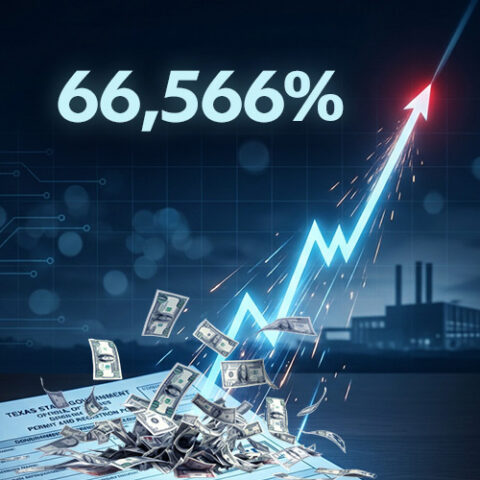
That's like turning $5,000 into $3.3 million. Tomorrow, November 24, at 8 p.m. ET, Silicon Valley Insider Jeff Brown reveals what's in the document Musk just quietly filed, and how to prepare in time. Register for free in a single click.

Two miles from the Iranian border, scientists are drilling into a mountain that could prove the existence of Noah’s Ark. For 70 years, nobody could look inside. This year, Elon Musk’s technology did. Jeff Brown was there… and he believes what he saw is the key to the final step of Elon’s masterplan, which Musk says could return 1,000x. See the footage – and get Elon’s critical partner stock for free – in this video.

It used to be that a Fed official could move markets with just a few words…
Jerome Powell was great at this.
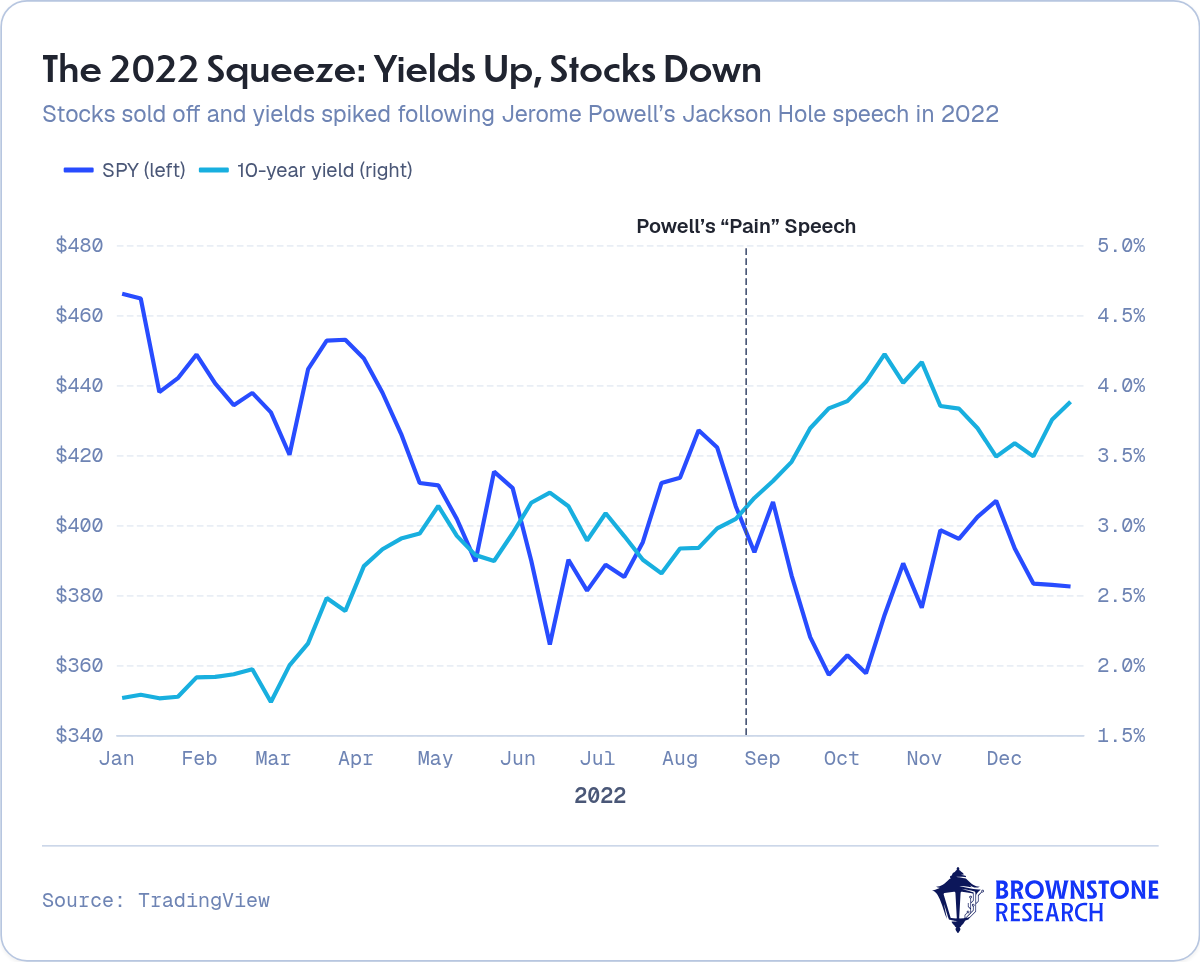
Heading into Powell’s keynote speech at the Jackson Hole Economic Symposium in August 2022, the Fed had already hiked its rate to a range of 2.25% to 2.5%, up from effectively zero five months earlier.
Investors tuned in to Powell’s speech that year looking for any sign the Fed would keep hiking. And Powell didn’t disappoint.
During the speech, he said “pain” was an unfortunate cost of bringing down inflation. He also referenced Paul Volcker – the Fed chair who hiked rates to nearly 20% in the early ’80s – several times.
Investors got the message…
The S&P 500 sold off hard in the following weeks. Yields on Treasurys also spiked as investors dumped government bonds to get ahead of the Fed’s next moves.
Investors typically call this “jawboning” – a way for the Fed to get what it wants by just talking. And it’s been common practice since at least the Greenspan years.
But this old practice is dying… and one of the Fed’s governors hasn’t gotten the memo.
On November 18, Fed Governor Christopher Waller went on CNBC and argued for a half-point (50-basis-point) rate hike at the December 9 Federal Open Market Committee meeting. “You might need to, like, shock people,” he said.
You might expect the bond market to panic. Instead, it shrugged. We can see that clearly in the Secured Overnight Financing Rate (SOFR) futures market.
SOFR futures tell us where traders expect short-term interest rates to go. And during Waller’s interview, the March 2027 SOFR contract’s implied rate jumped about 4 basis points (0.04%). But by market close, it was up just 2 basis points (0.02%). It hardly moved.
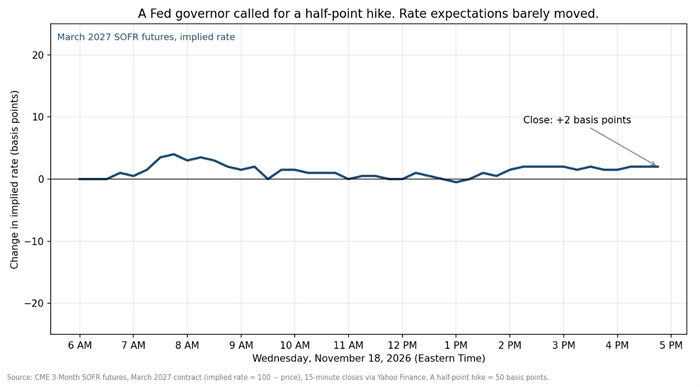
This is telling…
Kevin Warsh took over as Fed chair promising to end “forward guidance” – the habit of Fed officials telling markets what they plan to do in advance. And Warsh has kept his word.
He has delivered exactly one policy speech in six months. And his press conferences run about half as long as his predecessors’. What’s more, Warsh doesn’t even submit an estimate to the Fed’s rate-projection chart.
This is part of Warsh’s reform efforts. He’s on record saying, “We should not indulge a regime in which market participants are looking primarily to the Fed for their next trade.”
But Waller is still playing the old game. In fact, he said a quarter-point hike, rather than a half-point, would be enough if the Fed clearly signaled a follow-on hike in January.
That’s Waller pushing back against Warsh’s efforts to eliminate forward guidance. But he appears to be alone in his rebellion.
New York Fed President John Williams said the situation doesn’t call “for dramatic action.” Other officials who want more rate hikes are arguing for a gradual pace. And as we saw earlier, the SOFR futures market isn’t responding to Waller’s jawboning.
So Warsh’s reform appears to be working.
For decades, Fed officials could move trillions of dollars just by talking. But that power is fading. Markets are learning to price the committee’s decisions and the data… not one official’s speeches.
The lesson is simple. Under Warsh, a Fed governor’s speech is no longer a policy signal. Watch the data and the vote… not the talk.
Growth sectors are pulling back.
And while most of the attention is on the AI trade following Jensen Huang’s exit from Nvidia and Anthropic’s IPO, major cryptocurrencies are in free fall.
That includes Bitcoin, which is facing its own headwinds.
The first is a hawkish Fed. As I write, the market believes there’s a 95% chance of a quarter-point hike when the Fed meets in December. In other words, a hike is virtually certain. Another hike in January also looks likely.
Rising rates mean less liquidity and tighter financial conditions, neither of which is good for Bitcoin.
Another headwind on the horizon is the political landscape. Following the midterm elections, Democrats will take control of the House of Representatives and the Senate in January. That means more skeptical figures will likely chair the key committees overseeing digital assets.
Those catalysts have pushed Bitcoin down 28% since the start of October and sent it back toward the lows of the year.
But as my colleague Ben Lilly covered last Monday, Bitcoin could soon find at least a near-term bottom. I agree with that assessment.
That’s because the crypto is trading around the $60,000 level, which has served as price support since late 2024. The price zone has also been tested several times this year, sparking a rally each time.
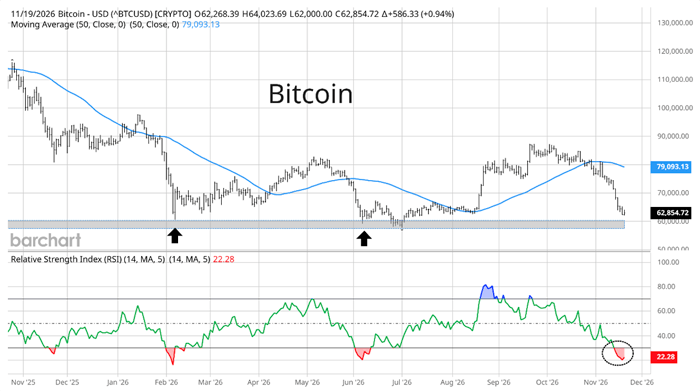
As the $60,000 level comes into play once again, there are signs Bitcoin is becoming extremely oversold. You can see Bitcoin is trading 21% below its 50-day moving average, making it extended to the downside.
The relative strength index (RSI) is also at the second most oversold level this year (circle). Bitcoin rallied the last two times the RSI hit oversold territory below 30 while it tested the $60,000 support level (shown with the arrows).
While headwinds keep piling up for Bitcoin, the chart again shows an oversold condition developing right at a key level. That means a short-term reversal higher could be in store.
That’s not a guarantee, of course. And Bitcoin is notoriously volatile. Anyone trading Bitcoin would do well to manage their risk.
But one way to trade the potential bounce is the iShares Bitcoin Trust ETF (IBIT), the largest spot Bitcoin ETF. A good stop for IBIT would be $31. That would correspond to Bitcoin losing support at $60,000 and represents about 12% downside from current levels.
Add Brownstone Research as your preferred source on Google to see our latest stories in your feed.
 Add as a preferred source
Read the latest insights from the world of high technology.
Prices and earnings can’t move in opposite directions forever.