




Bessent Finds His Buyer
Fortunately for Bessent, there’s one group of buyers with a voracious appetite for short-term U.S. debt.



What’s looked like random volatility in recent weeks is actually following a script written over decades of history.


What’s looked like random volatility in recent weeks is actually following a script written over decades of history.
We are in a midterm election year—the most consistently volatile of the four-year presidential cycle. Since 1926, the S&P 500 has averaged just 5.8% in midterm years, the weakest of the four.
The first three quarters tend to be the most difficult. The average intra-year drawdown is 16%. Uncertainty about which party controls Congress keeps institutional investors cautious and forces risk-takers to the sidelines.
But here’s what the headlines never tell you: The fourth quarter of midterm years has been consistently among the strongest periods in the entire presidential cycle.
Since 1926, Q4 of midterm years has averaged 7% gains with an 88% positive rate. And since 1950, the S&P 500 has averaged a 36% one-year forward return from midterm year lows. The script always looks terrifying in the middle. The ending has been remarkably consistent.
This year has followed the playbook almost exactly. Weak start. Powerful spring rally. The Nasdaq up more than 30% from its March low to its June peak. Then a violent summer correction.
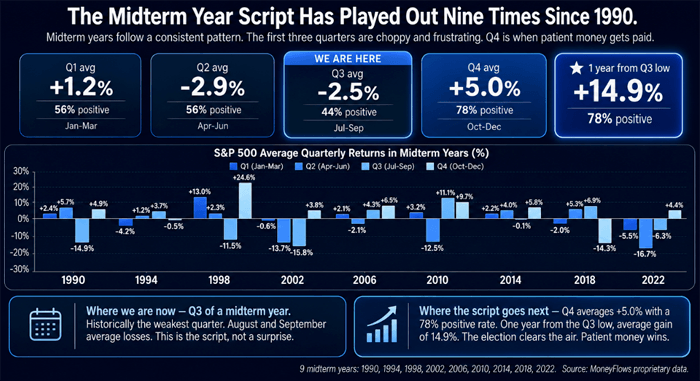
We are now in the choppy middle chapters. The ending hasn’t changed. My own data since 1990 follows suit:
Of course, corrections like we saw in July need a catalyst, and this one was no different.
Margin debt hit $1.5 trillion in June 2026—up 49% in a year and 60% above the prior record set in 2021. That’s a massive pressure build.
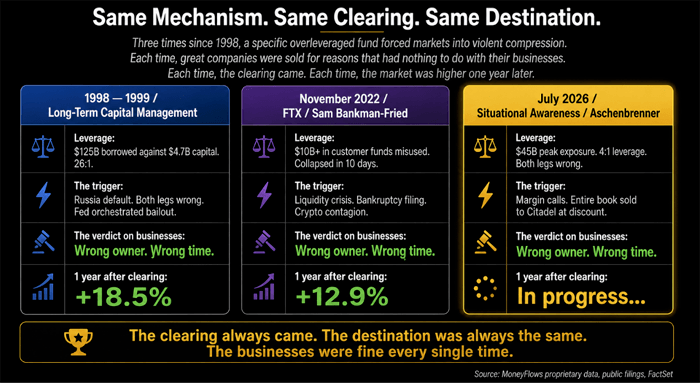
Situational Awareness, carrying $45 billion in peak exposure levered 4-to-1 into AI infrastructure stocks, got both legs of its trade wrong simultaneously. Margin calls arrived. The fund liquidated everything that wasn’t bolted to the floor—eventually into Citadel’s hands.
High-frequency algorithms sensed softening bids and widened spreads. More selling followed. The cascade had nothing to do with the underlying businesses. It just needed cash to meet margin.
Events like this also have a history.
Long-Term Capital Management did it in 1998, borrowing $125 billion against $4.7 billion in capital before the Fed orchestrated a bailout. FTX did it in November 2022, imploding in days and sending shockwaves through financial markets.
Each time, great companies got caught in the crossfire. Each time, the selling looked like a verdict on the market. It wasn’t. It was a verdict on leverage.
The flows tell the story…
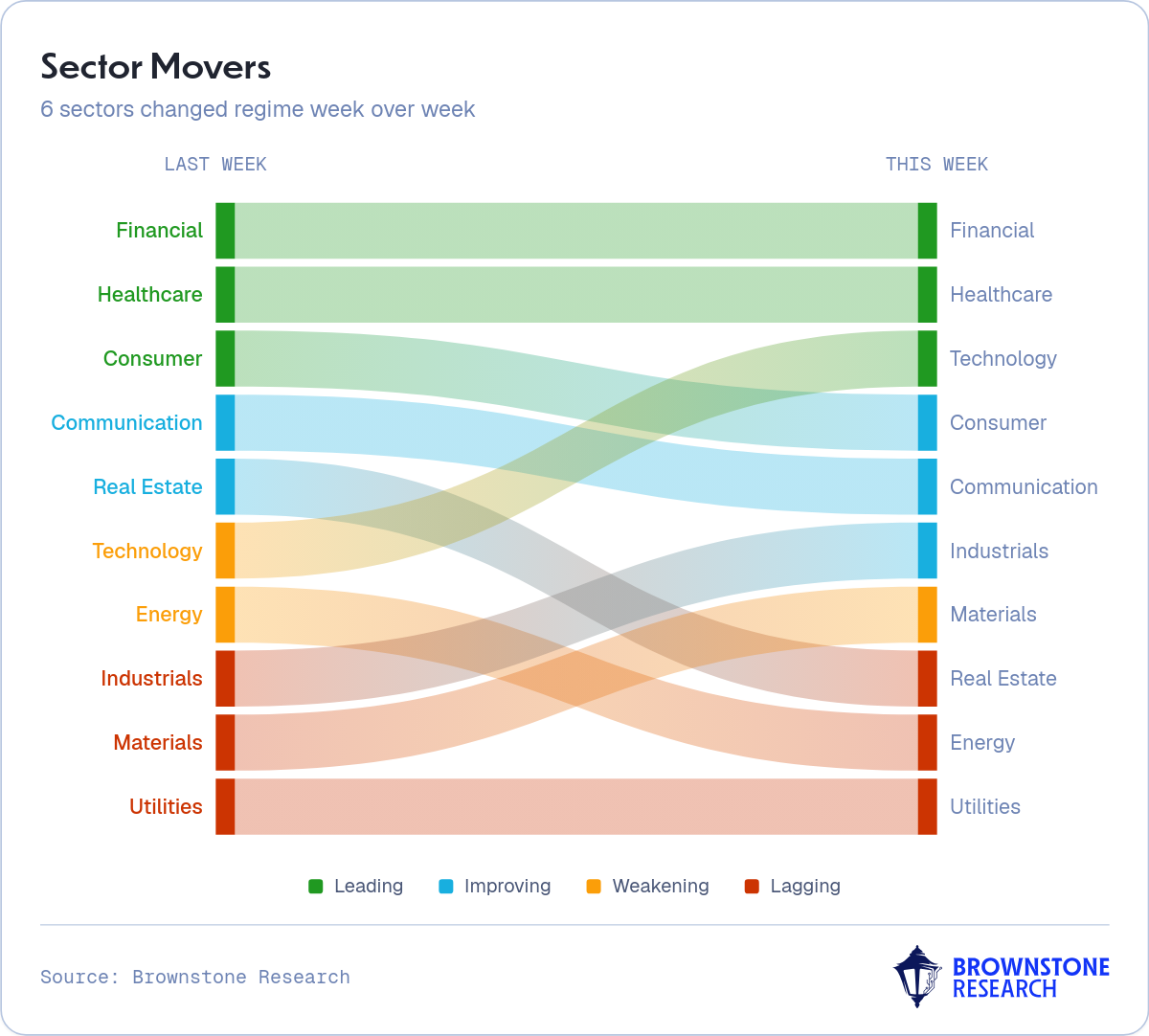
Below, you’ll see a recent reading from Inflection Watch, a software tool within Inflection Point, one of my publications that tracks institutional flows into and out of stocks. Two weeks ago, the technology sector was solidly in “lagging” territory. One week ago, it was in a “weak” regime. But look where the sector is now—back among the leaders.
The data points to the same long-term conclusion: higher. Every midterm year since 1990 was positive at nine and 12 months from late July. The election clears the uncertainty. Q4 arrives. Patient money wins.
The script is playing out exactly as written.

The VanEck Semiconductor ETF (SMH) is the closest thing to a single barometer for the entire semiconductor complex. It tracks Nvidia, TSMC, Broadcom and the rest of the AI-hardware supply chain.
As such, sharp movements in SMH should give us insight into how the market is looking at the ongoing AI infrastructure race.
That said, SMH has been on a roller coaster of late. The chart tells the story:
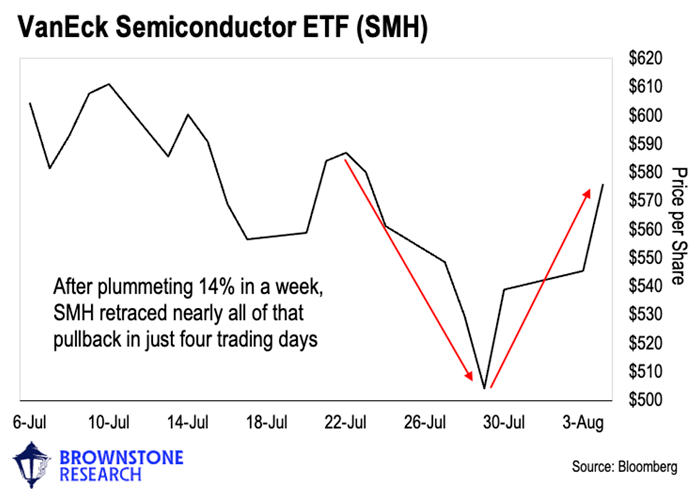
As we can see, the VanEck Semiconductor ETF plunged over 14% from July 22 to July 30. That’s a dramatic fall for an ETF with assets under management of around $70 billion.
But then SMH retraced that pullback and regained nearly all that single-week loss in just four trading days.
While SMH is down about 14% from its 52-week high, the ETF is still up nearly 60% on the year. On a year-to-date basis, semiconductor stocks have been one of 2026’s best-performing sectors, thanks largely to all the capital expenditure associated with the artificial intelligence (AI) arms race.
Semiconductors sit at the absolute center of the AI infrastructure buildout. Every data center expansion, every new model training run, every hyperscaler announcement ultimately shows up as demand for semiconductors.
So, when the barometer for the entire semiconductor complex is whipsawing back and forth like this, it tells us that institutional money is locking in profits given the stellar year-to-date performance… and other institutional investors are buying the dip as a bet that the AI-hardware supercycle still has years of runway.
In addition to profit-taking and dip-buying, the late-July decline coincided with broader market sensitivity to interest-rate expectations, inflation data and lingering questions about the pace of AI infrastructure returns. Also, as Jason just shared above, the forced liquidation of the hedge fund Situational Awareness was another contributing factor.
But the subsequent rebound aligned with reassuring hyperscaler capital-expenditure commentary. That underscores just how quickly sentiment can turn when the underlying demand narrative is reaffirmed.
For investors holding semiconductor exposure, the practical implication is that near-term price action in this sector is currently a poor signal of underlying fundamental change. So, we shouldn’t read too much into SMH’s choppy trading action over the past few weeks.
The more useful signal will come from the next round of company-specific earnings in the coming weeks, where actual bookings, backlog and forward guidance commentary can give investors a view on the data—which is unimpacted by market sentiment.

After the enormous gains we saw in artificial intelligence stocks during the second quarter, many institutional investors took profits and shifted capital into areas that had been left behind.
Financials moved higher. Healthcare caught a bid. Consumer staples strengthened.
That is a normal part of a healthy bull market. Leadership does not move in a straight line. Capital periodically leaves the strongest sectors to search for opportunities elsewhere where valuations are more attractive. These rotations give investors a chance to reset expectations, shake out weak hands and prepare for the next leg of the trend.
The important question is not whether technology stocks experienced a pullback. It is whether anything changed about the underlying growth trend.
And the latest earnings reports give us a clear answer. Nothing broke.
In fact, the artificial intelligence infrastructure buildout continues to accelerate.
Google, Microsoft and Amazon all reported cloud growth that exceeded expectations. Their cloud businesses are expanding at rates we have not seen since the pandemic forced companies around the world to move their operations online.
And stronger cloud demand is forcing the hyperscalers to raise their capital-spending plans again.
Source: Morgan Stanley
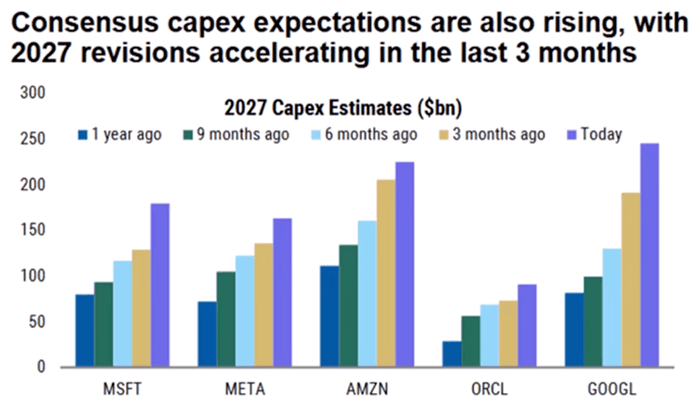
The chart above shows how rapidly Wall Street’s estimates for 2027 spending have increased over just the past several months. Microsoft, Meta, Amazon, Oracle and Google are all expected to deploy substantially more capital than analysts projected a year ago.
We expect the same process to begin with 2028 estimates.
The reason is simple.
As AI models become more capable and the cost of running them declines, companies will find more profitable ways to use them. That means more data centers, more servers, more networking equipment, more memory and more semiconductors.
Despite all this, valuations have moved in the opposite direction.
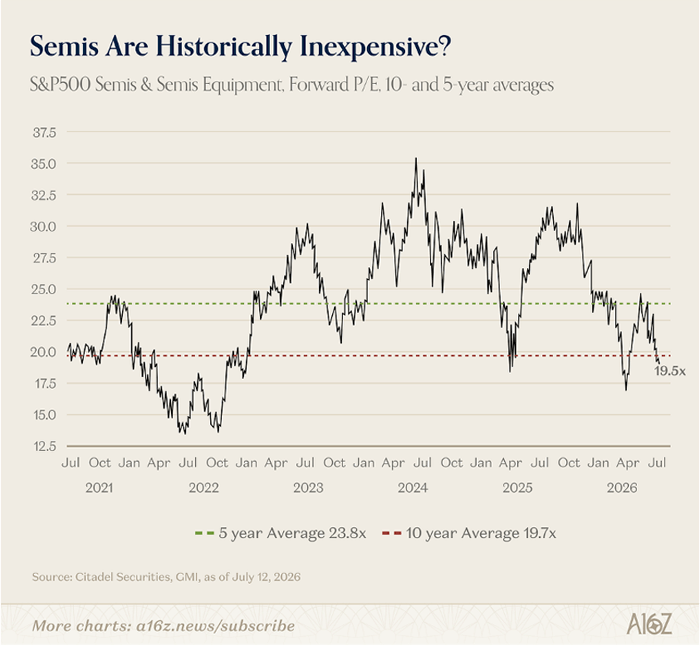
Semiconductor and semiconductor-equipment companies in the S&P 500 traded at approximately 19.5 times forward earnings. That was roughly in line with their 10-year average of 19.7 times and well below their five-year average of 23.8 times.
That is an attractive setup.
We have companies producing extraordinary earnings growth while trading at ordinary valuations. In several cases, their stocks declined because of sector rotation, leverage and forced selling—not because their underlying businesses weakened.
I expect capital to begin rotating back into technology as investors digest the latest earnings and recognize that the AI infrastructure cycle remains intact.
The move will not happen in a straight line. Volatility is part of investing in a trend this powerful. But reasonable valuations paired with above-average growth can be a powerful recipe for profits.
Add Brownstone Research as your preferred source on Google to see our latest stories in your feed.
 Add as a preferred source
Read the latest insights from the world of high technology.
Fortunately for Bessent, there’s one group of buyers with a voracious appetite for short-term U.S. debt.

Stocks were climbing out of bear territory, but then the bond market spoke up.

These factories will cost billions before even a single working chip is produced…