






Wall Street Is Telling You What’s Coming
Some of the biggest entities that are part of the tokenization trend are positioning themselves for the trend to play out.

Six months ago, Larry Fink—the CEO of the world’s largest asset manager, BlackRock—said this:
We spend so much time talking about AI, we’re not spending enough time talking about how quickly we’re gonna’ tokenize every financial asset… And moving ETFs and other things through a digital wallet and I think that’s gonna’ happen worldwide very rapidly.
With CLARITY Act passing a major milestone last week, and inching toward a potential July 4 signing, I thought it would be a good opportunity to revisit those comments.
Each day, our social feeds, mainstream media, and even corporate earnings calls are riddled with developments around AI and what it means.
Even the leaders of Nvidia and xAI are joining the President in a diplomatic trip to China, showcasing how AI is truly the central talking point.
But here’s what we’re not mentioning…
Fink spoke those words at the Future Investment Initiative in Riyadh back in October 2025.
And it was an inflection point for the financial industry.
CEO of ARK Invest, Cathie Wood, unpacked just how significant Larry’s comments were to the broader ecosystem…
She said Larry Fink is the leader of the pack. And his conversion on the “future tokenization of everything…gave the industry permission to say ‘wait a minute if I don’t get on board here I might lose out.’ He’s saying it’s important, then I better go learn something about it.”
He was not just saying it’s important. He was pointing out that nobody appreciates just how fast this will unfold.
And if we step back for a moment, we can see what Mr. Fink is getting at just based upon the last week of news…
No More Walled Gardens
JPMorgan Chase is led by Jamie Dimon.
Dimon’s been a strong critic of Bitcoin over the years, calling it a fraud and a pet rock.
But more recently, his tune has begun to change, saying blockchain is real. It’s a technology.
And now his firm is walking the walk…
The My OnChain Net Yield Fund (MONY) launched in December 2025. It’s a money market fund for qualified investors, which means it holds predominantly U.S. Treasuries.
The $101 million fund is managed by JPMorgan.
And what’s more interesting is that JPMorgan has a long history of operating permissioned blockchains. This includes what was called Quorum, an enterprise-focused, permissioned version of Ethereum that launched in 2016.
Then, in 2020, JPMorgan sold Quorum as its new Onyx came to market. The network began to process over $700 billion in transactions back in 2022 and 2023. It was later rebranded to Kinexys.
Dimon might be a critic of Bitcoin as an asset. But his firm has been developing blockchain technology for over a decade.
And what we just witnessed with MONY is that Kinexys is moving to a public blockchain solution.
It’s a trend we’ve covered closely here at Chain of Thought. The tokenization trend will take place on public and permissionless blockchains like Ethereum, Solana, and others. It won’t happen in permissioned walled gardens. The friction is simply too cumbersome.
But what’s more…
Last week, JPMorgan Chase announced the launch of the JPMorgan OnChain Liquidity-Token Money Market Fund (JLTXX). The announcement came with the bank filing paperwork for the fund.
Under the proposed structure of the fund, JLTXX fund shares will reside in digital wallets, and possibly be used as collateral in crypto markets.
This is a fund that complies with the stablecoin GENIUS Act.
And if you recall in Freeing $100 Trillion in Assets, Carlos Domingo, CEO of Securitize—the entity that’s helping onboard Wall Street assets to blockchains—stated “The notion that requiring a tokenized security to have a permissionless construct to effectively integrate within DeFi ecosystems is simply a misnomer.”
What this means is JPMorgan Chase understands the future of finance is not just onchain, but that DeFi protocols can be crucial to help it compete in this new ecosystem.
This is a larger trend…
Permissioned Walls Breaking Down
Years ago, it was common to hear that major banks were building permissioned blockchains or enterprise solutions.
No more…
We’re moving from the “walled garden environments” to public blockchains. It’s a major shift, and it’s picking up momentum in 2026.
We’re hearing announcement after announcement on products being issued on networks like Ethereum and Solana.
In fact, just last week, we heard that the Japan Blockchain Foundation is launching a yen stablecoin on Ethereum.
This is a product designed for B2B settlements and enterprise remittances.
The team behind the product could have just kept the yen stablecoin on their permissioned network… But they opted for a public network in Ethereum.
This change in mindset is becoming clearer by the day. The trend of tokenization is playing out in public blockchain networks. Not some corporate chain solution.
Even a consortium of major European banks is looking to issue a euro-denominated stablecoin on Ethereum in late 2026.
This mindset tells us the world of permissionless protocols will become the tooling for tomorrow’s financial system. Tooling that we’ve already added to our portfolio in Permissionless Investor because this has been our thesis over the past 18 months.
Now, the first iterations might look like wrapped versions of what already exists.
But the trend is moving towards natively issued assets.
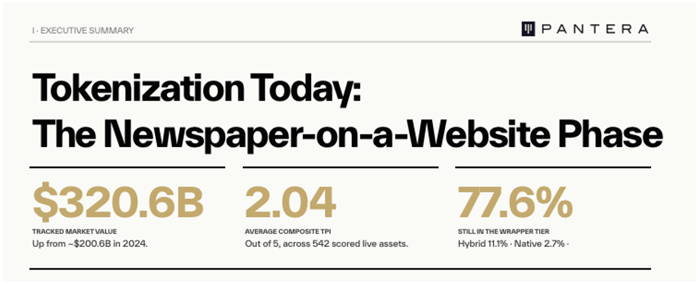
Pantera Capital, a crypto-focused venture capital firm, highlighted in The State of Tokenization report that 77.6% of tokenized assets are essentially wrappers. Which is to say they don’t differ from what already exists in the current financial system.
The firm’s metaphor of “newspaper-on-a-website phase” is a good one. During the early years of internet adoption, papers like The New York Times simply plastered a formatted newspaper onto their website. That was cumbersome and unnecessary, but old habits die hard. Now we digest it in native format, with breaking news hitting our social feeds daily.
Source: Pantera Capital
What this means is that current tokenized assets don’t settle nearly instantly, they are not usable with various decentralized finance protocols, nor can they be transacted freely. Those are some of the old habits that need to be unlearned.
But what this report also highlighted is that the newer issuances are starting to change this.
They are becoming more native to these blockchain systems.
In fact, we even covered a major partnership that just took place that will make it possible to issue stocks from 25,000 companies natively onchain.
The trend of tokenization is accelerating. That’s what Larry Fink was talking about.
But what I find most fascinating about all of this…
Moving Fast
Institutions aren’t sitting still. They know regulation is being codified in Congress. Stablecoin legislation is being implemented by the week. And the technology is making it easier to move assets onchain.
It’s why we’re seeing a major shift in one stock in particular – BitMine Immersion Technologies (BMNR).
BMNR is a digital asset treasury. Its focus is accumulating ETH on its balance sheet. It currently holds more than 5 million ETH or more than 4% of all ETH in circulation. That figure is growing by the week.
The appeal of BMNR is that the price of its stock can rise above the value of its holdings. Meaning if ETH’s price rises, BMNR stock can rise even further. It’s a similar setup to Strategy (MSTR) stock.
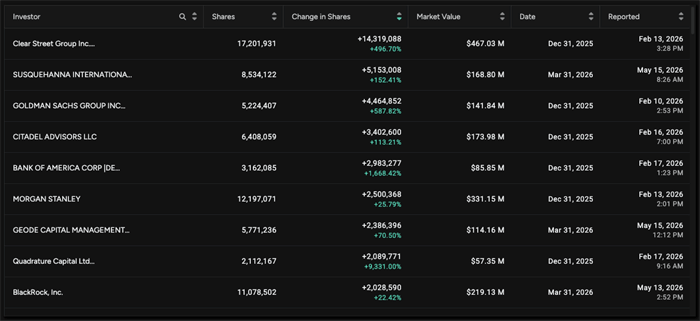
And what is interesting is that, ever since Larry’s comments, major entities have increased their shares held.
Some of those entities: Susquehanna, Goldman Sachs, Citadel, Bank of America, BlackRock, and many more.
Source: Quiver Quantitative
Which is a way of saying…
Some of the biggest entities that are part of the tokenization trend are positioning themselves for the trend to play out.
This is what I meant on Friday when I said that Wall Street is placing a major bet on not just the CLARITY Act, but on the transformation of finance as we know it.
Your Pulse on Crypto,
Ben Lilly
Editor, Chain of Thought
Continue following Brownstone Research
Add Brownstone Research as your preferred source on Google to see our latest stories in your feed.
 Add as a preferred source
More stories like this
Read the latest insights from the world of high technology.
-
-

Suddenly, the Pond is Covered
It’s a good way to visualize how big, consequential changes can sneak up on you.
-