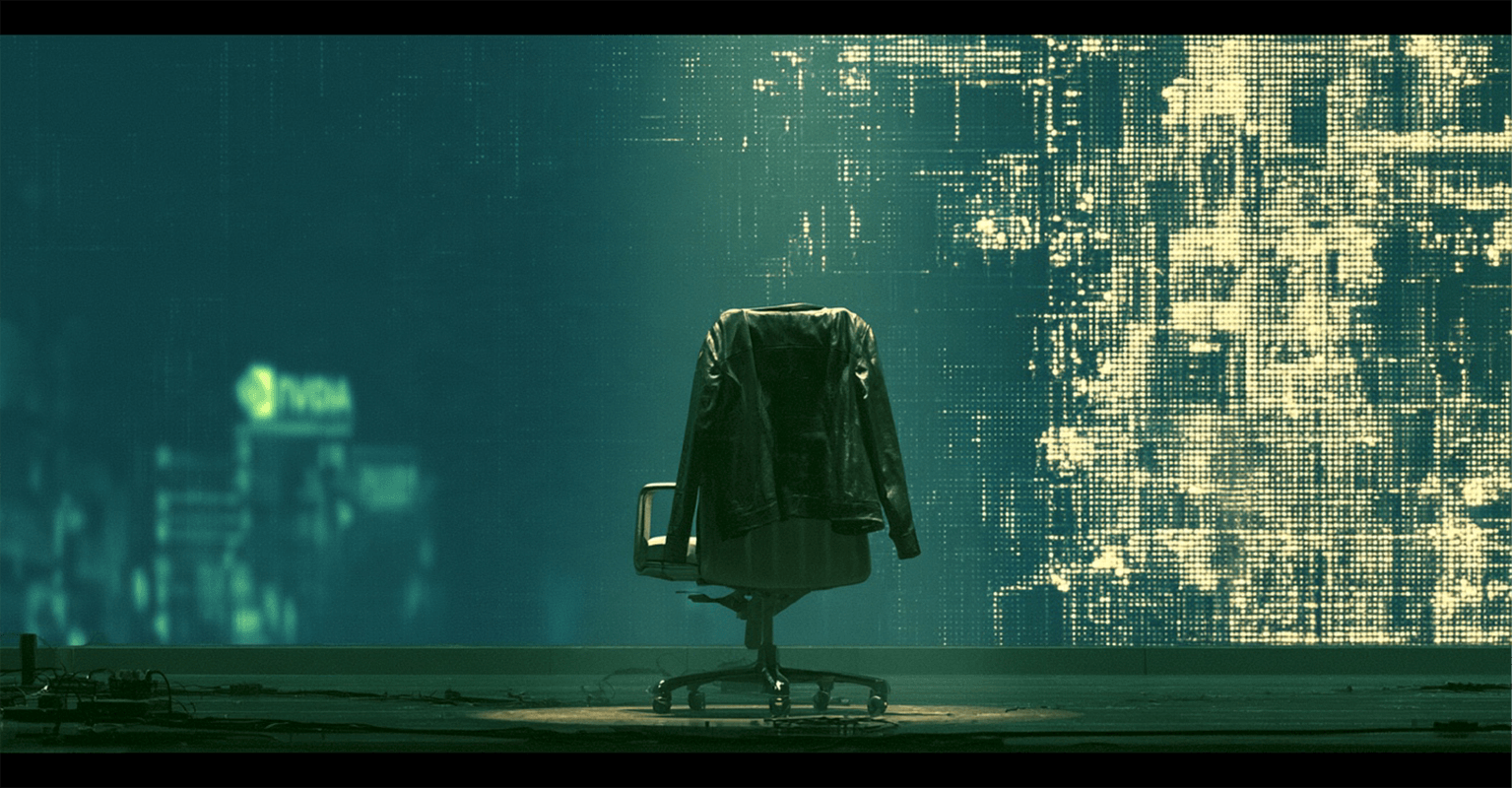




This Is What Forced Selling Feels Like
Last week was difficult. And the turbulence may not be over yet.



The damage to Nvidia would have been like a slow, unstoppable bleed.


That was fast.
On November 12, Nvidia’s board removed Jensen Huang as president and CEO.
On November 23, around 9 a.m. Eastern time, Nvidia’s board reinstated Huang as president, CEO, and board member.
As I shared with readers of The Bleeding Edge, Huang’s ouster was nothing more than a nefarious takedown. Now Jensen is back, and rightfully so.
The market responded accordingly. The stock rose 31% on Monday, adding roughly $1 trillion in market value… in a single day.

Nvidia would absolutely have survived without Huang.
The next two or three generations of GPU development are largely locked in, and Nvidia’s pull with TSMC for manufacturing capacity would have remained, enabling Nvidia to keep scaling the manufacturing of its semiconductors.
And more than $1 trillion will be spent on AI infrastructure in 2027, whether or not Jensen was in charge.
The same would have held for 2028.
The real risk lay further out. Several key employees likely would have defected to work with Jensen and build something new.
And Jensen would have built something new again, just as Palmer Luckey did after a political takedown forced him out of Facebook.
The damage to Nvidia would have been like a slow, unstoppable bleed.
Thankfully, that didn’t happen.
Instead, the right people won.
The builders won. Those who believe in economic growth and freedom won.
On the surface, this might look like silly politics or dirty competitive tactics. I wish it were that simple.
What happened is much bigger than that.
Some of us believe that artificial intelligence – and, more specifically, an artificial superintelligence – can help create a world where the truth reigns.
Where facts and evidence guide humanity to a world full of freedom, not tyrannical control.
We believe AI is a force for good that will lead to abundance and economic prosperity unlike anything the world has seen before.
The other camp believes that AI should be used to implement a system of control.
They want to use it for social engineering, so “they” can define the “truth” as they see fit, regardless of facts or evidence.
The latter is authoritarian and tyrannical – the world Orwell envisioned in “1984.”
We would only be able to see what “they” want us to see on the internet and social media – for our own “safety.” Trust them… they know what’s best for society.
The former decentralizes power and empowers individuals to understand the truth, contribute productively to society, and ensure that individual freedoms are preserved for everyone.
To be clear, the attempted – and failed – takedown of Jensen Huang was ideological. Nothing about it was organic or authentic.
Huang and Nvidia strongly supported open-weight and open-source AI models, which democratize artificial intelligence and decentralize the power that comes with it.
That’s why those who want to control society from their star chamber tried to take him down.
They failed.

Jeff Brown says Elon Musk's new filing in Texas unleashes what Elon himself calls "an infinite money glitch." In his new strategy session, he shows you how to prepare and names one essential supplier, completely free. Click To Watch It Now

Waller wants a 0.5% shock hike. Bessent hates the idea. Who wins? Larry Benedict isn’t taking sides in the ugly fight brewing between the Federal Reserve and the Treasury… His job is to show you why the fallout could be wildly lucrative, with Wall Street banks paying out as much as $21 billion that anyone can go for… [Get the Three Step Strategy Here]

There’s an old saying: Just because you’re paranoid doesn’t mean they’re not after you.
I’ve been thinking about that lately.
Consider the strange collection of headlines surrounding America’s technology industry. Microsoft Outlook experienced a major outage. The FAA suffered a nationwide disruption. Reports emerged of problems involving financial institutions and government communications systems. Then came Nvidia CEO Jensen Huang’s departure (before his eventual return) amid allegations of possible ties to Chinese intelligence.
And while there’s no evidence these events are connected, I find the timing fascinating.
So indulge me in a little geopolitical speculation. Who benefits when America becomes distracted, divided, and reluctant to invest in the technology that may determine its economic future?
Russia would welcome a distracted America. Moscow has a history of cyberoperations and influence campaigns, and a Washington preoccupied with domestic turmoil may pay less attention to problems overseas.
Iran is another possibility. In April, federal agencies warned that Iranian-affiliated hackers had disrupted American water, energy, and government infrastructure. Cyberattacks offer Tehran a cheap way to retaliate against a much more powerful adversary. Iranian-backed groups have additional motives, although none has been credibly linked to the incidents we’re discussing.
But China has a different incentive.
While Russia and Iran may benefit from instability, China has a direct economic interest in narrowing America’s technological lead. Beijing doesn’t necessarily need to create chaos. If political disputes or infrastructure problems slow American AI development, China gains time.
And time may be the most important commodity in this story.
AI is becoming foundational to medicine, manufacturing, scientific discovery, communications, and national defense. America enjoys extraordinary advantages, including Nvidia’s processors, world-class technology companies, and enormous capital resources.
China is working hard to close the gap, producing increasingly capable AI models while investing heavily in domestic semiconductors. But there’s another way to narrow the gap without developing better technology.
Your competitor can slow down.
Data centers have become surprisingly controversial. Residents worry about electricity bills, water consumption, and the infrastructure these enormous computing facilities require. Those concerns deserve attention. Nobody wants to discover their electric bill is subsidizing a trillion-dollar technology company.
But there’s a difference between making developers pay their fair share and making construction economically unattractive.
In June, OpenAI disclosed a likely China-linked influence operation called “Data Center Bandwagon.” It used AI-generated content to criticize American data centers, including claims about electricity prices. Another operation, “Tech and Tariffs,” targeted Trump’s technology policies.
OpenAI found no evidence these campaigns achieved significant reach. Still, of all the things a foreign influence operation could criticize, why American data centers?
Perhaps because computing infrastructure is critical to the AI race. Amplifying existing opposition could make construction harder. That doesn’t make legitimate American critics foreign agents. But an adversary can exploit a disagreement without creating it.
We should address legitimate concerns about AI infrastructure. Communities deserve protections, taxpayers shouldn’t subsidize private investments without justification, and national-security restrictions need careful consideration.
But the cost of moving too slowly deserves equal attention.
America has the companies, talent, financing, and technological advantages to lead AI for years. China knows that, and so do our other competitors.

Bitcoin just flashed a rare buy signal from one of our favorite indicators.
Regular readers will remember it. We covered it on July 8 in Bitcoin Sellers Are Getting Tired. At the time, Bitcoin had carved out a bottom around $60,000.
By late August, the asset was at $88,000.
Now it has fired again.
The signal compares Bitcoin’s price with its options skew.
At a high level, skew measures fear or greed in the options market.
When the options market is greedy, it buys upside via call contracts. When calls are in high demand, our skew reading on the chart below turns negative.
The opposite is true when the options market is fearful.
When traders are bearish, they buy put contracts. And they’re willing to pay a premium because they expect prices to fall, which would make the options more valuable. This outsized demand for puts over calls pushes the skew percentage higher.
It’s a contrarian indicator. When investors trip over themselves to buy calls, it suggests more downside risk. And when they scramble for puts, it implies a near-term bottom is close.
Here’s where the indicator stands today:

As you can see, skew is at levels that previously corresponded with lows in Bitcoin, such as the one we saw in July.
This crowding into bearish positions – along with the relief rally that followed Jensen Huang’s return to Nvidia – was a major driver of the nearly 20% recovery bounce between Friday’s low and Monday morning.
Now we wait for confirmation.
Last time this signal fired, the breakout took about a month to arrive.
Bitcoin chopped sideways near $60,000 throughout July and early August as skew gradually fell before the move began.
What we want to see into the end of 2026 is another boring consolidation, with price holding the lows and skew drifting back toward neutral. Those are ideal conditions to dollar-cost average into Bitcoin and other quality digital assets that now trade at steep discounts.
We remain convinced that the market is near a cyclical bottom. We covered that yesterday in All According to Plan.
Panic in digital assets is nothing new. But historically, these periods have been ideal opportunities for the most patient investors to build positions ahead of the next bull market.
Add Brownstone Research as your preferred source on Google to see our latest stories in your feed.
 Add as a preferred source
Read the latest insights from the world of high technology.
Last week was difficult. And the turbulence may not be over yet.

Prices and earnings can’t move in opposite directions forever.