




Bessent Finds His Buyer
Fortunately for Bessent, there’s one group of buyers with a voracious appetite for short-term U.S. debt.



To maintain those lofty valuations, companies can’t merely produce good results. They have to keep hitting it out of the park…


For some time now, I’ve been warning folks that this market is increasingly vulnerable to disappointment.
Not because the economy is suddenly falling apart. Not because the long-term outlook has fundamentally changed. But because investors’ expectations have become incredibly high.
Over the past couple of years, investors have piled into the same handful of AI and technology stocks, convinced that those companies can deliver strong earnings growth, quarter after quarter. That optimism has driven their valuations to extremes.
While that’s nice for investors, it also sets them up for a potential fall. Because to maintain those lofty valuations or to keep driving them higher, technology companies can’t merely produce good results. Instead, they have to keep hitting it out of the park.
That’s becoming an increasingly difficult hurdle to clear.
Just look at Tesla (TSLA). Despite reporting record vehicle deliveries and stronger-than-expected revenue, the stock suffered one of its biggest falls in over a year.
Earnings fell short of the market’s lofty expectations, and investors became concerned about margin pressure. Negative free cash flow plus a more subdued outlook for Tesla’s robotaxi rollout added another layer of negative sentiment. That saw the stock close down 14.5% from the previous day’s close.
Note also that much-hyped SpaceX has fallen almost 50% from its high.
To me, the fierceness of the selloff points to something beyond any single stock. It’s evidence that this market has become far less forgiving.
On top of that, U.S. 10-year Treasury yields climbed above 4.7%, surpassing May’s 4.69% peak. It’s the highest level since January last year. That comes as fears of inflation re-emerge, with hostilities in the Middle East pushing oil back toward the $100 level.
Investors are growing far more circumspect about which stocks they want to own and how much they are willing to pay.
It doesn’t necessarily mean that the bull market is over. But stock selection is becoming even more important, especially as we head through earnings season.
Put simply, companies that disappoint are going to be punished. The good news for traders is that this kind of uncertainty often creates plentiful trading opportunities.

The CLARITY Act text went public Wednesday afternoon, and in the hours that followed, we saw a wave of telling responses.
These responses largely fall into three camps… the optimists, the pessimists, and the realists.
As a reminder, the bill is a framework for digital assets. It sets out guidelines – with the goal of making the industry feel comfortable operating and essentially reshoring within the United States.
That’s significant because Washington, D.C., was hostile toward digital assets prior to President Trump taking office.
Since the change in sentiment, it’s been a continual progression to the point where on July 31, 2025, the new chairman of the SEC introduced Project Crypto… an initiative to put America’s financial system onchain. Now we’re waiting on the last remaining piece, legislation such as the CLARITY Act, to make all this positive momentum a permanent standard for blockchain technology.
So let’s take a look at where things stand…
The Yeas (almost all Republicans) were always going to vote in favor of the 700-page bill. Many echo the sentiment that we need to make America the home for innovation. They are also pointing to progress in other countries in writing laws around digital assets. Much of the rhetoric is around staying competitive.
As for the Nays, no Democrats are in favor of the text as it stands. The pessimists of the group have been fighting it tooth and nail every step of the way. Frankly, nothing will change their minds.
However, there is a third group of pro-crypto Democrats who have generally favored a legislative framework for crypto and blockchain. They have come out in opposition to the way the text is currently written.
This is the main group to watch. They represent a group that is open to negotiations. This group’s main issue is around the proposed ethics language – a valid concern given some questionable ethical issues around some of the Trump family’s crypto dealings, which we’ve discussed before.
There is room for the President and Republicans to give a little to make a deal happen. The Democrats who have been openly working with Republicans to get this bill passed will likely get their small victory here.
The ironic part of all of this is that the Democrats no longer want the President to continue profiting off crypto, but there are currently no definitive laws against it. It would almost be acting against their own interests to not vote in favor of CLARITY.
This is all to say, there is a significant motivation for this group to get the bill passed despite what most are vocalizing. It just needs some revision to the ethics guidance.
Plus, there’s another factor: crypto political action committees (PACs). They were very active in the 2024 elections. Estimates place spending at $196 million in the prior election cycle. The results? Nearly every candidate backed by crypto lobbyists won.
That is to say, if this bill does get to the floor for a vote, the fear of the crypto PAC will influence the vote.
That’s because crypto PACs are even larger. For the 2026 midterms, PACs have spent nearly $200 million already. It will far surpass what was spent in 2024 even though this is not a presidential election cycle.
This reality means any candidate voting “Nay” on the record is putting a target on their back. I wouldn’t be surprised to see a lot of Senators in the pessimistic camp change their tune once it’s time for a vote.
Whether you like the fact that money matters in politics or not, the reality is politicians need it to win elections.
This is why, if the CLARITY Act gets to the floor of the Senate for a vote, I believe it will pass.

Not long ago, sailors navigated without GPS. Just a starting position, a compass heading, speed, and time. With these four inputs, they traversed thousands of miles of open water with remarkable accuracy.
It’s a similar principle in the markets. The navigator doesn’t need to see the destination to trust the math, and neither do investors.
Midterms are a perfect example. Let’s look at what nine midterm election years since 1990 say about where markets go from late July on.
Three months out, markets averaged a loss of 1.7% and were positive only 44% of the time. Six months out, still mixed – an average gain of just 3.4%.
But at nine months, every single midterm year was higher, averaging 10.6%.
At one year, the perfect record holds – 100% positive, averaging 12.8%.
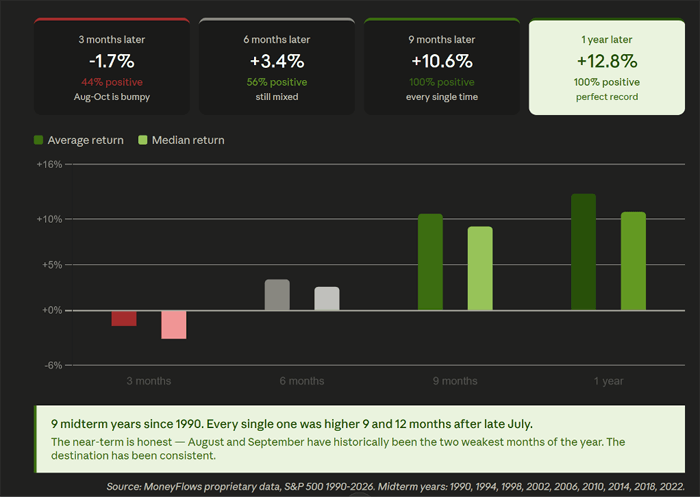
The three closest analogs – 1998, 2014, and 2018 – all entered late July with positive year-to-date gains.
In 1998, August delivered a brutal 14.6% decline as Russia defaulted and the LTCM hedge fund collapsed. Then October gained 8%, November 5.9%, December 5.6%. The full year from July returned 18.5%.
In 2014, the closest match, the ride was smooth – August up 3.8%, a mild September dip, then steady gains through year-end, finishing up 9%.
In 2018, October fell 6.9%, and December fell another 9.2% as the Fed pushed rates to a cycle peak. The year from July still returned 4.9%.
All three were higher. None were easy.
That brings us to 2026. The current setup enters late July with a Big Money Index at 67.5% – the highest of any comparable midterm year.
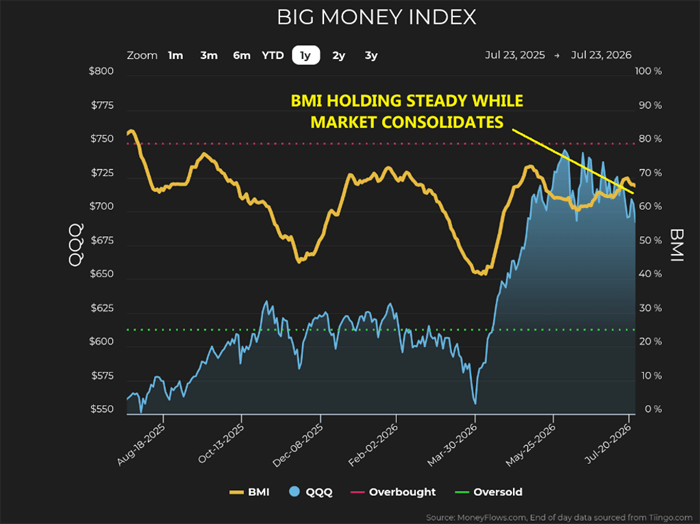
The S&P is up 8% year to date. But tensions are building.
Brent crude crossed $100 as the Iran conflict escalates, which has inflation implications. Politically, Senator Lindsey Graham’s sudden passing opened a Senate seat that could shift the chamber’s balance heading into November. Senate math just got murkier.
Plus, August and September are historically the two weakest months on the calendar, more so in midterm years.
Remember, markets dislike uncertainty, and uncertainty is mounting… Near-term dead reckoning is honest: choppy waters ahead.
But this is the time to trust the math. It points to the same destination every time: Q4 of a midterm year.
Since 1926, the fourth quarter of midterm years averaged 7% gains with an 88% positive rate. Since 1950, the average one-year forward return from midterm-year lows has been 36%.
Leverage should come out of the system. Seasonal headwinds will pass. The election will happen. And soon, we’ll have smooth sailing ahead once more.
Add Brownstone Research as your preferred source on Google to see our latest stories in your feed.
 Add as a preferred source
Read the latest insights from the world of high technology.
Fortunately for Bessent, there’s one group of buyers with a voracious appetite for short-term U.S. debt.

Stocks were climbing out of bear territory, but then the bond market spoke up.

These factories will cost billions before even a single working chip is produced…