



How Do AI Agents Pay?
Blockchains are undercutting credit card companies. Layer 2 solutions like Base or Arbitrum are settling transactions for tiny fractions...


After all this time, the industry still wants walled gardens...

Back during the 2017 Bitcoin bull, which is when most of the world learned about the asset, a mantra emerged—“Blockchain, not Bitcoin.”
The asset was still viewed skeptically back then. This was the era of Buffett’s “rat poison, squared” quote. Institutional adoption was essentially zero. And at least in “polite” circles, Bitcoin was viewed as a speculative vehicle at best and some type of Ponzi at worst.
But the underlying technology—blockchain—had potential, the thinking went. Of course, it would have to be permissioned and controlled before any “reputable” institution could use it. But maybe…just maybe…there was something there.
Put another way, “Blockchain, not Bitcoin” was a way for the banks to redirect attention away from the cryptocurrency market and attempt to build value for themselves. They did this by offering permissioned enterprise blockchain solutions.
Several projects were involved in that effort—Quorum, R3 Corda, Hyperledger Fabric. Eight years ago, these names were all the rage. But nearly a decade later, all these projects have moved towards public and permissionless environments.
And far from collapsing, Bitcoin continued to grow. The asset carries a $1.4 trillion market capitalization and is now regularly held by institutional investors via a litany of spot ETFs.
Put another way, Bitcoin (and public blockchains) won. The permissioned enterprise solutions faded away.
For those who understand the benefit of these open source and public systems, it’s not surprising at all. But like many things… Time is a flat circle.
The latest news out of Washington, D.C. is giving me flashbacks to that old self-centered motto.
We’ll get into the most recent drama, along with what the likely outcome is, in just a moment.
But first…
Tokenization is where real-world assets such as stocks, real estate, private equity, nation-state debt, corporate debt, and more get converted into digital form via tokens that transact on public blockchains.
We’ve covered it extensively in essays such as Freeing $100 Trillion in Assets, Wall Street Is Telling You What’s Coming, and Adapt or Die.
The trend is worth watching because the manner in which $100 trillion worth of assets trade is being rewritten.
It’s moving onchain.
To date, there’s $33 billion in assets already on blockchains…
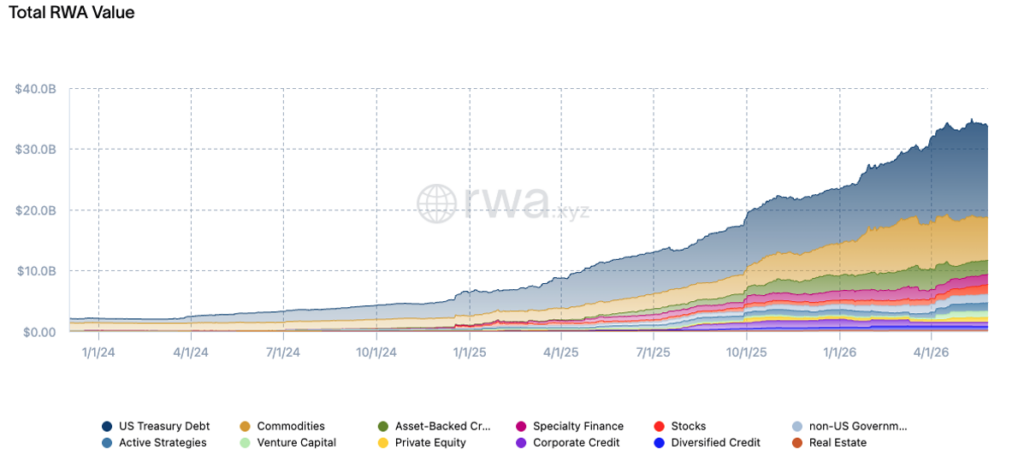
Source: RWA.xyz
And with new guardrails and guidance thanks to the CLARITY Act, this figure will move into the trillions of dollars by the end of the decade. The result: How and where these assets will move is set to generate incredible opportunities in the digital asset ecosystem.
This is why our team is regularly checking in with our contacts in Washington, D.C. to get the latest. Conversations and negotiations are taking place daily. And we want to position our subscribers ahead of the trend.
The latest news—the Securities and Exchange Commission (SEC) has paused its proposed innovation exemption.
The exemption itself was an SEC draft that paved the way for digital platforms to trade tokenized U.S. equities, 24/7. It was a major green light for the tokenization trend.
The exemption was set to bypass traditional exchange constraints so firms can test smart contract-based compliance and fractional ownership under specific volume caps.
It was proof that Project Crypto, the initiative pushed by the White House, SEC, and CFTC, to move finance onchain, was full throttle.
This framework was initially announced by SEC Chair Paul Atkins to a room where Jeff Brown and I were seated back in March of this year.
Then on May 22, the SEC hit the brakes. The framework is now delayed. The reason won’t surprise you. The SEC received major pushback from traditional stock exchanges.
To us, this feels a whole lot like “Blockchain, not Bitcoin.”
The main concern by exchanges like the New York Stock Exchange and Nasdaq was around third parties issuing stocks that are more akin to digital representations.
In all fairness, this is an understandeable argument.
Wall Street doesn’t want to see a dozen versions of the same stock show up onchain with varying rights. It’s also not a great product for the everyday investor.
You might think you own Apple (AAPL) shares. But, in reality, the token held has no claim to a share of Apple stock. It’s a scenario that puts a lot of burden on the investor to know what version of Apple tokens are the best.
If anti-crypto Elizabeth Warren were railing against this exemption for this reason, I’d sympathize.
It’s often referred to as the synthetic model. And it was a viewpoint echoed by SEC Commissioner Hester Peirce saying:
I’ve always expected that it’d be limited in scope & would facilitate trading only of digital representation of the same underlying equity security that an investor could purchase in the secondary market today, not synthetics
The takeaway: The SEC looks to be getting closer to what onchain stocks will look like. And the true signal on how it’ll look is seen by those agreeing with the SEC’s comments. Those would be entities like Securitize and DTCC.
We covered both in Freeing $100 Trillion in Assets. We also explained that these two entities represent the most likely models for how stocks will move onchain.
DTCC will tokenize what’s called a “security entitlement,” which the SEC is OK with since it’s how we currently trade stocks in our normal brokerage accounts.
The other way is Securitize’s IST model or Issuer-Sponsored Tokens. It’s where companies can issue tokens as the stock itself. It’s a more native model.
And it’s one that’s being practiced by other entities such as Bullish, Ondo Finance, and SuperState. Each has the infrastructure to move stocks onchain via the IST solution.
Pushing pristine stocks onchain is what everybody should be in favor of. It keeps legal rights intact and ensures capital markets function as they should.
When it comes to the New York Stock Exchange and Nasdaq, they want to protect their moat. They want these tokens trading on their venues, not on various protocols throughout the industry.
After all this time, the industry still wants walled gardens.
And while they might get their way initially… It won’t last.
The network effects of public and permissionless protocols are too grand. It’s the main reason we saw Quorum, Hyperledger Fabric, and R3 Corda all move towards these ecosystems.
The opportunity is just too big to pass up. And the other reason why it’ll happen is because ISTs will act as a gateway.
These tokens are expected to work with various decentralized finance protocols such as lending and borrowing platforms.
These assets will move away from these permissioned systems. And since these tokens provide users with greater functionality, it’s only natural that capital will be attracted to these assets and not the tokens offered by DTCC, which lack some of these characteristics.
It’s a value proposition that flies in the face of the major project boasted by industry stalwarts like Canton Network, which is heavily dependent upon the DTCC model.
The recent SEC delay suggests incumbents are scared.
We saw this battle play out with Wall Street when it came to stablecoins. We’re now seeing it play out with exchanges via tokenization.
But the writing is on the wall.
ISTs will become the preferred version of stocks. These tokens will move away from permissioned environments in favor of the greater functionality that exists in permissionless systems.
Before long, the incumbents will wonder what went wrong as they’re forced to build into permissionless and public protocols.
The destination seems inevitable. The question is how we get there. That’s the story we’re eager to see unfold.
No matter what, we’ll be uncovering the best opportunities available at the nexus of this paradigm shift.
Your Pulse on Crypto,
Ben Lilly
Editor, Chain of Thought

Read the latest insights from the world of high technology.
Blockchains are undercutting credit card companies. Layer 2 solutions like Base or Arbitrum are settling transactions for tiny fractions...

Congestion means network demand. And network demand means demand for the native tokens to pay for these transactions.

Be excited. The stage is set for one of the biggest bull runs in digital assets.