


Will OpenAI Go Bankrupt?
In today’s AMA, we explore the true utility of full self-driving vehicles… what to do when markets crash… and...



Only one form of transportation has felt futuristic for decades… like a mirage always on the horizon. Never close, never achievable.

Managing Editor’s Note: The dollar is in danger…
That’s according to our colleague, Market Wizard Larry Benedict. Larry says that on October 7, Washington threatens the U.S. dollar… and your bonds, cash savings, even the dollars in your pocket are all at risk.
That’s why he is calling an emergency briefing. Next Wednesday, September 30, at 8 p.m. ET, he’s revealing exactly what’s going on… how banks have already turned this situation into a $22 billion windfall… and a three-step process you can use to go after a piece of it.
Just go here to add your name to Larry’s guest list for next Wednesday.
Supersonic commercial aviation (Boom Aerospace) to cut flight times nearly in half…
Electric vertical takeoff and landing aircraft (eVTOL – Joby Aviation (JOBY) & Archer Aviation (ACHR)) to fly over that pesky urban traffic…
Hypersonic travel through space to enable 90-minute flights between New York and Tokyo (SpaceX (SPCX))…
Fully autonomous passenger vehicles (Tesla (TSLA) & Waymo) to recapture hours a day…
And seagliders that transform coastal travel between seaports (Regent) all represent the future of transportation.
And they are all happening at once, right now. Near-future events that we have to look forward to.
Only one form of transportation has felt futuristic for decades… like a mirage always on the horizon. Never close, never achievable.
The bullet train, or shinkansen as it is known in Japan (新幹線), has been in use for more than 50 years – without a single safety incident.
Despite more than five decades of service, to most, it still feels futuristic.
I’ve enjoyed traveling by shinkansen for almost 30 years now, and I still shake my head as to why this technology hasn’t been more widely adopted around the world.
Perhaps incredibly, there has been no further innovation in rail transportation beyond the shinkansen.
Other countries have copied, or stolen, or licensed Japan’s technology and adapted it for their own markets. But the technology is basically the same.
The only upgrade to the shinkansen technology has been magnetic levitation (maglev), of which there is only one high-speed maglev system in commercial operation today – the Shanghai Maglev. That’s it.
The most recent radical new form of rail transport was presented by Elon Musk in August 2013 – the Hyperloop Alpha.
For anyone curious, you can find the original paper right here.
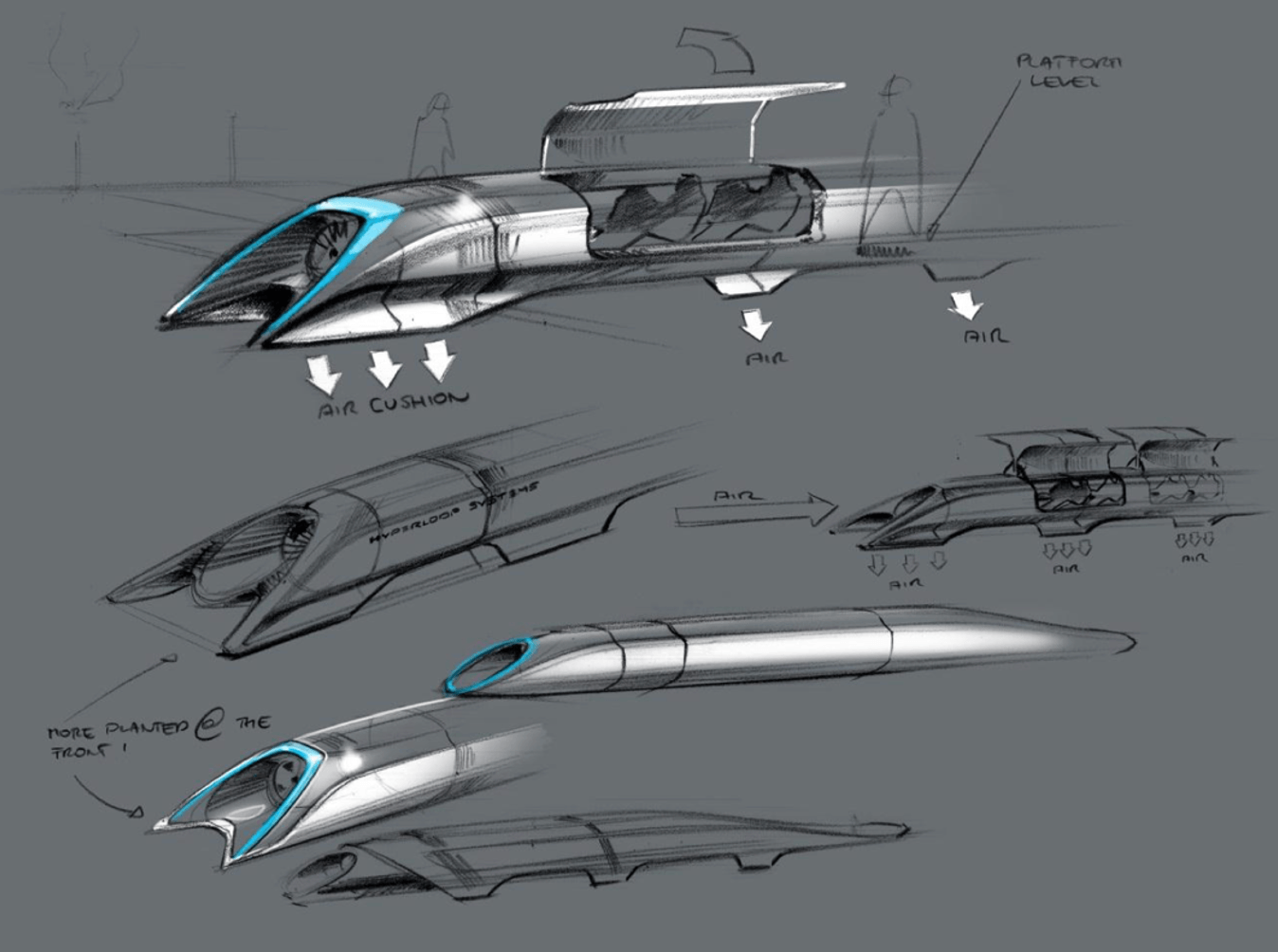
Hyperloop Alpha, rendering | Source: Tesla
The catalyst for Musk publishing this idea was the abject failure of California’s high-speed rail project – a total disaster of a project that was originally authorized in 2008 and has yet to lay a single piece of mainline track, nearly 20 years later.
Musk stated accurately in 2013…
How could it be that the home of Silicon Valley and JPL – doing incredible things like indexing all the world’s knowledge and putting rovers on Mars – would build a bullet train that is both one of the most expensive per mile and one of the slowest in the world?
Incredibly, 13 years later, California has spent $15.6 billion and has almost nothing to show for it other than some earthwork, rough grading, and some concrete work (no railing).
Musk was right.
But he was way too busy working on both SpaceX and Tesla to take on another major project at that time, which is why he published his idea on the Hyperloop technology, hoping that the private sector would pick it up and run with it.
Several U.S. and European companies have attempted to run with the concept, but most of them have shut down or have very limited traction today.
But Musk didn’t leave the idea for dead.

Ask most Americans where their money is safe, and they'll name the same four things. According to Jeff Brown and Larry Benedict, all four are now in danger. Not from a stock market crash, but from what they expect to happen to the U.S. dollar at 1:00 p.m. ET on Wednesday, October 7, on a deadline set by the federal government. During their upcoming emergency briefing, they’ll say why – and where they say the money goes instead. Click here to reserve your free seat.

Everyone is too distracted by the mainstream AI trade – chasing every bit of news about SpaceX, OpenAI, Anthropic, and Nvidia – all while missing where the real wealth will be made. Porter Stansberry, CEO & Founder of Porter & Co., don’t want you to miss it. That’s why he's laying everything out for you here. Ignition Point is now available to stream here.
Three years after publishing the paper on Hyperloop Alpha, he founded The Boring Company, a civil engineering technology company that builds a tunnel boring machine in order to enable underground transportation.
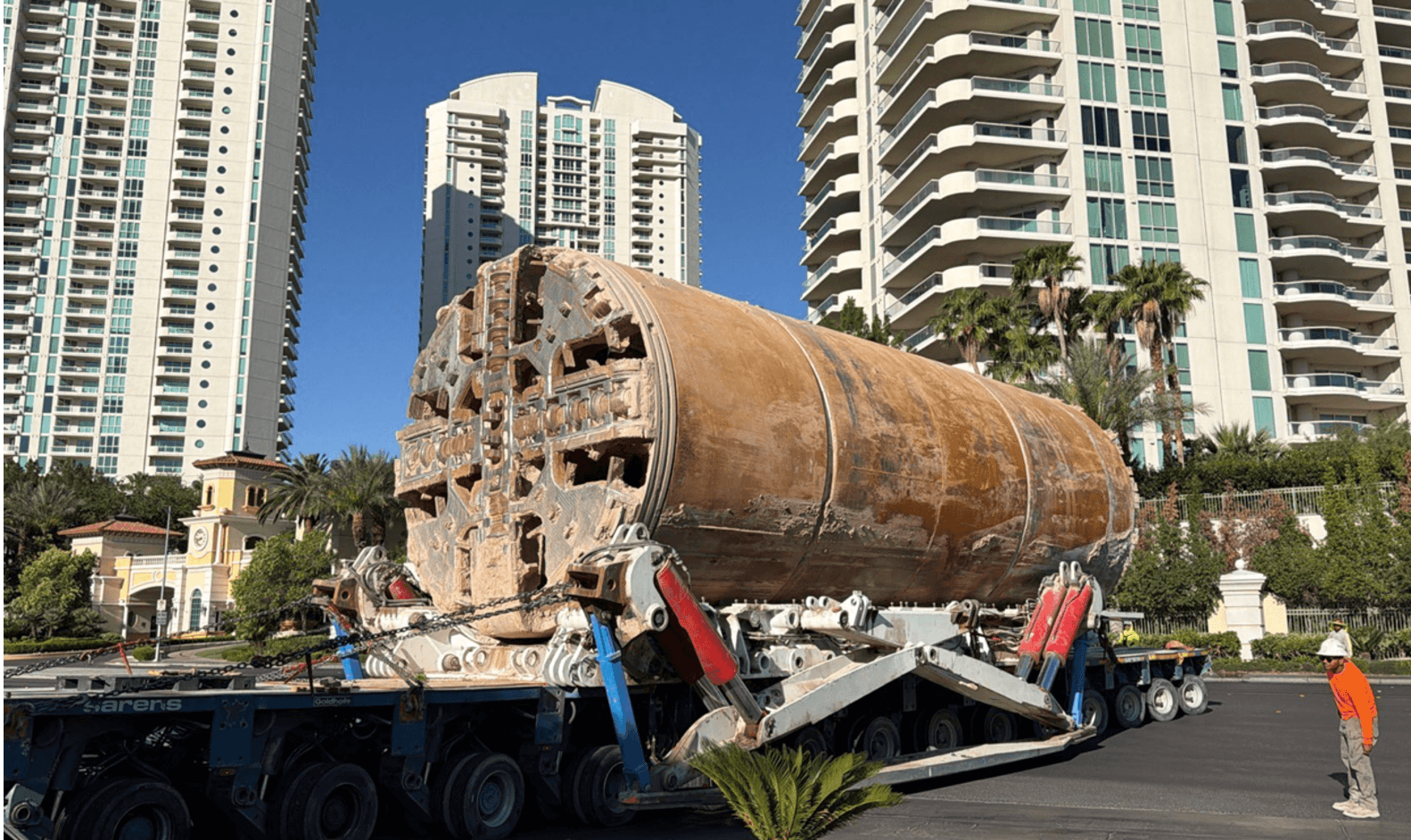
Prufrock 2 Tunnel Boring Machine in Las Vegas | Source: The Boring Company
To say that The Boring Company has radically transformed boring technology would be an understatement.
Conventional transit tunnels bored underground have historically cost hundreds of millions to over $1 billion a mile and can only bore through 10-30 meters a day.
The Boring Company has demonstrated 230 meters a day, more than 1 mile a week, with a single Prufrock boring machine.
And the cost will surprise you.
The Boring Company can get it done for around $5-10 million a mile, a tiny fraction of the cost of conventional methods.
The largest underground loop system developed by The Boring Company is in Las Vegas, which already has 13 active loop stations with 14 more opening soon.
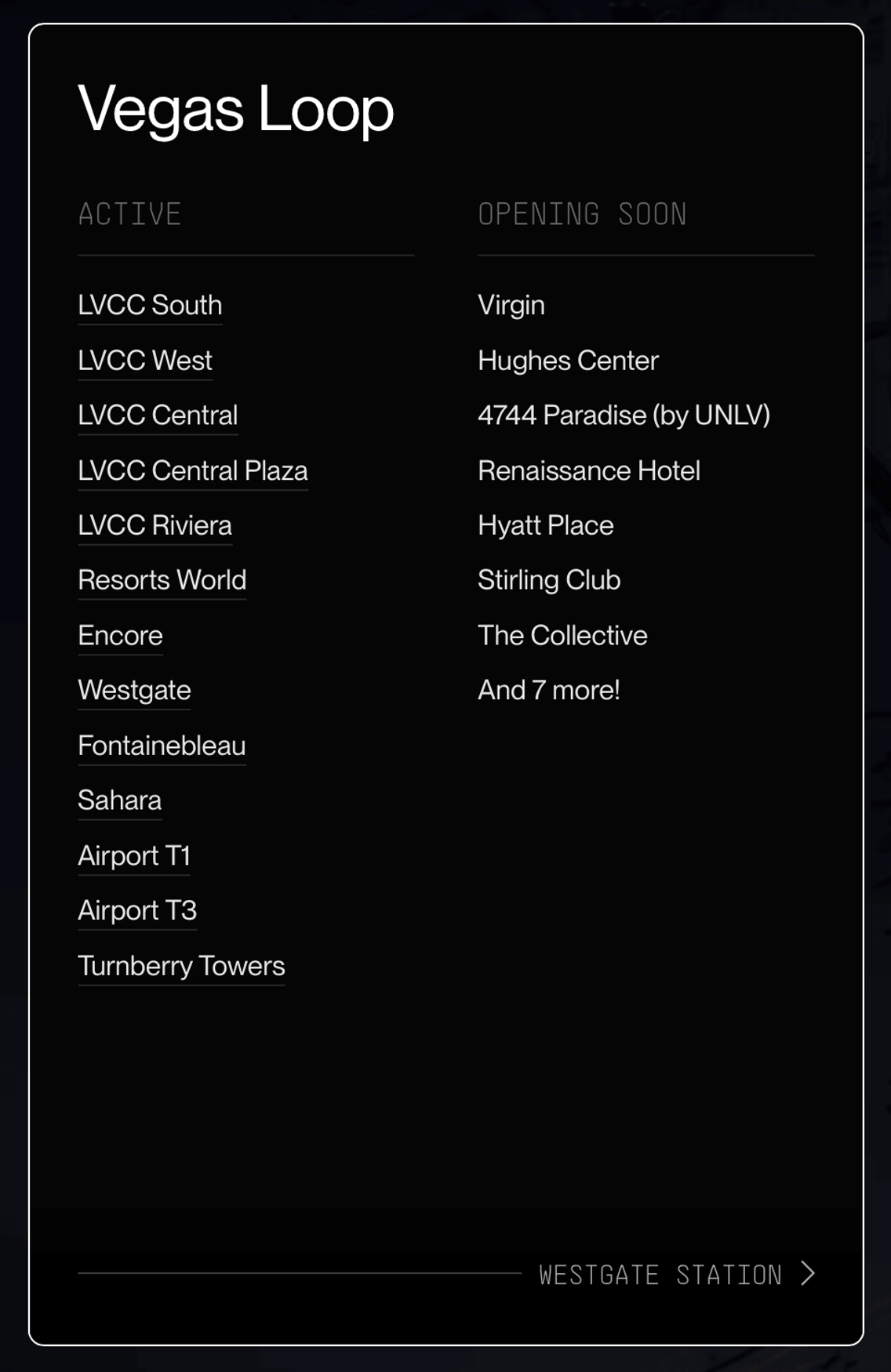
Vegas Loop Stations | Source: The Boring Company
To understand the scale of what the Vegas loop system will become, we can look at the map shown below.
This August, Clark County, Nevada, recently approved a loop network of 123 stations.
The finished product will be a remarkable feat of engineering accomplished for a fraction of the cost of what California has already spent with almost nothing to show for it.
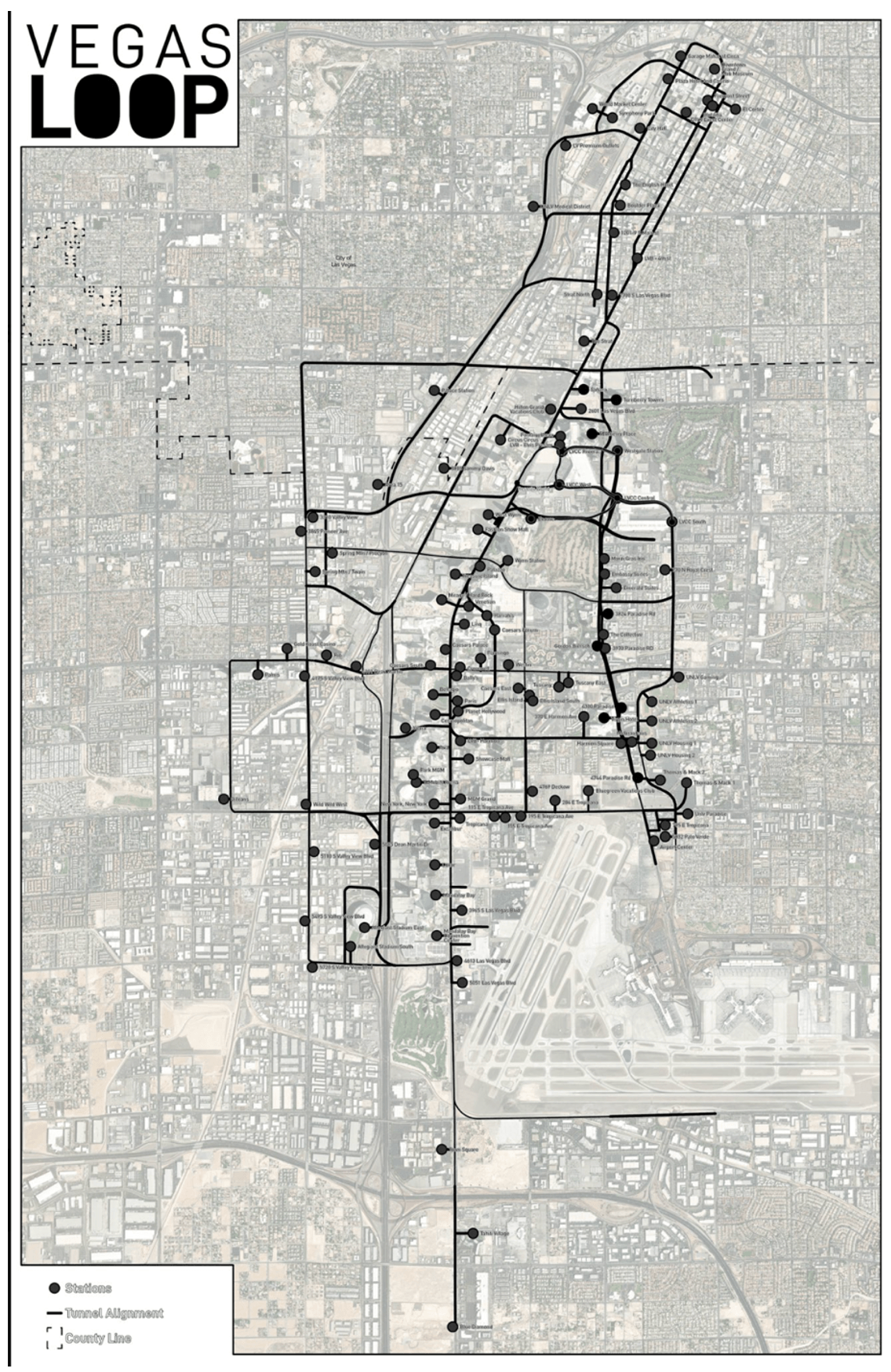
123 Stations of Vegas Loop | Source: The Boring Company
In addition to the Vegas Loop, construction began last year in Nashville on the Music City Loop, the first legs of which will become operational by the first quarter of 2027.
There has been some renewed excitement around The Boring Company in the last few days, and a resurgence of what might become a Hyperloop tunnel.
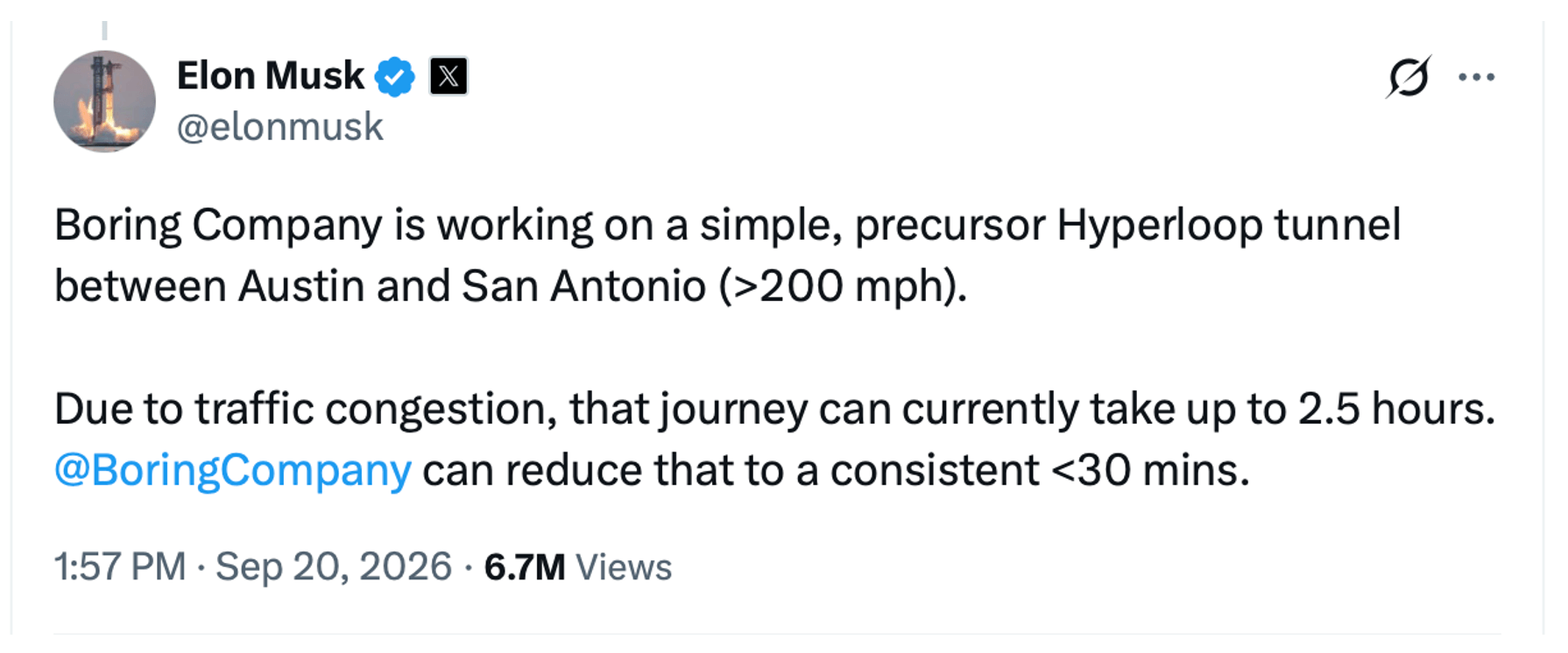
Source: X @elonmusk
Musk made public a renewed push to develop a Hyperloop tunnel between Austin and San Antonio, capable of traveling at more than 200 miles per hour.
This would cut the trip down to less than 30 minutes, with no traffic at all.
Wouldn’t that be incredible?
The best part is that the engineering has already been proven. It just needs to get built.
Is it possible? Absolutely. Especially considering that earlier this month, The Boring Company just announced that it raised $3 billion in a venture funding round backed by Valor Equity Partners, Sequoia Capital, A16Z, Temasek, and Baron Capital, among others.
Why is this so significant? It’s simple.
Let’s assume that the Hyperloop tunnel between Austin and San Antonio is 84 miles, and let’s assume $7 million a mile.
The entire system could be built for about $600 million.
In order to accelerate progress, The Boring Company could fund or finance the build, in exchange for the permits, and get paid on the backend once it is in operation.
Don’t think this is possible? Well, it’s already being done.
The Boring Company is fully funding the Music City Loop in Nashville. No taxpayer dollars are being spent at all.
Once complete, The Boring Company could operate for a profit, or sell the project off to a transportation company or private equity firm for monetization (which I believe is a more likely outcome).
If San Antonio and Austin agree to permit the project, this will get done, and it will become the first high-speed, underground Hyperloop system in the world.
This is the future of transportation, and hundreds of cities around the world should be clamoring for this technology.
But I have to point out: are we thinking too small?
Are these machines just designed for terrestrial applications here on Earth?
No way… this technology is being built for Mars.
The current diameter of the Prufrock boring machines is between 4 and 4.5 meters.
The payload bay of a SpaceX Starship has a diameter of 8 meters.
An extraterrestrial Prufrock boring machine can be broken into segments and launched to Mars over several Starships to be assembled on the Red Planet.
It would be used for both mining and the construction of an underground city to protect the civilization on Mars from the harsh environment on the surface of the planet.
A Martian Loop.
For the future,
Jeff
Add Brownstone Research as your preferred source on Google to see our latest stories in your feed.
 Add as a preferred source
Read the latest insights from the world of high technology.
In today’s AMA, we explore the true utility of full self-driving vehicles… what to do when markets crash… and...
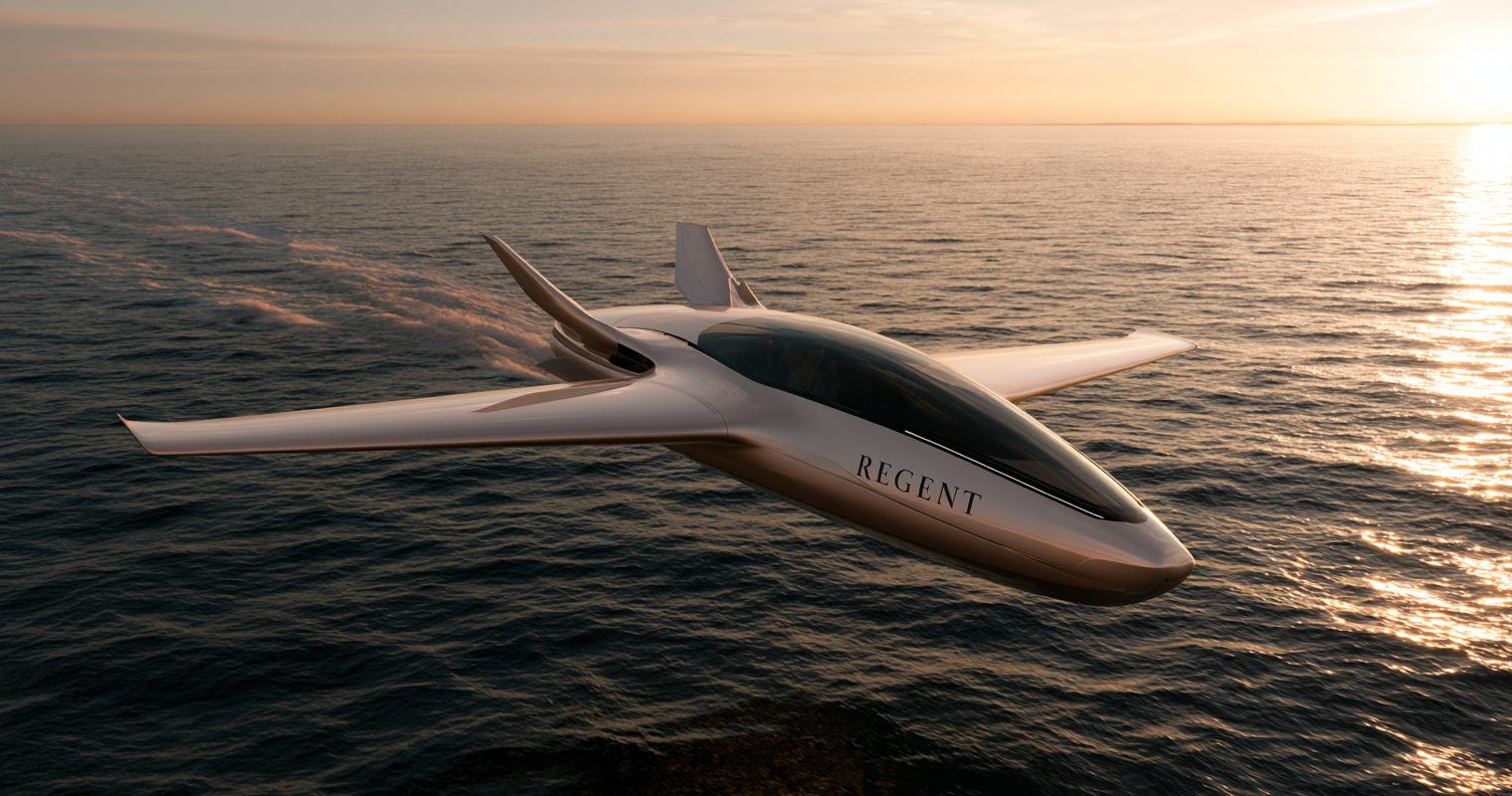
We’ve been waiting for future forms of commercial transportation for decades, and finally that time has come.
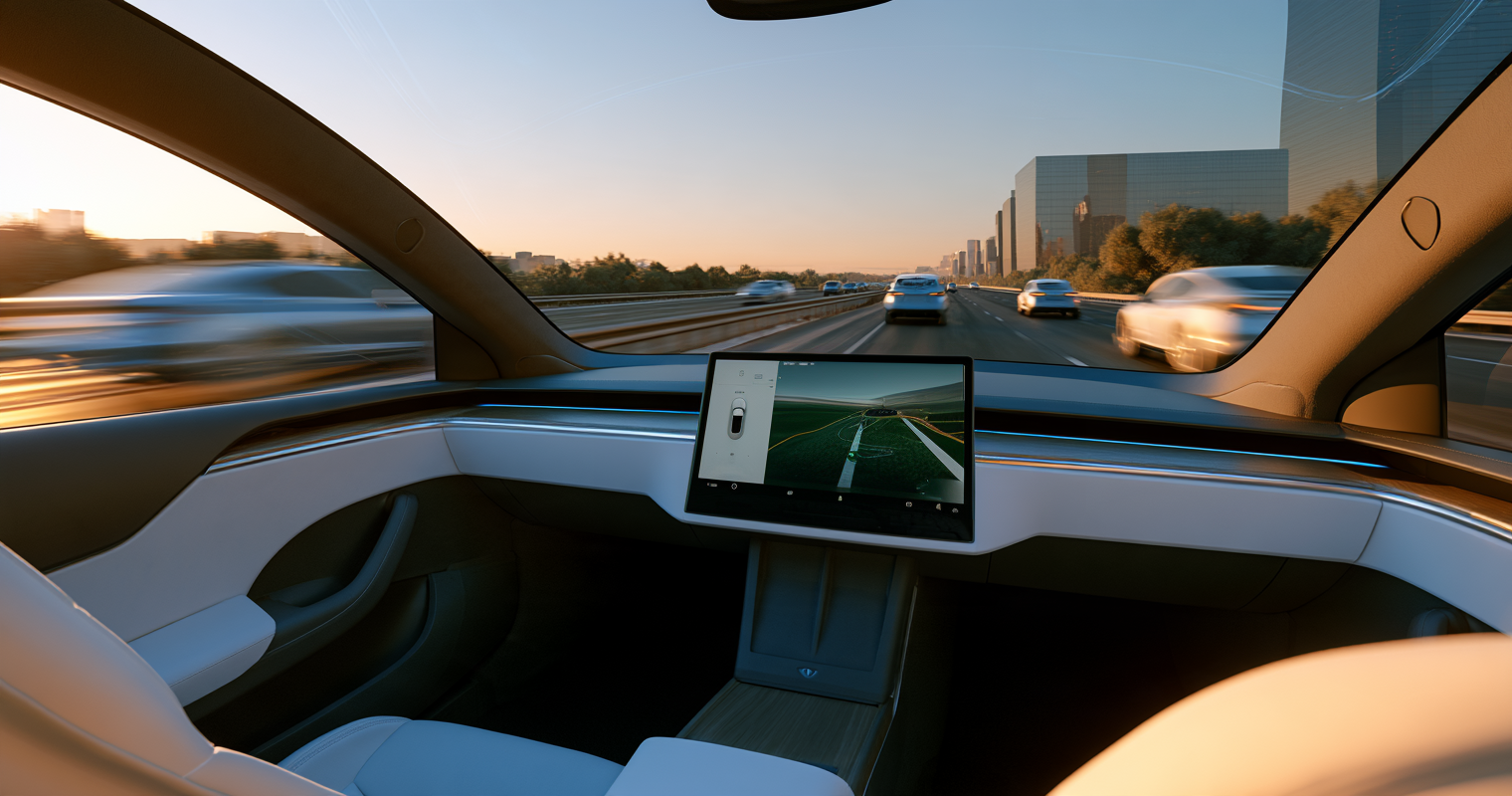
It’s now very clear that Tesla and the NHTSA have been working closely together…